About Place De La Revolution
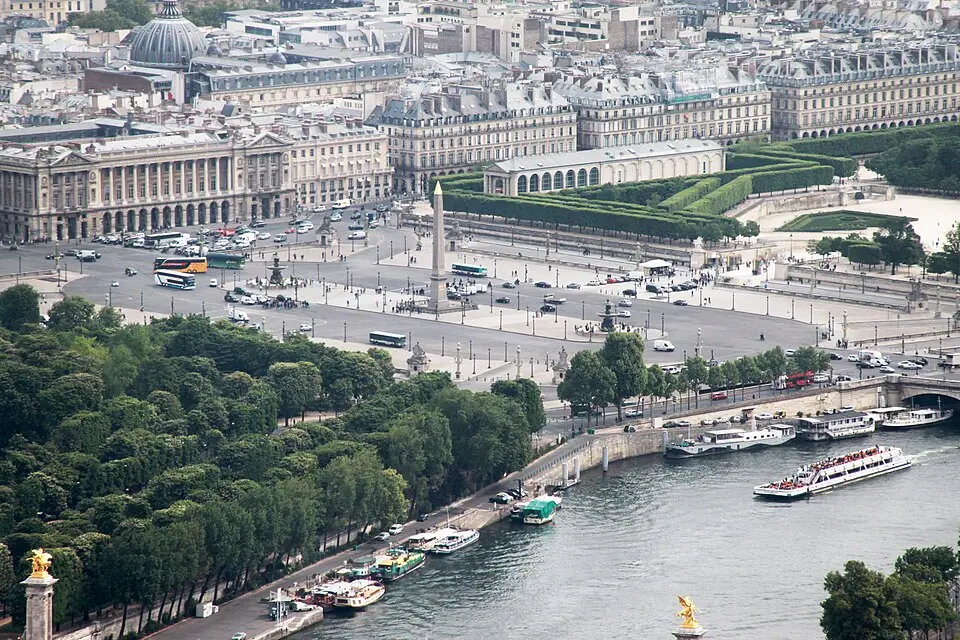
The Place de la Concorde, which translates as Concord Square, is the largest square in Paris, covering 7.56 hectares (about 18.7 acres). It lies in the 8th arrondissement on the Right Bank of the Seine, just north of the river, and forms an important urban link between the Jardin des Tuileries to the west and the Avenue des Champs-Élysées to the east. At 360 meters long and 210 meters wide, it is the second-largest square in France after the Place des Quinconces in Bordeaux. One of the city's five so-called royal squares, which also include the Place des Vosges, Place Dauphine, Place Vendôme, and Place des Victoires, it embodies the classical architecture of the 18th century and the evolution of French taste during the Enlightenment.
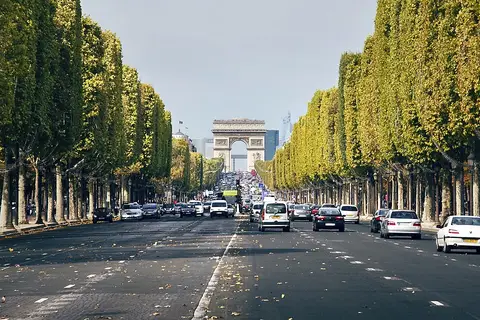
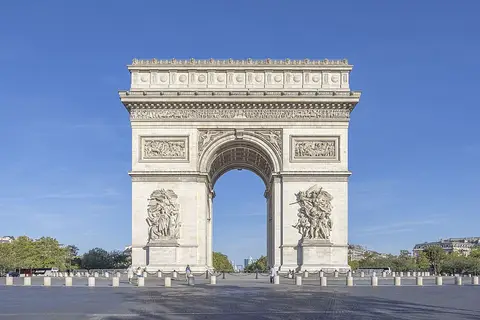
The square's strategic location is significant, as two major traffic arteries meet here. The north-south axis runs from Montmartre via Boulevard Haussmann and the Église de la Madeleine to the National Assembly, while the west-east axis leads from the Grande Arche along the Champs-Élysées to the Louvre. The obelisk in the middle of the square stands on the historic sightline that runs from the Louvre to the Arc de Triomphe at the Étoile. Another sightline, running at a right angle to it, leads from the Madeleine across the Seine to the Palais Bourbon, the seat of the National Assembly. This central position makes the square an important hub in the city's fabric, easily reached via the Concorde Metro station and numerous RATP bus lines.
The history of the site is closely tied to France's political upheavals, which is also reflected in its frequent name changes. Originally called Place Louis XV, it became the Place de la Révolution after August 10, 1792, and in 1795, under the Directory, was given the name Place de la Concorde to symbolize the reconciliation of the French after the Reign of Terror. During the Restoration, the names Place Louis XV and Place Louis XVI were briefly revived, before it was called Place de la Charte for a short time in 1830. Since the July Monarchy, it has once again borne the name Place de la Concorde. This naming history documents the instability of France's political regimes since 1789 and the major historical events that took place on the square.
The original design goes back to the architect Ange-Jacques Gabriel, whose 1755 plans formed the basis for the layout you see today. The square was conceived as an octagon and was originally meant to be surrounded by a moat. At its center stood an equestrian statue of Louis XV, created by the sculptor Edme Bouchardon. This monument was destroyed and melted down during the Revolution in 1792. In its place, a guillotine was erected in 1793, which became the site of the execution of King Louis XVI and Queen Marie-Antoinette, along with many other revolutionaries and opponents of the regime. Over two and a half years, more than 1,300 people were put to death here, making the square one of the bloodiest places of the French Revolution.
In the 19th century, various governments tried to beautify the square and cover up its dark past. After plans for other monuments fell through, the Viceroy of Egypt, Muhammad Ali Pasha, gave France two obelisks in 1830. The western obelisk was transported to Paris and erected on the square on October 25, 1836. Made of pink granite from Aswan, it was originally erected in the 13th century BC in front of the Luxor Temple by Ramses II. The obelisk is about 23 meters tall and weighs roughly 230 metric tons. Hieroglyphs on its sides show scenes of the king making offerings to Amun-Re and celebrate his valor. In 1998, it received a gilded bronze pyramidion that crowns its tip.
The square's present-day appearance was shaped largely by the architect Jakob Ignaz Hittorff between 1836 and 1840. He kept Gabriel's basic layout but added two monumental cast-iron fountains. The northern fountain, the Fontaine des Fleuves, represents the Rhône and Rhine rivers as well as agriculture, while the southern fountain, the Fontaine des Mers, symbolizes the Mediterranean and the Atlantic as well as seafaring. These fountains flank the obelisk and were inaugurated in 1840. Hittorff also designed the 20 cast-iron candelabras and rostral columns, which allude to the Ministry of the Navy that was housed here at the time.
At the corners of the square stand eight allegorical statues representing major French cities: Bordeaux, Lille, Brest, Rouen, Lyon, Marseille, Nantes, and Strasbourg. These seated city goddesses were created by various sculptors and stand on pedestals that replaced former guardhouses. The north side of the square is dominated by two large neoclassical buildings that Gabriel designed between 1757 and 1775. Originally built as city mansions, they now house the famous Hôtel de Crillon and the renovated building of the former Ministry of the Navy.
The Hôtel de Crillon, originally the Hôtel d'Aumont, has been a grand hotel since 1909 and offers luxurious rooms and suites. Next door is the headquarters of the Automobile Club de France. The building of the former Ministry of the Navy, which previously served as the royal furniture repository, underwent extensive restoration between 2017 and 2021. Since opening in 2021, it has housed a museum on the building's history, the Al Thani Collection from Qatar, and the French branch office of the world football governing body FIFA. This use underscores the cultural and historical significance of the site.
The square is also a stage for modern events and celebrations. Every year on July 14, France's national holiday, major festivities take place here. In the 20th century, the Place de la Concorde was the scene of political demonstrations, including a Gaullist counter-demonstration in 1968 and the election celebrations of presidents such as Jacques Chirac in 1995 and Nicolas Sarkozy in 2007. Cultural events also took place here, such as Jean-Michel Jarre's concert in 1979. In 2024, during the Olympic Games, the square served as a venue for breaking, skateboarding, BMX, and 3x3 basketball competitions, with temporary grandstands set up for the occasion.
The urban significance of the Place de la Concorde was recognized in 1937, when the square was designated a historic monument by decree. This protection ensures the preservation of the paving, fountains, statues, balustrades, and lampposts. The square thus embodies not only the architectural mastery of the 18th and 19th centuries but also the complex history of France, ranging from royal splendor through revolutionary terror to modern democracy. Here you experience a unique blend of historical gravity and urban elegance that makes the square one of the most iconic places in the world metropolis of Paris.
At a glance
- Category
- Sight › Historic sites
- Rating
- no reviews yet · write a review
- Address
- place de la concorde
Paris, France - District
- 8th Arrondissement of Paris
- Phone
- —
- Website
- —
- —
- Coordinates
- 48.86468° N · 2.32056° E
- Data quality
- confidence 0.70
- Identifier
- ID a4885873-0e6…
Location & surroundings
Toggle layersRatings & comments
none yetNear Place De La Revolution
closest 5 per category · 2 kmSights
Restaurants
Museums
Hotels
More:Historic sites in Paris (1,524)Sights in 8th Arrondissement of Paris (87)All sights in Paris (1,859)
300 places within 2 km loaded.
You need a free account to leave reviews and photos – that keeps comments genuine and lets you edit them later.