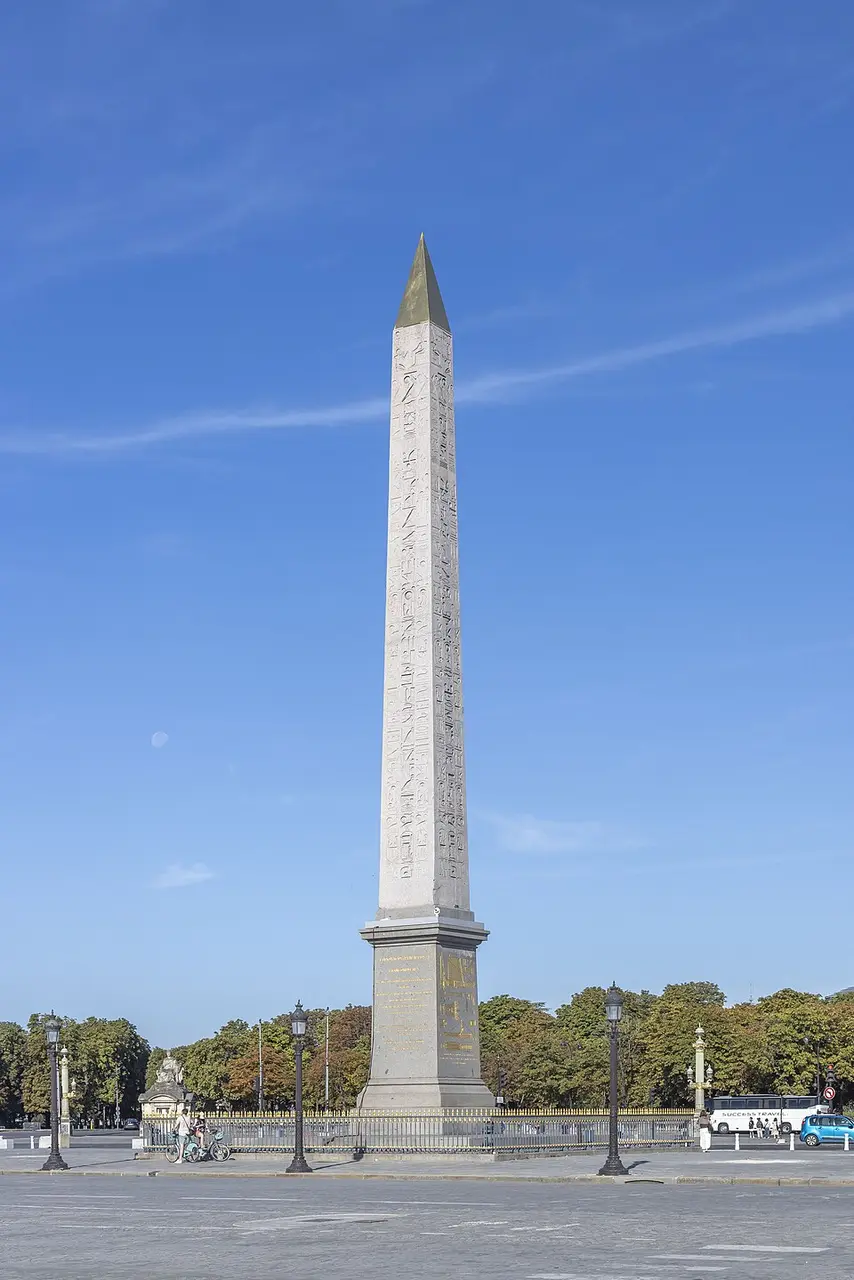
About Obélisque de Louxor
The Luxor Obelisk is an impressive monument of ancient Egyptian culture that now stands in the heart of Paris on the Place de la Concorde. The oldest monument in the French capital, it marks a central point on the so-called Axe historique, the grand sightline that runs from the Louvre to the Grande Arche. Carved from a single block of pink granite, this monolith dates to the 13th century B.C. and was originally erected in front of the Temple of Luxor. Standing about 75 feet tall and weighing roughly 230 tons, it bears witness to the monumental building skills of ancient Egypt and still draws the eyes of visitors today.
The story of this stone begins under the pharaoh Ramses II, who had it set up together with a second obelisk, which still stands at the original site, as flanking elements in front of the pylon of the Luxor Temple. The inscriptions and reliefs on all four sides praise the king's bravery and piety and list his titles. The central column of hieroglyphs is deeply cut and finely polished, while the outer columns are only worked in outline, which gives the stone an interesting play of light. The scenes show the king making offerings to the god Amun-Re and convey a clear program of rule that includes providing for the god, warding off enemies, and embellishing the sanctuaries.
The obelisk's arrival in Europe dates back to 1830, when the Egyptian viceroy Muhammad Ali Pasha gave both obelisks of Luxor to France. The famous Egyptologist Jean-François Champollion, who had seen the stones himself on a journey, recommended the western obelisk because he considered it better preserved than its eastern counterpart. Although the plan was to transport both monuments, only the western one made it to France. For this purpose, the French navy had a special ship called the Luxor built in Toulon, one that could sail on the open sea as well as navigate up the Nile.
The transport was a logistical masterpiece that took several years. The obelisk was carefully lowered in Luxor and loaded onto a ship, with some near-catastrophic moments when the slipway broke under the weight of the stone. The journey took it down the Nile, across the Mediterranean, and finally up the Seine to Paris. The ship reached the city in December 1833, but the actual erection was delayed for almost three more years. Heated debates arose over the ideal location, since the Place de la Concorde was politically fraught: it was where King Louis XVI had been executed during the French Revolution.
King Louis-Philippe nevertheless chose the square, since the obelisk was meant to serve as a politically neutral monument that would outlast any change of power. On October 25, 1836, the stone was raised under the direction of the naval engineer Apollinaire Lebas. Thousands of people, including the king himself, watched as the monolith was brought into an upright position with winches and ropes. Beneath the pedestal today lies a box containing coins and medals that were placed there at the time of the erection. The new pedestal, made of five granite blocks, comes from Brittany and was designed by the architect Jakob Ignaz Hittorff.
The tip of the obelisk, the so-called pyramidion, was already damaged in Egypt and initially remained undecorated. Only in 1998 did the obelisk receive a new gilded bronze cap that imitates the original electrum tips with which Egyptian obelisks were crowned. This cap was funded by the foundation of Pierre Bergé and Yves Saint Laurent and was restored in 2022, when it was regilded. A small gilded steel point added in 2023 protects the top of the cap from birds and the elements.
Visitors can not only admire the obelisk as an architectural marvel but also take in the detailed inscriptions and reliefs documenting the reign of Ramses II. The compass directions of the sides refer to the original orientation in Luxor, so the west face, which once looked toward the Nile, points toward the Seine in Paris. The base of the obelisk bears the names of the pharaoh, which probably served to protect the stone from being erased by later rulers, as it was customary in Egypt to remove the names of one's predecessors.
Today the obelisk is a popular destination for tourists and locals alike and symbolizes the cultural ties between France and Egypt. It stands in contrast to the surrounding modern architecture and recalls the distant ancient world. The gilded diagrams on the pedestal, which show how the stone was taken down and set up, offer further insight into the technical achievement of the 19th century. These depictions are often interpreted as a counterpart to the hieroglyphs of the obelisk itself, since they record the engineering skill of the era in a language of their own.
The obelisk has been received in many ways in art and literature. Writers such as Friedrich Hebbel and Théophile Gautier drew inspiration from its mysterious appearance, while art historians debate its political and symbolic significance. Some see it as an apolitical monument that marks a point of balance in the conflict between monarchy and the bourgeoisie, while others stress that it was meant to overshadow the memory of the Revolution and promote an imperial narrative.
The Luxor Obelisk is thus far more than just a stone in Paris. It is a monument steeped in history that bridges the vastness of time and the distances between cultures. Its presence on the Place de la Concorde makes it an indispensable part of the Parisian cityscape and a place to reflect on the past, on art, and on the human ability to create and preserve great works.
At a glance
- Category
- Sight › Monuments
- Rating
- no reviews yet · write a review
- Address
- Place de la Concorde
75008 Paris, France - District
- 8th Arrondissement of Paris
- Phone
- +33149524263
- Website
- fr.wikipedia.org
- —
- Coordinates
- 48.86554° N · 2.32113° E
- Data quality
- confidence 1.00
- Identifier
- ID 915aeecf-651…
Location & surroundings
Toggle layersFAQ about Obélisque de Louxor
quick answersWhat is the Luxor Obelisk in Paris?
The Luxor Obelisk (Obélisque de Louxor) is an ancient Egyptian monument on the Place de la Concorde in the 8th arrondissement of Paris and is considered the oldest monument in the French capital. The monolith was carved from a single block of pink granite and dates to the 13th century B.C. It stands about 75 feet (23 meters) tall, weighs roughly 230 metric tons, and originally stood in front of the Luxor Temple.
How did the Luxor Obelisk get to Paris?
The Luxor Obelisk came to Paris as a gift: in 1830, the Egyptian viceroy Muhammad Ali Pasha gave France both obelisks of Luxor, but only the western one was actually transported. The Egyptologist Jean-François Champollion had recommended it because he considered it better preserved. The French Navy had a ship, the Luxor, built specially in Toulon to carry the stone down the Nile, across the Mediterranean, and up the Seine; it reached Paris in December 1833. The obelisk was not erected until October 25, 1836.
What do the inscriptions on the Luxor Obelisk mean?
The inscriptions on all four sides of the Luxor Obelisk in Paris praise the bravery and piety of Pharaoh Ramses II and list his titles. The scenes show the king making offerings to the god Amun-Re and convey a program of rule built on provisioning the god, repelling enemies, and beautifying the sanctuaries. Look closely at the middle column: it is deeply cut and finely polished, while the outer columns are only worked in outline, which creates an interesting play of light.
Why is the Luxor Obelisk on the Place de la Concorde?
King Louis-Philippe chose the Place de la Concorde in Paris because the Luxor Obelisk was meant to be a politically neutral monument that would outlast any change of power. The square was politically charged, since King Louis XVI had been executed there during the French Revolution, which led to heated debates over the location. Today the obelisk marks a central point on the Axe historique, the sight line running from the Louvre to the Grande Arche.
What can you see around the Luxor Obelisk in Paris?
Around the Luxor Obelisk you'll find above all the Place de la Concorde itself, a historic square in the 8th arrondissement of Paris. Nearby, travelguide195 also lists the Voie Triomphale (Triumphal Way) about 165 feet (50 meters) away and the Pont tournant des Tuileries about 330 feet (100 meters) away. travelguide195 also lists around 98 restaurants within 500 meters (about 1,640 feet), and the obelisk is part of the tour "Paris at Night: From the Madeleine District to the Latin Quarter."
Ratings & comments
none yetNear Obélisque de Louxor
closest 5 per category · 2 kmSights
Restaurants
Museums
Hotels
More:Monuments in Paris (322)Sights in 8th Arrondissement of Paris (87)All sights in Paris (1,859)
300 places within 2 km loaded.

You need a free account to leave reviews and photos – that keeps comments genuine and lets you edit them later.