About Luxor Obelisk
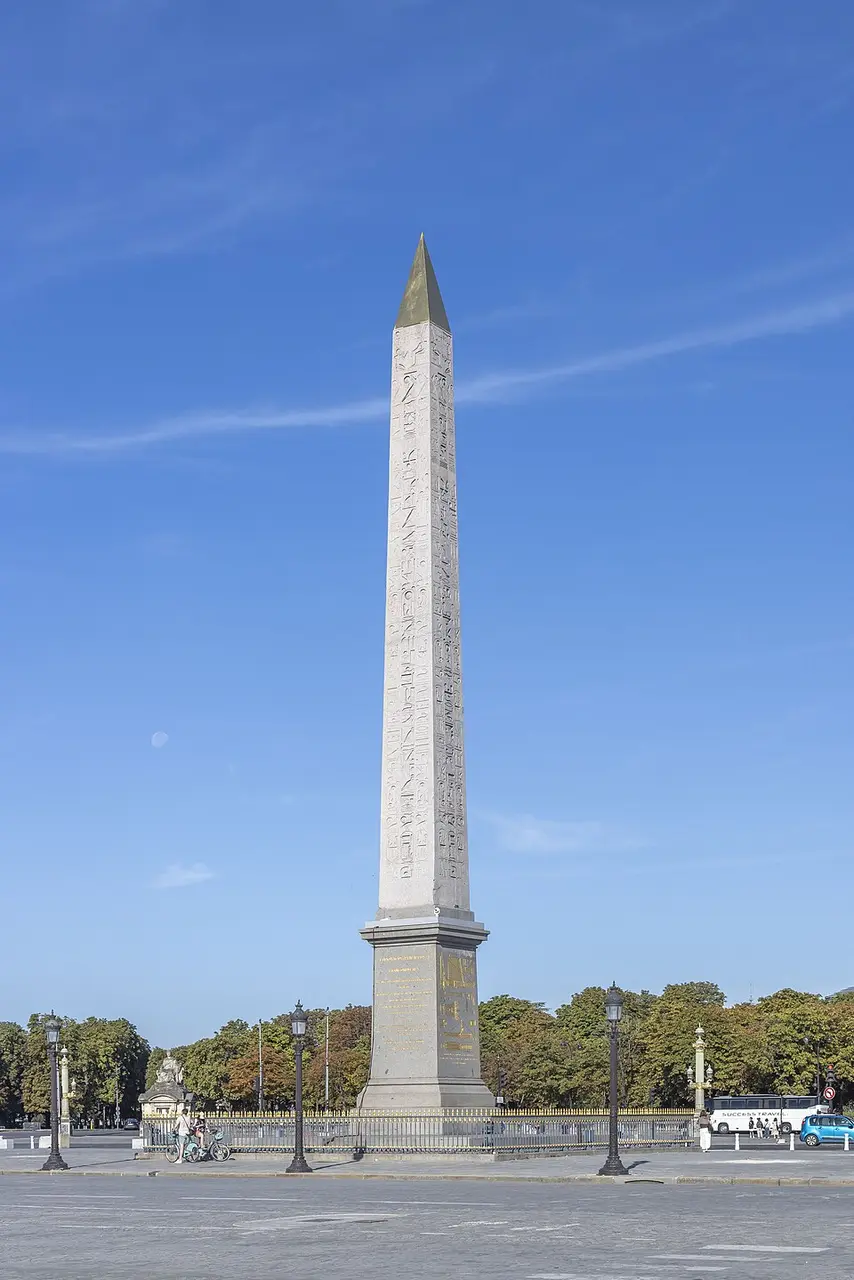
The Luxor Obelisk on the Place de la Concorde in Paris is one of the oldest monuments in the French capital. A monument from antiquity, it draws the eye and forms a central point on the so-called Axe historique, the great sight line that runs from the Louvre to the Grande Arche. This monolith, roughly 23 meters tall and weighing about 230 tons, is carved from a single block of pink granite that originally came from Syene, present-day Aswan. Images and inscriptions of the pharaoh Ramses II appear on all four sides, pointing to his reign and his piety. Since 1998, the tip of the obelisk has been covered by a gilded cap that adorns the so-called pyramidion and recalls the ancient electrum tips that crowned obelisks in ancient Egypt.
The story of this stone begins in the 13th century B.C., when Ramses II had it erected together with a second obelisk in front of the Luxor Temple in Thebes. There, the two monoliths flanked the temple entrance, and the eastern counterpart still stands in its original location today. The western obelisk, which came to Paris, was presented to France as a gift in 1830 by the Egyptian viceroy Muhammad Ali Pasha. Although both obelisks had been promised, only one made it to Europe. The choice of this particular stone was also made on the advice of Jean-François Champollion, who had seen it on a trip and judged it to be better preserved than its counterpart.
The transport to France was a logistical masterpiece of the 19th century. The French navy had a flat-bottomed sailing ship named Luxor built specially for the task, one that could sail the open sea as well as travel up the Nile thanks to its shallow draft. The width of the ship was even adapted to the narrowest bridge arches on the Seine. After a long journey across the Mediterranean and up the Seine, the obelisk reached Paris in 1833. The work on land, from lowering it in Egypt to raising it again in Paris, was coordinated under the direction of the naval engineer Apollinaire Lebas.
In Paris itself, the question of where to put it was hotly debated. While some wanted to place the obelisk in an archaeologically fitting setting such as the Louvre courtyard or in front of the Panthéon, King Louis-Philippe chose the Place de la Concorde. The square was politically charged, since Louis XVI had been executed here during the French Revolution. The king argued that the obelisk, as a monument with no direct connection to French politics, would outlast any change of power, whereas other monuments on this spot might be removed or replaced.
The monolith was raised on October 25, 1836, before an audience of more than 200,000 spectators. Because a planned steam engine failed, workers had to fall back on traditional winches. 350 artillerymen operated the ropes as the obelisk was pivoted on one edge of its base and slowly brought upright. A cedar box containing coins and medals was set beneath the pedestal to commemorate the event. The new pedestal, made of five blocks of granite from Brittany, was designed by the architect Jakob Ignaz Hittorff, who was also responsible for the redesign of the square.
The surface of the obelisk is rich in detail. At the top of each side, a scene shows the king making an offering to the god Amun-Re. Below it are three columns of hieroglyphs that name the pharaoh's titles and praise his valor. The middle column is cut more deeply and finely polished, while the outer columns are only worked in outline. This difference in treatment means the light reflects differently off the columns, making them stand out clearly from one another. The inscriptions describe the king's program of rule, which includes providing for the god, repelling enemies, and beautifying the sanctuaries.
A distinctive feature of the stone is a large crack running from the base up nearly a third of the shaft. The ancient Egyptians had already sealed this crack with putty and secured it with wooden dovetail clamps, whose recesses became visible when the obelisk was taken down in 1831. The crack was repaired when the obelisk was erected in Paris. Since 2000, the obelisk has been monitored electronically to ensure its stability. During a comprehensive restoration in 2022, all cracks were sealed with special silicate-based fillers to safeguard the stone for the future.
The tip of the obelisk, the pyramidion, was already damaged in Egypt and initially remained undecorated. Not until 1998 did the obelisk receive a new gilded bronze cap topped with a gilded steel point. This cap imitates the ancient electrum pyramidia and was funded by a foundation. During the 2022 restoration, the cap was regilded, and in 2023 its upper end was fitted with an additional gilded steel tip after birds had damaged the original version.
Today the obelisk is a popular destination for visitors who want to experience the history and culture of Egypt in the heart of Paris. It stands on a tall pedestal, on whose sides gilded diagrams show the dismantling in Luxor and the erection in Paris. These depictions recall the technical achievement of the 19th century. The inscriptions on the pedestal honor Louis-Philippe as the sponsor of the project and also refer to Napoleon's Egyptian campaign, which makes the obelisk a symbol of French imperial history as well.
Artists and writers have often drawn inspiration from the obelisk. Friedrich Hebbel noted in his diary that the stone exerts an ancient spell that makes people pause. Others saw in it a symbol of political memories being overlaid by an imperial narrative. Despite its historical significance, the obelisk remains a fascinating object that links the ancient world with the modern city of Paris. It is not only an archaeological find but also a central part of the city's identity and of the tourist experience in the French capital.
At a glance
- Category
- Sight › Monuments
- Rating
- no reviews yet · write a review
- Address
- Le Carpaccio, 4 Rue de Berri
75008 Paris, France - District
- 8th Arrondissement of Paris
- Phone
- +332954546324
- Website
- www.parisinfo.com
- —
- Coordinates
- 48.86556° N · 2.32111° E
- Data quality
- confidence 0.76
- Identifier
- ID 75be45ea-cd8…
Part of the tour
Paris and Its History: From the Sun King to the Present →Location & surroundings
Toggle layersRatings & comments
none yetNear Luxor Obelisk
closest 5 per category · 2 kmSights
Restaurants
Museums
Hotels
More:Monuments in Paris (322)Sights in 8th Arrondissement of Paris (87)All sights in Paris (1,859)
300 places within 2 km loaded.
You need a free account to leave reviews and photos – that keeps comments genuine and lets you edit them later.