About Arc de Triomphe
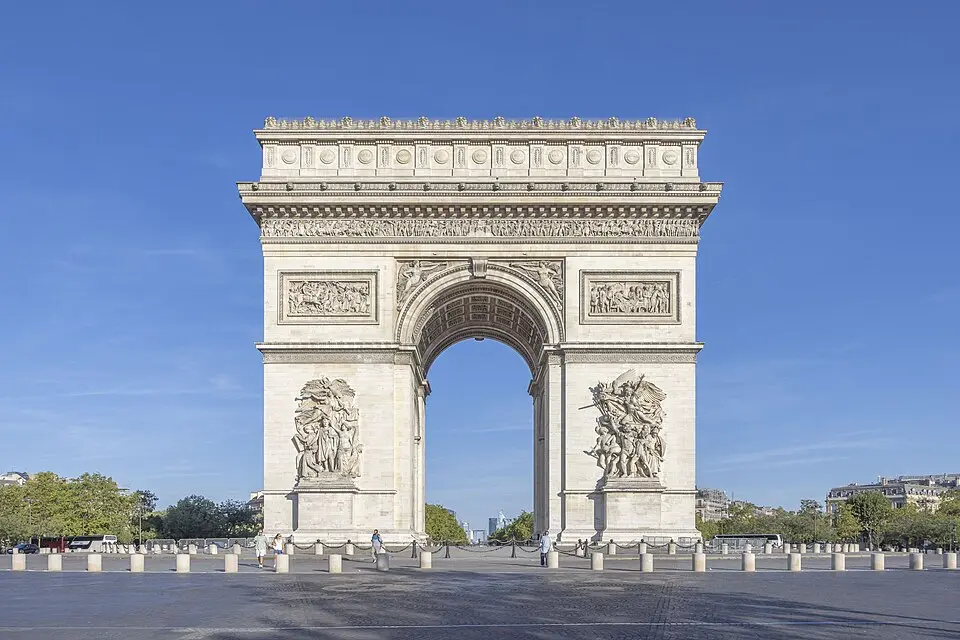
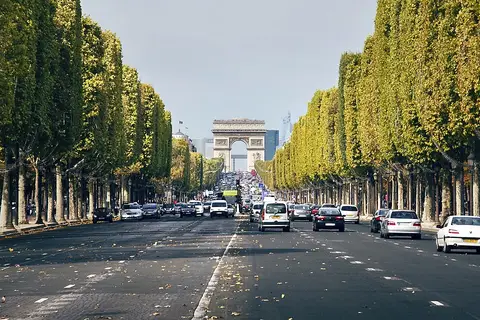
The Arc de Triomphe de l'Étoile is one of the best-known landmarks in Paris, standing at the center of the Place Charles de Gaulle, the western end of the Avenue des Champs-Élysées. This monumental structure was built between 1806 and 1836 to honor the glory of the imperial armies. It is part of the city's historic axis, from which twelve avenues radiate like the points of a star. Today the monument is managed by the Centre des monuments nationaux and is a focal point for state ceremonies, with solemn processions often beginning or ending here. Beneath the arch lies the Tomb of the Unknown Soldier of World War I, where the Eternal Flame is tended daily. This tribute to the unidentified fallen reaches its high point in the annual parade on November 11, the anniversary of the 1918 armistice.
The history of the Arc de Triomphe is closely tied to Napoleon I, who commissioned it after the Battle of Austerlitz to glorify his victories. After the death of the original architect, Jean-François Chalgrin, and Napoleon's abdication, work stalled for some time before resuming under Louis XVIII and later under King Louis-Philippe I. The latter decided to return to the Napoleonic design and commissioned various artists to create the sculptural decoration. The arch was finally completed in 1836. A tragic event marked its inauguration, when an assassin narrowly missed the king, who then canceled the planned military parade. Over the decades, the arch also became the setting for daring feats of aviation, as pilots attempted to fly through its opening, as well as a symbol of solidarity, for instance when the words "Paris est Charlie" were projected onto its facade in 2015.
Architecturally, the arch draws on the tradition of ancient Rome and, at a height of nearly 50 meters (about 164 feet), is an impressive structure. The inner walls house a small museum and bear the names of more than six hundred military officers as well as 158 victorious battles, including Napoleon's most important engagements. The large reliefs at the base of the arch are especially famous. The best known is "La Marseillaise" by François Rude on the east facade, which depicts the departure of the volunteers in 1792. This work is regarded as a milestone in sculpture's turn toward Romanticism and, with its heroic energy, surpasses the more classical depictions on the other sides, such as the "Triumph of 1810" by Jean-Pierre Cortot. Further reliefs by Antoine Étex and other artists adorn the facade and depict important historical moments.
Visitors can climb a staircase or take an elevator to an observation platform, which offers sweeping views over Paris and the star-shaped network of streets. Pedestrians can reach the monument only via an underpass, since the arch stands in the middle of a traffic circle. The structure is not just a historic monument but also a place of living culture. In 2021, for example, it was temporarily wrapped in fabric as part of a major art project by Christo and Jeanne-Claude, a project that had been planned since the 1960s and cast the monument in a new light. The Arc de Triomphe has also inspired numerous similar structures around the world, including ones in Bucharest and Pyongyang, and remains an unmistakable symbol of French history and identity.
At a glance
- Category
- Sight › Monuments
- Rating
- no reviews yet · write a review
- Address
75116 Paris, France- District
- 8th Arrondissement of Paris
- Phone
- +33155377377
- Website
- www.paris-arc-de-triomphe.fr
- —
- Coordinates
- 48.87378° N · 2.29504° E
- Data quality
- confidence 0.98
- Identifier
- ID 2ad0d744-857…
Part of the tour
Paris in One Day: From Notre-Dame to the Eiffel Tower →Location & surroundings
Toggle layersFAQ about Arc de Triomphe
quick answersWhat is the Arc de Triomphe in Paris?
The Arc de Triomphe de l’Étoile is a monumental triumphal arch and one of the best-known landmarks in Paris. It stands at the center of the Place Charles de Gaulle in the 8th arrondissement, at the western end of the Avenue des Champs-Élysées, where twelve avenues radiate out like a star. Napoleon I commissioned it after the Battle of Austerlitz. The arch, just under 50 meters (164 feet) high, was built from 1806 to 1836 on the model of Roman triumphal arches.
What is the Tomb of the Unknown Soldier at the Arc de Triomphe?
Beneath the Arc de Triomphe in Paris lies the Tomb of the Unknown Soldier of World War I, which commemorates the unidentified fallen. The Eternal Flame at this tomb is tended daily. The high point of the commemoration is the annual parade on November 11, the anniversary of the 1918 armistice.
What reliefs and inscriptions can you see at the Arc de Triomphe?
At the Arc de Triomphe in Paris, the large reliefs at the base of the arch are especially famous. The best known is "La Marseillaise" by François Rude on the east façade, which depicts the departure of the volunteers in 1792; other reliefs are by Jean-Pierre Cortot ("The Triumph of 1810") and Antoine Étex, among others. The inner walls bear the names of more than six hundred military figures and of 158 victorious battles. The arch also houses a small museum.
Can you climb to the top of the Arc de Triomphe?
Yes, the Arc de Triomphe in Paris has an observation deck. You can reach it by stairs or by elevator. From the top, you get a sweeping view over Paris and the twelve avenues radiating out like a star around the Place Charles de Gaulle.
Are there restaurants and tours around the Arc de Triomphe?
Yes, there are plenty of restaurants around the Arc de Triomphe in Paris: travelguide195 lists around 283 restaurants within 500 meters. The Arc de Triomphe is also part of the travelguide195 tour "Paris in One Day: From Notre-Dame to the Eiffel Tower."
Ratings & comments
none yetNear Arc de Triomphe
closest 5 per category · 2 kmSights
Restaurants
Museums
Hotels
More:Monuments in Paris (322)Sights in 8th Arrondissement of Paris (87)All sights in Paris (1,859)
299 places within 2 km loaded.
You need a free account to leave reviews and photos – that keeps comments genuine and lets you edit them later.
This iconic triumphal arch forms the focus of the main east-west road axis of Paris, running between the Louvre and the Grande Arche de la Défense in the west. The monument was commissioned by Napoleon in 1806 as a tribute to his victories as Emperor of France - it was finally completed in 1836, long after his death. 50 m (150 ft) high and 45 m wide, the Arc de Triomphe is decorated with battle scenes and martial sculptures that includes La Marseillaise by Rude. The Tomb of the Unknown Soldier was placed beneath the arch in 1920, where an eternal flame burns in tribute to the French dead of both World Wars. The arch is surrounded by a large roundabout, aptly known as l'Etoile - 'the star' - with 12 thoroughfares leading off from it. Visitors can purchase a ticket to climb to the top of the arch, from where magnificent views spread out over western Paris. Admission to a small museum devoted to the history and meaning of the monument is included. The central island and the arch are accessed by an underground passage. Do not attempt to negotiate by foot the busy multi-lane road that rings the Arc de Triomphe, which many Parisian drivers seem to consider their own personal speedway.
Source: Wikivoyage, „Paris/8th arrondissement“ · authors per page history · CC BY-SA 4.0