About Panthéon
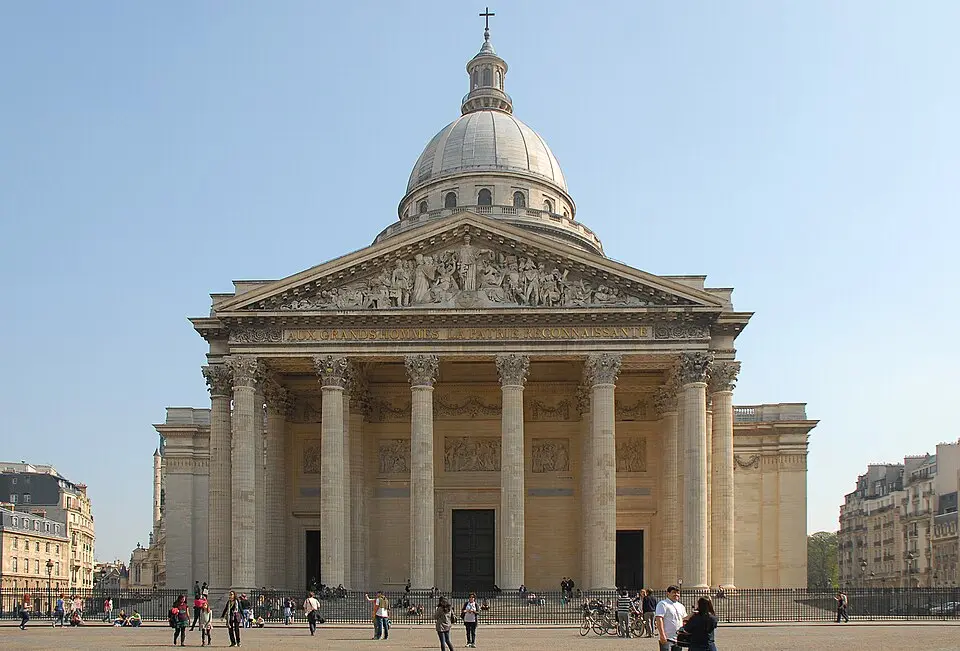
The Panthéon in Paris, located in the 5th arrondissement on the hill of Sainte-Geneviève, is France's national hall of fame and the final resting place of important figures from French history. The name derives from the ancient Greek word for "all the gods," a nod to the Roman Pantheon, which served as its architectural model. The building was originally planned as a church, but during the French Revolution the National Assembly converted it into a secular memorial in 1791. Since then it has served as a place of tribute for men and women who have rendered great service to the country, and the inscription on its pediment reads "To the great men, the grateful homeland."
The history of the site goes back to the fifth century, when a church was built here in honor of Saint Genevieve, the patron saint of Paris. Over the centuries the building's form and use changed, until King Louis XV commissioned a new, magnificent church in the 18th century. The architect Jacques-Germain Soufflot designed a building that combines classical Roman forms with Gothic elements. The floor plan follows a Greek cross, while the facade recalls an ancient temple. Soufflot died in 1780, before the dome was finished, and his students ultimately completed the project in 1790.
Architecturally, the Panthéon is a masterpiece of Neoclassicism. The exterior revives the forms of Roman antiquity, most notably the great dome set on a drum ringed with columns. Inside, however, Soufflot drew inspiration from the elegance of Gothic cathedrals. Instead of heavy supports, you will find slender columns and ribbed vaults that give the space a remarkable lightness. The four arms of the cross are flanked by side aisles, which draw the eye upward. This blend of a classical facade and a Gothic interior makes the building a unique testament to the history of European architecture.
Beneath the entire floor of the former church lies no ordinary basement but an extensive network of corridors with numerous chapels. Here the remains of those honored rest in tombs of honor, much like the veneration of saints in Christian churches. Among the best-known figures interred here are the philosopher Voltaire, the writer Victor Hugo, the physicist Marie Curie, and the Resistance fighter Jean Moulin. Admission to the Panthéon, officially known as Panthéonisation, is a political and cultural process that can only take place by decree of the President of the Republic. Many figures were not transferred here until decades or even centuries after their deaths, such as Alexandre Dumas, whose remains were moved to the hall of fame only in 2002.
The building also has an important scientific history. In 1851, the physicist Léon Foucault used his famous pendulum here to provide empirical proof of the Earth's rotation. In addition, the Panthéon changed purpose twice in the 19th century: first back to a church, and finally, in 1885, permanently back to a national hall of fame, after the death of Victor Hugo sparked a broad public debate. Today the site is not only a burial ground but also a symbol of the values of the French Republic. You can admire the impressive architecture, visit the tombs of great figures, and experience the historic significance of the site as a meeting point of politics, science, and art.
At a glance
- Category
- Sight › Monuments
- Rating
- no reviews yet · write a review
- Address
- Pl. du Panthéon
75005 Paris, France - District
- Quartier de la Sorbonne
- Phone
- +33144321800
- Website
- www.paris-pantheon.fr
- contact@atel-hotels.com
- Coordinates
- 48.84631° N · 2.34635° E
- Data quality
- confidence 0.94
- Identifier
- ID 0a293850-a5e…
Location & surroundings
Toggle layersFAQ about Panthéon
quick answersWhat is the Panthéon in Paris?
The Panthéon in Paris is France's national hall of fame and the final resting place of important figures from French history. Originally planned as a church, it was converted into a secular memorial by the National Assembly in 1791, during the French Revolution. The inscription on the pediment reads "To the great men, the grateful homeland." The name derives from the ancient Greek word for "all gods" and refers to the Roman Pantheon, which served as the architectural model.
Who is buried in the Panthéon in Paris?
The Panthéon in Paris is the resting place of men and women who served France with distinction, including the philosopher Voltaire, the writer Victor Hugo, the physicist Marie Curie, and the Resistance fighter Jean Moulin. The tombs of honor lie in an extensive network of passages with numerous chapels beneath the entire floor of the building. Admission, known as the Panthéonisation, is granted only by decision of the President of the Republic. Some were transferred long after their deaths, such as Alexandre Dumas, whose remains were moved to the Panthéon in 2002.
Who built the Panthéon in Paris, and what is architecturally special about it?
The Panthéon in Paris was designed by the architect Jacques-Germain Soufflot, after King Louis XV commissioned the construction of a new church in the 18th century. Soufflot died in 1780 before the dome was finished, and his students completed the building in 1790. The building is considered a masterpiece of Neoclassicism: on the outside, a temple pediment and a large dome on a column-ringed drum define its look, while inside, slender columns and ribbed vaults inspired by Gothic architecture create a sense of lightness. The floor plan follows a Greek cross.
What can you see around the Panthéon in Paris?
Around the Panthéon in Paris, you'll find several sights within a short distance. travelguide195 lists Foucault's Pendulum (Le Pendule De Foucault) about 23 meters away, the Place du Panthéon about 100 meters away, the Ancienne École Polytechnique about 210 meters away, and the Musée Curie about 260 meters away. The Musée Curie is a natural thematic fit with the Panthéon, where Marie Curie is buried.
Where is the Panthéon in Paris located?
The Panthéon stands on the Place du Panthéon in the 5th arrondissement of Paris, in the Sorbonne neighborhood on the hill of Saint Genevieve. A church in honor of the patron saint, Genevieve of Paris, already stood on this site in the fifth century. travelguide195 lists around 364 restaurants within 500 meters. The Panthéon is also part of the tour "Paris for Food Lovers: From the Palais-Royal to the Latin Quarter."
Ratings & comments
none yetNear Panthéon
closest 5 per category · 2 kmSights
Restaurants
Museums
Hotels
More:Monuments in Paris (322)Sights in Quartier de la Sorbonne (23)All sights in Paris (1,859)
300 places within 2 km loaded.
You need a free account to leave reviews and photos – that keeps comments genuine and lets you edit them later.
It was conceived by Louis XV as a grand neo-classical church honouring St. Geneviève, the patron saint of Paris. After the Revolution, the building was converted into a mausoleum for the great philosophers, military, artists, scientists, and heroes of the French Republic. Occupants of the crypt include Voltaire, Rousseau, Victor Hugo, Zola, the Curies, and Alexandre Dumas (reinterred here in 2002). The view from the dome (206 steps) is marvellous. Check tour departure times at the information desk. A fascinating reconstruction of Foucault's pendulum also hangs within the Panthéon.
Source: Wikivoyage, „Paris/5th arrondissement“ · authors per page history · CC BY-SA 4.0