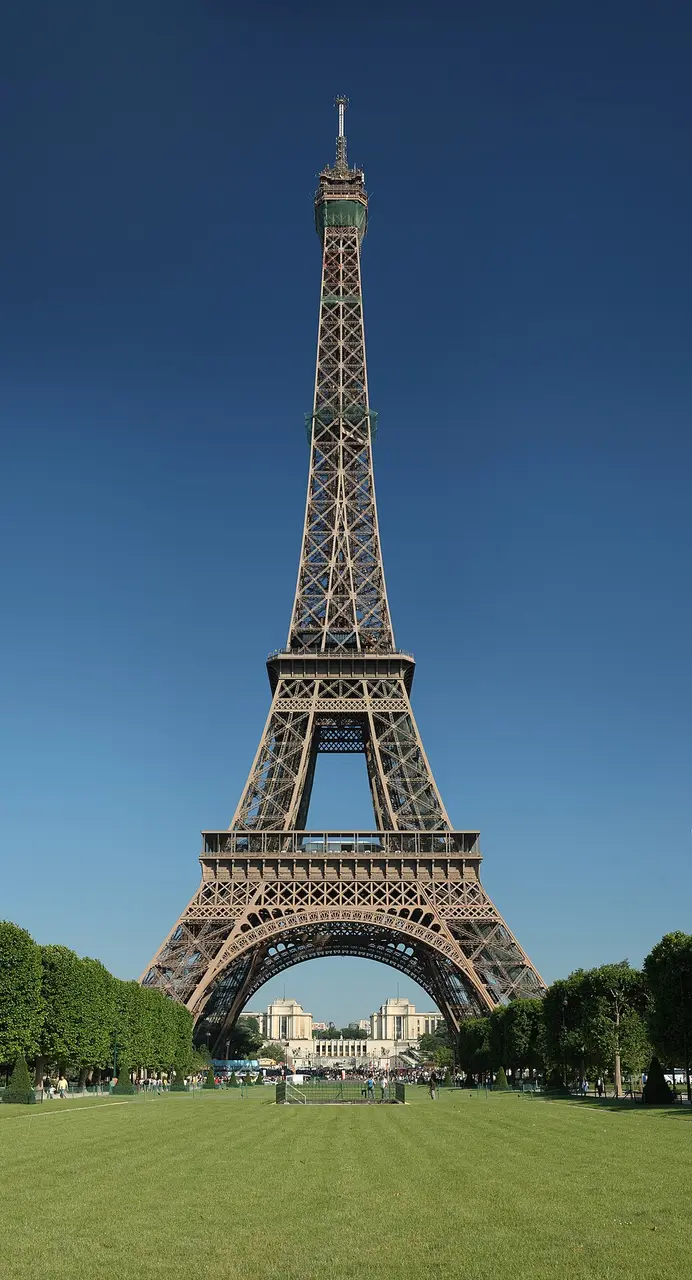
About La Tour Eiffel
The Eiffel Tower is an iconic structure in the French capital, Paris, and ranks among the most visited landmarks in the world. Rising 330 meters (1,083 feet), this wrought-iron lattice tower towers over the city's rooftops in the 7th arrondissement, at the northwestern end of the Champ de Mars, right on the banks of the Seine. The monument was built between 1887 and 1889 and originally served as a monumental entrance gateway and observation tower for the World's Fair, which celebrated the 100th anniversary of the French Revolution. The structure is named after its builder, Gustave Eiffel, who drove the project forward with great personal and entrepreneurial commitment.
The history of the tower is closely tied to the technical possibilities of industrialization, which made the construction of tall structures possible in the first place. As early as the 1830s and 1870s, there were proposals for similar structures, but they were never realized. In 1884, the engineers Maurice Koechlin and Émile Nouguier from Eiffel's firm presented a design for a 300-meter metal pylon. The construction was designed so that the angle of the struts offered little resistance to crosswinds and channeled the forces downward, giving the structure great stability. Eiffel had the design patented but was not satisfied with its purely technical aesthetic.
To increase public acceptance, Eiffel commissioned the architect Stephen Sauvestre to rework the tower's form. Sauvestre added a monumental arch at the first level, which served as an entrance gateway and gave the tower a less austere appearance. He also added masonry pedestals and decorative elements to the structure. This revised design won Eiffel over; he acquired the usage rights and presented the tower as a scientifically significant project for meteorology, astronomy, and aerodynamics. Construction began in January 1887 and was completed in March 1889, shortly before the World's Fair opened.
The construction work was technically demanding and required precise planning. A caisson method was used for the foundations, since they had to be sunk below the level of the Seine riverbed. The building material was wrought iron produced by the puddling process, which could only be riveted, not welded. The individual parts were prefabricated in the factory on a modular basis and assembled in Paris. In all, 2.5 million rivets hold the components together. Up to 250 people worked on the site, including chimney sweeps who were accustomed to working at great heights. Despite the enormous height and the complex construction, there was only a single fatal accident during the entire construction period.
The opening of the tower on March 31, 1889, was a historic event. Gustave Eiffel climbed the tower himself and raised the French tricolor at the top. At that time, the structure, at 312 meters (1,024 feet), was the tallest in the world, surpassing the Washington Monument. The tower also met with fierce criticism, however. Many intellectuals and artists protested against it, finding the open iron construction scandalous and fearing that the tower would disfigure the cityscape. A famous letter of protest was signed by prominent figures such as Guy de Maupassant and Charles Gounod. Despite this opposition, the tower was very popular with the general public, and the construction site drew large numbers of visitors.
After the World's Fair, the tower's future was uncertain because its 20-year operating concession was running out. Eiffel tried to secure the structure's usefulness through scientific research and military applications. Weather stations were set up on the tower, and experiments on aerodynamics and cosmic radiation were carried out. The tower became especially important for telecommunications. In 1898, the first wireless telegraph connection succeeded, and in 1921, the first public radio program in Europe was broadcast from the Eiffel Tower. In 1935, the first official television broadcast followed, making the tower the birthplace of television in France.
During the two world wars, the Eiffel Tower played a strategic role. In World War I, it served as a telecommunications center for the military, where enemy radio messages were intercepted and decoded. In World War II, the German occupiers cut the elevator cables, so the tower could only be reached by the stairs. Hitler visited Paris but did not climb the tower. After the liberation of Paris in 1944, American troops used the tower for their broadcasting stations. In the following decades, the Eiffel Tower developed into a major attraction and a symbol of modernity.
Since the 1990s, the tower has been part of the UNESCO World Heritage. The operating company takes care of the structure's preservation and marketing. In recent years, extensive renovations have been carried out, including the redesign of the first platform with new pavilions and the installation of accessible elevators. A security barrier was also built around the tower, consisting of glass walls and metal fences, which both provides protection and echoes the tower's conical shape. The tower remains an important broadcasting site for radio and television in the Greater Paris area.
For visitors, the Eiffel Tower offers a unique view over Paris. You can climb the tower by elevator or stairs and explore the city from the various platforms. On the third level is the restaurant Le Jules Verne, which has been awarded two Michelin stars. The tower is not only a technical masterpiece but also a cultural symbol that is taken up again and again in art and culture. Every year, a good six million paying visitors come to the structure, which is regarded as a national symbol of France and a worldwide icon of modernity.
During the 2024 Summer Olympics in Paris, the Eiffel Tower was once again in the spotlight. At the opening ceremony, which for the first time was not held in a stadium, the tower was part of an elaborate light show. The Olympic rings were mounted between the first and second levels and are to be replaced by a lighter replica after the Games. The tower thus remains a living symbol that unites history, technology, and culture and continues to shape the Paris skyline.
At a glance
- Category
- Sight › Monuments
- Rating
- no reviews yet · write a review
- Address
- 5 Avenue Anatole France, 75007 Paris, France
75007 Paris, France - District
- 7th Arrondissement
- Phone
- +33892701239
- Website
- www.toureiffel.paris
- —
- Coordinates
- 48.85782° N · 2.29517° E
- Data quality
- confidence 0.98
- Identifier
- ID ffa2cea3-ab6…
Part of the tour
Paris in One Day: From Notre-Dame to the Eiffel Tower →Location & surroundings
Toggle layersFAQ about La Tour Eiffel
quick answersWhat is the Eiffel Tower in Paris?
The Eiffel Tower (La Tour Eiffel) is a 330-meter-tall wrought-iron lattice tower in Paris and one of the most visited attractions in the world. It was built between 1887 and 1889 as a monumental entrance arch and observation tower for the World's Fair, which celebrated the 100th anniversary of the French Revolution. It is named after its builder, Gustave Eiffel, who also presented it as a scientific project for meteorology, astronomy, and aerodynamics.
Where is the Eiffel Tower in Paris?
The Eiffel Tower stands in the 7th arrondissement of Paris, at 5 Avenue Anatole France, 75007 Paris. It is located at the northwest end of the Champ de Mars, right on the banks of the Seine.
Who designed the Eiffel Tower?
The first design for the Eiffel Tower in Paris was presented in 1884 by engineers Maurice Koechlin and Émile Nouguier from Gustave Eiffel's firm, at that time as a 300-meter-tall metal pylon. Gustave Eiffel had the design patented and commissioned the architect Stephen Sauvestre to rework its form. Sauvestre added a monumental arch as an entrance at the first level, along with masonry bases and decorative elements.
How was the Eiffel Tower built?
The Eiffel Tower in Paris was built from January 1887 to March 1889 using puddled wrought iron, which could only be riveted. The individual parts were prefabricated at the factory and assembled in Paris; in total, 2.5 million rivets hold the components together. Caissons were used for the foundations below the level of the Seine riverbed. Up to 250 people worked on the construction, including chimney sweeps, and there was only a single fatal accident during the entire building period.
Are there restaurants and tours around the Eiffel Tower?
Yes, you'll find plenty of restaurants around the Eiffel Tower in Paris: travelguide195 lists around 99 restaurants within 500 meters. If you'd like to combine the Eiffel Tower with other sights, it is part of the tour "Paris in One Day: From Notre-Dame to the Eiffel Tower."
Ratings & comments
none yetNear La Tour Eiffel
closest 5 per category · 2 kmSights
Restaurants
Museums
Hotels
More:Monuments in Paris (322)Sights in 7th Arrondissement (60)All sights in Paris (1,859)
293 places within 2 km loaded.
You need a free account to leave reviews and photos – that keeps comments genuine and lets you edit them later.
A symbol of Paris and one of the most famous landmarks in the world. Built by Gustave Eiffel in 1887-1889, the tower was almost torn down in 1909 and only saved due to its use as a telegraphy antenna. The queues can be very long. The tower allows online reservations at its website. You can select a date and time frame. If you miss the time on your ticket, you have lost your money. The north, west, and east pillars have elevators that go to the first and second floors; the south pillar has stairs that can be climbed to the second floor. To reach the top floor, an additional elevator ride is required, and the wait for this can be very long as well. Disabled visitors are not allowed beyond the second floor due to safety concerns. Taking the Métro as far as Ecole Militiare and then strolling up the Champ de Mars is a lovely way to arrive at the tower. Another phenomenal approach is to exit the Metro at Trocadero and see the Eiffel Tower from the other side of the Ecole Militaire.
Source: Wikivoyage, „Paris/7th arrondissement“ · authors per page history · CC BY-SA 4.0 · as of 7/25/2018