About Place de la Concorde
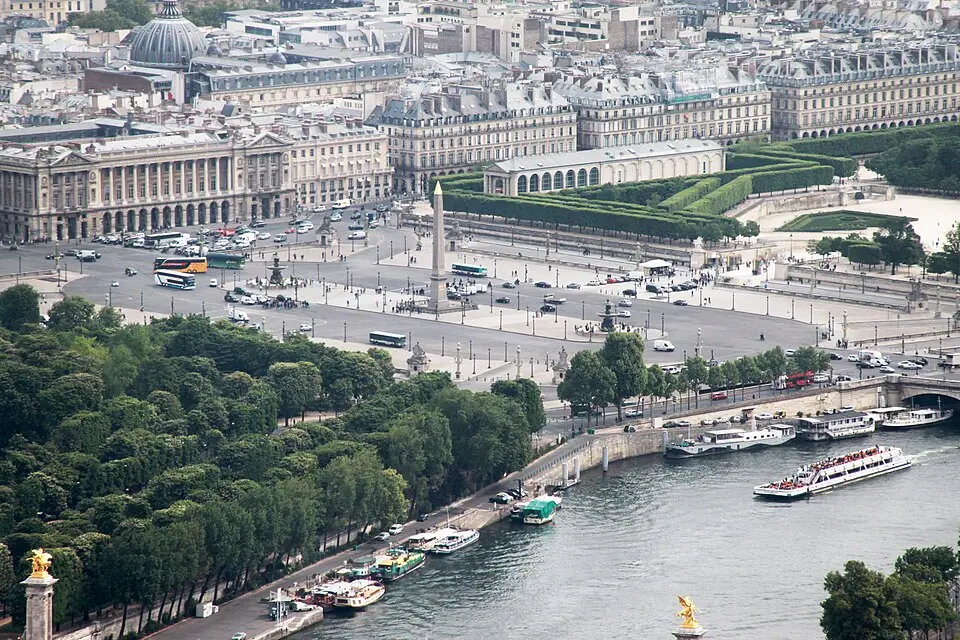
The Place de la Concorde, which translates as Harmony Square, covers 7.56 hectares (about 18.7 acres), making it the largest square in Paris. It lies in the 8th arrondissement on the Right Bank of the Seine, north of the river, and forms an urban link between the Jardin des Tuileries and the famous Avenue des Champs-Élysées. At 360 meters long and 210 meters wide, it is the second-largest square in France after the Place des Quinconces in Bordeaux. As one of the city's five so-called royal squares, which also include the Place des Vosges, Place Dauphine, Place Vendôme, and Place des Victoires, it holds outstanding historical and architectural significance. The name was chosen in 1795 by the Directory during the French Revolution to symbolize the reconciliation of the French people after the Reign of Terror.
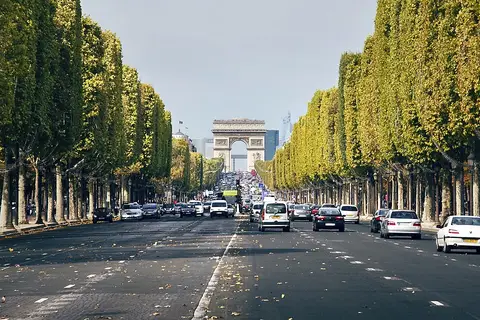
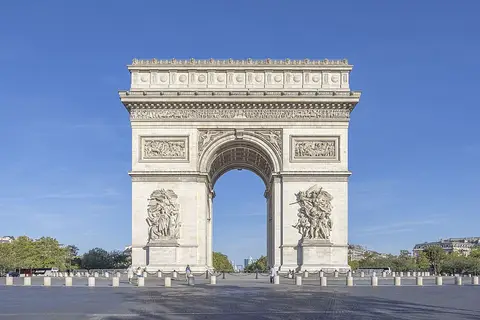
The square is centrally located and hugely important for traffic, as two of the city's major axes cross here. The north-south axis runs from Montmartre via the Grands Magasins and the Église de la Madeleine to the National Assembly. The west-east axis leads from the Grande Arche via the Place Charles-de-Gaulle and the Champs-Élysées to the Louvre. A particular feature of the urban design is the historic line of sight that extends from the Louvre across the obelisk in the square to the Arc de Triomphe at the Étoile. A second sight line, running at a right angle to the first, connects the Madeleine church with the Palais Bourbon on the other side of the Seine. The square is easy to reach by public transportation, including the Concorde metro station and several RATP bus lines.
The history of the site goes back to the 18th century, when the land was still marshy and frequently flooded by the Seine. King Louis XV decided to create a new square on an undeveloped plot at the end of the Tuileries Gardens, which at the time still lay outside the city limits. The architect Ange-Jacques Gabriel drew up the plans, which were approved in 1755. The square was to be laid out as an octagon and provide a dignified setting for an equestrian statue of Louis XV, created by the sculptor Edme Bouchardon. The monument was unveiled in 1765, while the square itself was not completed until 1776. At that time it was called Place Louis XV.
During the French Revolution, the site took a dramatic turn. The equestrian statue was destroyed and melted down in 1792. In its place, a guillotine was erected, and the square became the scene of numerous executions. Among those executed here were King Louis XVI, his wife Marie Antoinette, and prominent revolutionaries such as Danton and Robespierre. Over 1,300 people lost their lives here within two and a half years. This bloody chapter left a lasting mark on the square and made it a place of political conflict, and over the following decades it was renamed several times to reflect France's changing regimes and political moods.
The square's present-day appearance owes much to the era of the July Monarchy and the Second Empire. After the July Revolution of 1830, the square received its final name. A highlight of this period was the erection of the Luxor Obelisk in 1836. The architect Jakob Ignaz Hittorff redesigned the square between 1836 and 1840. He kept Gabriel's basic layout but added two monumental fountains and surrounded the square with lampposts and so-called rostral columns. This design was meant to highlight French achievements in shipbuilding, since the Naval Ministry was housed in one of the buildings on the north side.
The obelisk itself is a monolith of pink granite roughly 23 meters (about 75 feet) tall, which originally stood in front of the Luxor Temple in Thebes. It was erected by Ramses II in the 13th century B.C. and was given to France by Egypt in 1830. In Paris, it stands on a nine-meter-high pedestal of Breton granite. In 1998 it received a gilded bronze pyramidion. The obelisk is the oldest monument in the city and forms the visual center of the square. Each year, the celebrations for France's national holiday on July 14 reach their climax here, making the square a central place of national identity.
The two large fountains flanking the obelisk are also the work of Hittorff. The northern fountain, the Fontaine des Fleuves, is dedicated to the Rhône and Rhine rivers as well as agriculture. The southern fountain, the Fontaine des Mers, symbolizes the Mediterranean and the Atlantic as well as seafaring and fishing. Both fountains are made of cast iron and were inaugurated in 1840. They are adorned with allegorical figures and genii created by various artists of the time. The 20 cast-iron candelabras that light the square bear ship prows and allude to the maritime history of the site.
At the corners of the square stand eight allegorical statues representing the most important cities of France. These seated city goddesses, created by Gabriel, stand on pedestals that once served as sentry boxes. They represent Bordeaux, Lille, Brest, Rouen, Lyon, Marseille, Nantes, and Strasbourg. These sculptures frame the octagon planned by Gabriel and give the square its classical, harmonious character. The combination of architecture, sculpture, and water features makes the Place de la Concorde a masterpiece of Enlightenment urban design.
On the north side of the square stand the neoclassical buildings constructed by Gabriel, which dominate the square's facade. These buildings, erected between 1757 and 1775, are distinguished by monumental Corinthian columns and colonnades. The western part houses the Hôtel de Crillon, which originally served as a town mansion and has been a luxury hotel since 1909. It was here that Benjamin Franklin signed an important treaty between France and the United States in 1778. The eastern part formerly housed the royal furniture repository, which later became the Naval Ministry.
The former Naval Ministry was extensively restored between 2017 and 2021 and today houses a museum, the Al Thani Collection from Qatar, and the French office of the international soccer federation FIFA. The building was opened in 2021 by President Emmanuel Macron and is open to the public. This use underscores the cultural and international importance of the site. The square was designated a historic monument in 1937, which ensures its preservation and protects it from further structural changes.
In the 20th and 21st centuries, the Place de la Concorde was the setting for numerous historic events and cultural activities. Demonstrations, political celebrations, and cultural events have taken place here. During the 2024 Olympic Games, the square hosted competitions in breakdancing, skateboarding, BMX, and 3x3 basketball. The opening ceremony of the 2024 Paralympic Games was also held here. In addition, the city of Paris is planning a comprehensive redesign of the square and the Champs-Élysées to expand pedestrian space and reduce car traffic. These measures are intended to improve quality of life and make the square fit for the future.
The Place de la Concorde is not only an architectural gem but also a place of living history. It reflects the political upheavals, cultural developments, and social changes of France. Here you can experience the connection between past and present, from revolutionary history and classical architecture to modern cultural events. The square invites you to linger and offers an impressive glimpse into the history and identity of the French capital.
At a glance
- Category
- Sight › Monuments
- Rating
- no reviews yet · write a review
- Address
- 8 Place de la Concorde
75008 Paris, France - District
- 8th Arrondissement of Paris
- Phone
- +33142661107
- Website
- www.paris.fr
- —
- Coordinates
- 48.86553° N · 2.32087° E
- Data quality
- confidence 0.84
- Identifier
- ID a459d69e-da0…
Part of the tour
Paris in One Day: From Notre-Dame to the Eiffel Tower →Location & surroundings
Toggle layersRatings & comments
none yetNear Place de la Concorde
closest 5 per category · 2 kmSights
Restaurants
Museums
Hotels
More:Monuments in Paris (322)Sights in 8th Arrondissement of Paris (87)All sights in Paris (1,859)
300 places within 2 km loaded.
You need a free account to leave reviews and photos – that keeps comments genuine and lets you edit them later.
The largest square in Paris with fantastic vistas in every direction. It was in this square (then called la Place de la Revolution ) that the French King Louis XVI, Marie Antoinette and many others were guillotined during the Terror. The large Egyptian obelisk in the centre of the Place de la Concorde was brought from the Temple of Luxor.
Source: Wikivoyage, „Paris/8th arrondissement“ · authors per page history · CC BY-SA 4.0 · as of 6/24/2017