Sight · Historic sites
Grande Roue de Paris, Place de la Concorde.
place de la Concorde, 75008 Paris
About Grande Roue de Paris, Place de la Concorde.
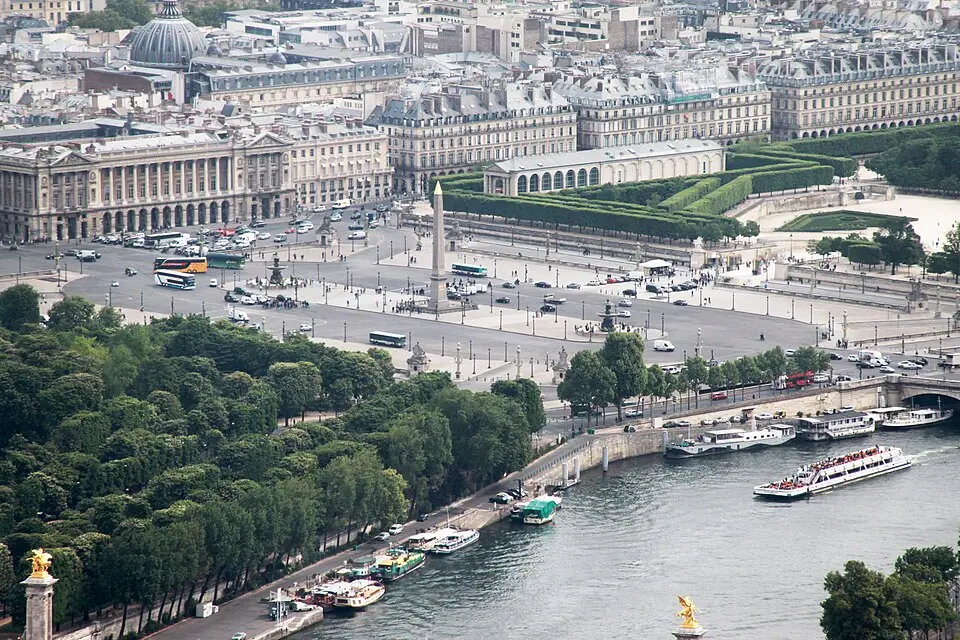
The Place de la Concorde, which translates as Harmony Square, covers 7.56 hectares (about 18.7 acres), making it the largest square in Paris. It sits in the 8th arrondissement on the Right Bank of the Seine, north of the river, stretching between the Jardin des Tuileries and the Avenue des Champs-Élysées. At 360 meters long and 210 meters wide, it is the second-largest square in France after the Place des Quinconces in Bordeaux. The square occupies a central spot where two major axes cross: a north-south axis running from Montmartre past the Église de la Madeleine to the National Assembly, and a west-east axis running from the Grande Arche along the Champs-Élysées to the Louvre. This strategic location makes the square a key hub of the city, easy to reach by several Metro lines and bus routes.
The history of the site is closely tied to France's political development. The land was originally marshy and often flooded by the Seine. King Louis XV decided to build a new square on an undeveloped plot at the end of the Tuileries Gardens, which at the time still lay outside the city limits. The architect Ange-Jacques Gabriel drew up the plans, which were approved in 1755. The square was laid out as an octagon and surrounded by a moat. Its main purpose was to provide a fitting setting for the equestrian statue of Louis XV, created by the sculptor Edme Bouchardon. The monument was unveiled in 1765, while the square was still under construction. After its completion in 1776, the square was called Place Louis XV.
During the French Revolution, the site underwent a dramatic transformation. The equestrian statue was destroyed and melted down in 1792. In its place, a guillotine was erected in 1793, used to execute King Louis XVI and later his wife, Marie-Antoinette, along with numerous other political opponents. Over 1,300 people died here within two and a half years. During this period, the square was known as the Place de la Révolution. After the Revolution, the Directory chose the name Place de la Concorde in 1795 to symbolize the reconciliation of the French people after the Reign of Terror. The name changed several times in the years that followed, reflecting the country's political instability, before it was finally restored under the July Monarchy.
The square's present appearance was largely shaped in the 19th century. A central feature is the Luxor Obelisk, installed in 1836. This monolith of pink granite, about 23 meters (75 feet) tall, dates from the 13th century B.C. and was erected by Ramses II in front of the Luxor Temple in Thebes. The Viceroy of Egypt gave it to France as a gift. The obelisk stands on a tall base of Breton granite and is decorated with hieroglyphs praising the king's valor and piety. In 1998, it received a gilded pyramidion on its tip. The obelisk forms the center of the square and stands on the sightline from the Louvre to the Arc de Triomphe.
The obelisk is flanked by two monumental fountains designed by the architect Jakob Ignaz Hittorff. The northern fountain, the Fontaine des Fleuves, represents the Rhône and Rhine rivers as well as agriculture and industry. The southern fountain, the Fontaine des Mers, is dedicated to the Mediterranean and the Atlantic as well as seafaring and fishing. Both fountains are made of cast iron and were inaugurated in 1840. They are adorned with numerous allegorical figures and genii created by various artists. The fountains underscore the maritime significance of the site, since one of the neighboring buildings once housed the Ministry of the Navy.
Around the edges of the square stand eight allegorical statues symbolizing major French cities. These seated city goddesses represent Bordeaux, Lille, Brest, Rouen, Lyon, Marseille, Nantes, and Strasbourg. They were created by various sculptors in the 19th century and stand on pedestals that originally served as sentry boxes. The square is also decorated with cast-iron lampposts and rostral columns, likewise designed by Hittorff. These elements give the site a unified, classical look that reflects the Age of Enlightenment and the classical architecture of the 18th century.
The north side of the square is dominated by two large neoclassical buildings constructed by Ange-Jacques Gabriel. With their monumental Corinthian columns and colonnades, they were completed between 1757 and 1775. The western building houses the Hôtel de Crillon, which has operated as a luxury grand hotel since 1909. It was here that Benjamin Franklin signed an important treaty of friendship and commerce between France and the United States in 1778. The eastern building originally held the royal furniture repository and later became the Ministry of the Navy. After extensive renovation, it now houses a museum, the Al Thani Collection from Qatar, and the French office of the world football association FIFA.
The square is not only an architectural masterpiece but also the site of major historical and cultural events. During the French Revolution it served as the scene of executions; in the 19th century it witnessed the July Revolution and the erection of the obelisk. In the 20th century, significant political demonstrations and celebrations took place here, including the election-night celebrations of several presidents. The square was designated a historic monument in 1937, which secured its preservation. More recently, it was redesigned for the 2024 Olympic Games, with temporary competition venues built for sports such as breakdancing, skateboarding, and BMX.
Today, the Place de la Concorde is a popular destination for tourists and locals alike. Visitors can admire the imposing architecture, the richly detailed fountains, and the historic obelisk. The surrounding area offers more attractions close by, including the Louvre, the Champs-Élysées, and the Jardin des Tuileries. The square is a gathering place where French history comes alive. Whether on a quiet stroll or during a big celebration, the Place de la Concorde embodies the grand and eventful history of the French capital in a singular way.
The urban design of the square expresses the evolution of French taste in the 18th century. The combination of classical architecture, allegorical sculpture, and functional infrastructure makes it an outstanding example of urban planning. The sightlines connecting the square with other important places in the city underscore its central role in the urban fabric. The Place de la Concorde is more than just a square; it is a symbol of the political and cultural upheavals France has been through, and a place where past and present meet.
For travelers, the square offers a fascinating blend of history, art, and city life. The chance to experience the traces of the Revolution, the splendor of the Empire, and the modern use of the site makes it an essential part of any Paris trip. The careful preservation of historic elements such as the fountains and statues, along with the integration of new uses such as the art collections in the former Ministry of the Navy, show how the site has maintained and built on its importance over the centuries. The Place de la Concorde remains a place that invites you to marvel and reflect.
At a glance
- Category
- Sight › Historic sites
- Rating
- no reviews yet · write a review
- Address
- place de la Concorde
75008 Paris, France - District
- 8th Arrondissement of Paris
- Phone
- —
- Website
- —
- —
- Coordinates
- 48.86525° N · 2.32197° E
- Data quality
- confidence 0.86
- Identifier
- ID 026e738d-bf0…
Location & surroundings
Toggle layersRatings & comments
none yetNear Grande Roue de Paris, Place de la Concorde.
closest 5 per category · 2 kmSights
Restaurants
Museums
Hotels
More:Historic sites in Paris (1,524)Sights in 8th Arrondissement of Paris (87)All sights in Paris (1,859)
300 places within 2 km loaded.
You need a free account to leave reviews and photos – that keeps comments genuine and lets you edit them later.