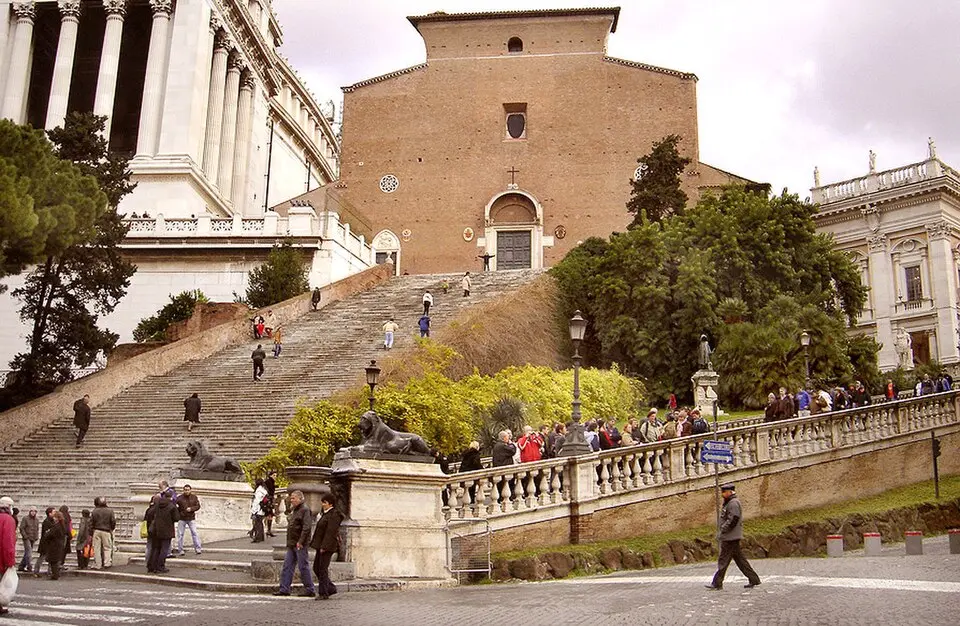
About Capitolini
The Capitoline Hill, or Capitol for short, is one of the seven classical hills of Rome and is considered the historic and religious center of the ancient city. Geographically, it lies northwest of the Palatine Hill and consists of two peaks separated by a saddle. In antiquity, the southern summit was home to the Capitolium, the most important temple of the Roman Empire, which was dedicated to the so-called Capitoline Triad of Jupiter, Juno, and Minerva. As a sacred center, this site also carried enormous political significance: Consuls took office here with solemn sacrifices, and the triumphal processions of victorious generals ended here. The northern peak, by contrast, served as a citadel of refuge and housed, among other things, the Temple of Juno Moneta, which was also linked to Roman coinage.
The history of the hill is closely tied to the development of Rome. Originally not part of the early settlement, it was incorporated in the sixth century B.C. A famous legend tells how sacred geese from the sanctuary of Juno saved the city from a Gallic assault in 387 B.C. by noticing the nighttime attack and waking the inhabitants. On the southern summit stood the sacred precinct of the Area Capitolina, which was closed and guarded at night. Beneath it lay underground chambers where old votive offerings and materials were stored. Colossal statues also adorned the square, including a giant statue of Jupiter and a bronze image of Hercules. At the southern tip of the hill is the Tarpeian Rock, from which condemned criminals were hurled to their deaths in antiquity.
In modern times, the Capitoline Hill underwent a sweeping redesign that fundamentally changed the character of the place. After the Sack of Rome in 1527, the square lay in ruins. When Emperor Charles V visited the city in 1536, Pope Paul III asked Michelangelo to redesign the piazza. The artist developed a comprehensive concept meant to symbolize the city's resurgence. Today's Piazza del Campidoglio is a masterpiece of Renaissance architecture that deliberately turns away from the old center, the Roman Forum, and faces instead the new seat of power, the Vatican. The trapezoidal layout opens on both sides and draws the eye toward the Forum, while the paving, with its many-rayed star, represents the universe with the sun and the emperor at its center.
Today, visitors experience a place that impressively brings together the layers of history. The Palazzo Senatorio, Rome's city hall, stands on the foundations of the ancient Tabularium, the state archives. It is flanked by the Palazzo dei Conservatori and the Palazzo Nuovo, both of which are part of the Capitoline Museums. At the center of the square stands a copy of the equestrian statue of Marcus Aurelius. The original, which survived the Middle Ages because it was mistakenly believed to depict the Christian emperor Constantine, is now on display in the museum, since air pollution had severely damaged the bronze. At the foot of the ramp leading to the Palazzo Senatorio is a statue that depicted Minerva in antiquity and was reinterpreted in the Renaissance as the goddess Roma, flanked by representations of the Nile and the Tiber.
The Capitoline Hill is more than just a historic site; it is a symbol of Rome's self-image as the head of the world. Michelangelo's design for the square honors the architectural language of antiquity and translates it into a public space that feels both open and enclosed. The name Capitol was later given to other important buildings, such as the Capitol in Washington, D.C., although there it was the ancient temple, not the hill itself, that served as the model. For many, the Capitoline Hill, along with the Acropolis and Golgotha, is one of the foundations of Europe on which Western cultural history is built.
At a glance
- Category
- Museum › Museums (general)
- Rating
- no reviews yet · write a review
- Address
- Piazza di San Marco, 49
00186 Rome, Italy - District
- Roma I
- Phone
- —
- Website
- www.rome.info
- —
- Coordinates
- 41.89329° N · 12.48279° E
- Data quality
- confidence 0.91
- Identifier
- ID 8eb5e5de-f46…
Location & surroundings
Toggle layersRatings & comments
none yetNear Capitolini
closest 5 per category · 2 kmSights
Restaurants
Museums
Hotels
More:Museums in Roma I (180)All museums in Rome (383)
300 places within 2 km loaded.
Don't miss in Rome
All sights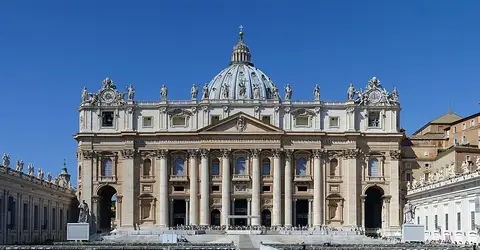 Historic sites01
The Dome at San Pietro Basilica
No address · Rome○ Website○ Phone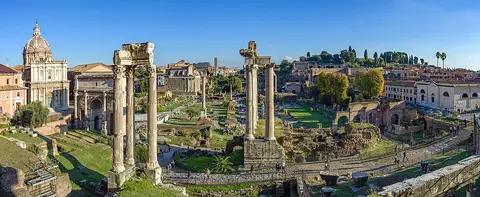 Historic sites02
Roman Forum
Via della Salara Vecchia, 5/6 · Rome● Website● Phone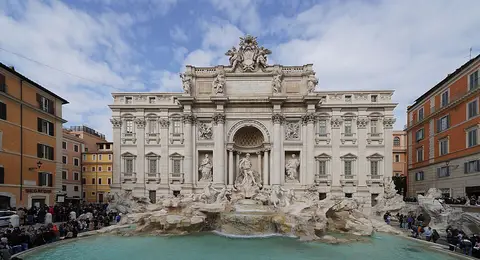 Historic sites03
Restauro Fontana di Trevi
Piazza di Trevi, 91 · Rome● Website○ Phone Monuments04
You need a free account to leave reviews and photos – that keeps comments genuine and lets you edit them later.