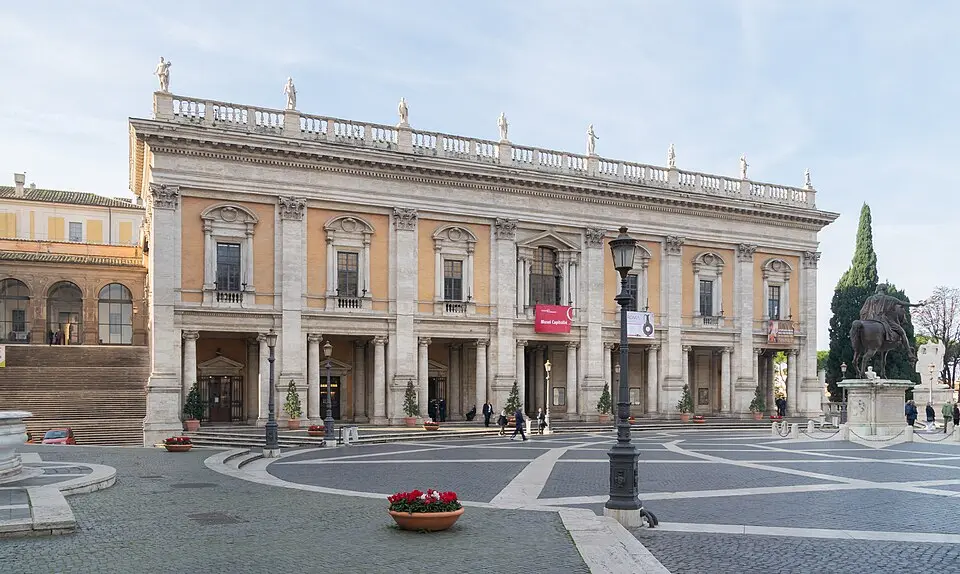
About Konservatorenpalast
The Palazzo dei Conservatori is a significant Renaissance building on Rome's Capitoline Square, and today it houses much of the Capitoline Museums. The building's history is closely tied to the political development of Rome, as it was the seat of the secular city government, the Conservators, until 1870. Since the sixteenth century, the palace has also served as a sculpture museum. Michelangelo Buonarroti shaped the architecture of the site with his redesign of the square beginning in 1537, integrating the building into a harmonious ensemble with the Palazzo Senatorio and the later Palazzo Nuovo. The facade features a colossal order with Corinthian pilasters and a portico supported by Ionic columns. A historic highlight is the Hall of the Horatii and Curiatii, where the Treaties of Rome establishing the European Economic Community were signed in 1957. Here, you'll experience a unique blend of ancient history, Baroque architecture, and modern European history.
At a glance
- Category
- Sight › Historic sites
- Rating
- no reviews yet · write a review
- Address
- —
Rome, Italy - District
- Roma I
- Phone
- —
- Website
- ru.wikipedia.org
- —
- Coordinates
- 41.89323° N · 12.48283° E
- Data quality
- confidence 0.81
- Identifier
- ID 63758b13-196…
Location & surroundings
Toggle layersFAQ about Konservatorenpalast
quick answersWhat is the Palazzo dei Conservatori in Rome?
The Palazzo dei Conservatori is an important Renaissance building on Capitoline Square (Piazza del Campidoglio) in Rome, and today it houses much of the Capitoline Museums. It stands in the Roma I district and is one of the historic sites of the Italian capital. Since the 16th century, the palace has served as a sculpture museum.
What is the historical significance of the Palazzo dei Conservatori?
Until 1870, the Palazzo dei Conservatori in Rome was the seat of the city's secular government, the so-called Conservators, after whom it is named. Its history is therefore closely tied to the political development of Rome. In 1957, the Treaties of Rome establishing the European Economic Community were also signed in the Hall of the Horatii and Curiatii.
What role did Michelangelo play in the Palazzo dei Conservatori?
Beginning in 1537, Michelangelo Buonarroti redesigned Capitoline Square in Rome and integrated the Palazzo dei Conservatori into a harmonious overall complex. This complex also includes the Palazzo Senatorio and the later-built Palazzo Nuovo. The facade of the Palazzo dei Conservatori features a colossal order with Corinthian pilasters and a portico supported by Ionic columns.
What can you see around the Palazzo dei Conservatori in Rome?
Around the Palazzo dei Conservatori on Capitoline Square in Rome, several attractions are just a few yards away. travelguide195 lists, among others, the Lupa Romana monument right at the palace, the Marcus Aurelius monument about 16 meters away, and the church of S. Maria d'Aracoeli about 42 meters away. The Palazzo Nuovo of the Capitoline Museums (about 45 meters) and the Palazzo Senatorio (about 48 meters) are also very close.
Are there restaurants near the Palazzo dei Conservatori?
Yes, you'll find a wide selection of restaurants around the Palazzo dei Conservatori in Rome. travelguide195 lists about 128 restaurants within 500 meters of the palace on Capitoline Square.
Ratings & comments
none yetNear Konservatorenpalast
closest 5 per category · 2 kmSights
Restaurants
Museums
Hotels
More:Historic sites in Rome (1,014)Sights in Roma I (642)All sights in Rome (1,312)
300 places within 2 km loaded.
Don't miss in Rome
All sights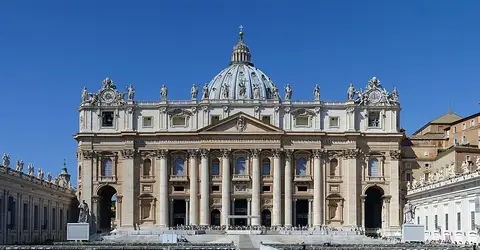 Historic sites01
The Dome at San Pietro Basilica
No address · Rome○ Website○ Phone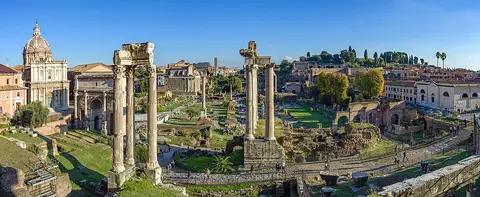 Historic sites02
Roman Forum
Via della Salara Vecchia, 5/6 · Rome● Website● Phone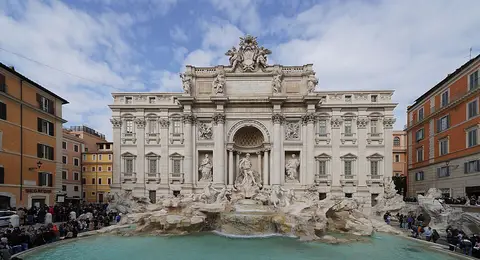 Historic sites03
Restauro Fontana di Trevi
Piazza di Trevi, 91 · Rome● Website○ Phone Monuments04
You need a free account to leave reviews and photos – that keeps comments genuine and lets you edit them later.
Also based on a Michelangelo architectural plan, this compact gallery is well endowed in classical sculpture and paintings. Highlights include the small 1st-century-BC bronze Lo Spinario , a Greek statue of a little boy picking a thorn from his foot; the Lupa Capitolina (Capitoline Wolf), a rare Etruscan bronze statue probably dating from the 5th century BC; and (in the entrance courtyard), the massive head, hands, foot and kneecap from a colossal statue of Constantine the Great. The palace also contains a Pinacoteca (Picture Gallery) with paintings mainly from the 16th and 17th centuries - highlights include: Caravaggio's Fortune-Teller and his curious John the Baptist; The Holy Family, by Dosso Dossi; Romulus and Remus, by Rubens; and Titian's Baptism of Christ.
Source: Wikivoyage, „Rome/Colosseo“ · authors per page history · CC BY-SA 4.0