About The Dome at San Pietro Basilica
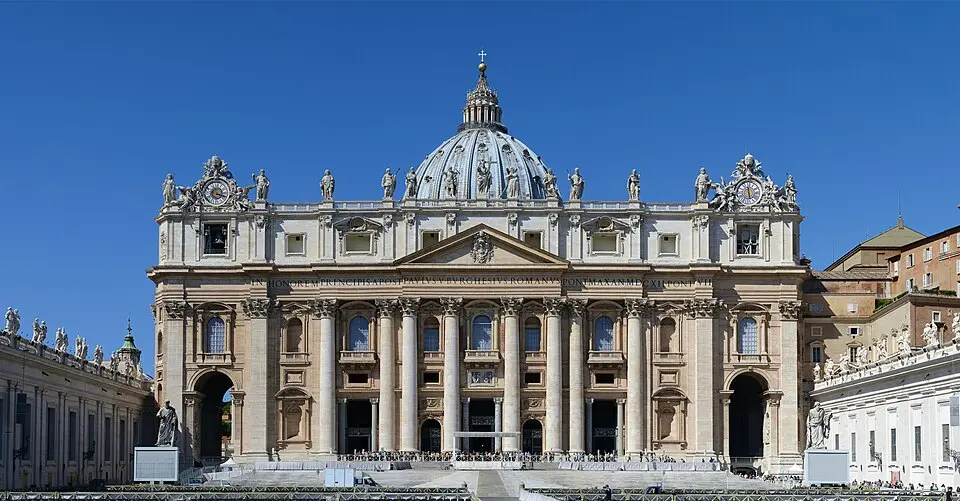
St. Peter's Basilica in Rome, also known as the Basilica of Saint Peter, is one of the most important and largest churches in the world. As the memorial church of the Apostle Simon Peter, it stands on the territory of the independent state of Vatican City and is one of the seven pilgrimage churches of Rome. With a built-up area of more than twenty thousand square meters and room for twenty thousand people, the structure is an architectural masterpiece that has stood at the center of the Catholic faith since the 16th century. Although the popes have resided nearby since the late 14th century, St. Peter's is neither the cathedral of the Diocese of Rome nor the highest-ranking church, as these roles have historically belonged to the Lateran Basilica. Even so, as a papal basilica and the former patriarchal basilica of the West, it enjoys a unique status in the Christian world.
The history of the site reaches far back into antiquity. In the first century A.D., Vatican Hill lay outside ancient Rome and served as a burial ground. Emperor Caligula built a circus here, where, according to tradition, the Apostle Peter was crucified and buried in the year 64. Archaeological excavations in the 20th century uncovered an ancient burial road beneath today's basilica, which had been filled in to make way for the first Christian church. These finds show that the site was already venerated as Peter's tomb in the early 2nd century, underscoring its spiritual significance.
The predecessor, Old St. Peter's, was built around the year 324 by Emperor Constantine the Great. This monumental five-aisled basilica with a transept was enormous for its time and served as the main church for many centuries. In the Middle Ages, the building suffered severe damage from warfare and plundering but was always rebuilt. In the 15th century, under Pope Nicholas V, the first renovation work began, though it did not lead to a complete rebuilding. The poor structural condition of the old building and the desire for a more impressive house of worship laid the groundwork for the decision to tear down the old basilica and build a new, even more imposing one.
Construction of the new building began in 1506 under Pope Julius II. The first design came from Donato Bramante, who originally planned a longitudinal building but then settled on a centrally planned structure with a Greek-cross floor plan and a central dome. After Bramante's death, various architects, including Raphael and Antonio da Sangallo, took over the project, with the plans alternating between Greek-cross and Latin-cross layouts. In 1547, Michelangelo Buonarroti took charge and fundamentally changed the design. He conceived a centrally planned building with four apses and designed the distinctive shape of the monumental main dome, which remains the basilica's landmark to this day.
After Michelangelo's death, Giacomo della Porta and other architects continued the work and completed the dome in 1591. Finally, under Carlo Maderno, it was decided to build a longitudinal structure in the form of a Latin cross, extending the eastern part of Michelangelo's design with a long nave. Maderno also designed the Baroque main façade, which was completed in 1612. The solemn consecration of the largely finished basilica took place in 1626 under Pope Urban VIII. Gian Lorenzo Bernini, who took over the artistic decoration after Maderno's death, created the famous bronze canopy over Peter's tomb and designed the surrounding St. Peter's Square with its iconic colonnades.
St. Peter's Square, designed by Bernini, is a transverse oval measuring 240 meters at its widest point. In the middle stands the Vatican Obelisk, which came from Caligula's circus and rests on a tall pedestal with four bronze lions. The colonnades surrounding the square are arranged symmetrically and bear 140 statues of saints. If you stand on the special markers in the pavement, the four rows of columns visually merge into a single line, creating an impressive architectural illusion. The square serves as a grand forecourt for papal audiences and major ceremonies.
The east façade of the basilica, designed by Carlo Maderno, is 115 meters wide and almost 46 meters high. It is divided into three stories and characterized by Corinthian pilasters and columns in a colossal order. Thanks to its stepped composition, the façade appears increasingly expansive. It is crowned by a balustrade with 13 statues, including Christ, John the Baptist, and eleven apostles. The two side bell towers were never completed and seem to merge with the façade. Today they hold large clocks designed by Giuseppe Valadier.
Inside the basilica, you will find a space of breathtaking scale. The nave is 98 meters long and is structured by monumental piers, on which stand larger-than-life statues of the founders of religious orders. The coffered barrel vault is decorated with gilded stucco. A particular highlight is the bronze statue of Saint Peter at the transition to the crossing, which pilgrims often touch, leaving the statue's right foot heavily worn. The space is richly decorated with mosaics, which together form the largest mosaic in the world.
The side aisles house several important chapels. In the north aisle is the Chapel of the Pietà, where Michelangelo's famous marble sculpture of the Pietà is displayed. The work, completed in 1499, shows Mary with the body of Jesus and has been protected behind bulletproof glass since an attack in 1972. Also in the north aisle is the Chapel of Saint Sebastian, where Pope John Paul II has been interred since 2011. The altarpieces and domes of these chapels are adorned with elaborate mosaics depicting scenes from the lives of the saints and biblical events.
In the south aisle you will find the Baptistery and the Chapel of the Presentation of Mary. In the Baptistery stands a baptismal font made from an ancient porphyry sarcophagus in which Emperor Otto II was once buried. The mosaics in the domes and on the walls of the chapels take up the themes of baptism and Marian devotion. The architecture and furnishings of St. Peter's bear witness to the collaboration of the greatest artists of their time and make the site an incomparable testimony to Christian art and history. Here, visitors experience not only religious stillness but also the immense splendor of a building shaped over the centuries by the vision of the popes and the talent of its architects.
At a glance
- Category
- Sight › Historic sites
- Rating
- no reviews yet · write a review
- Address
- —
Rome, Italy - Phone
- —
- Website
- —
- —
- Coordinates
- 41.90210° N · 12.45420° E
- Data quality
- confidence 0.71
- Identifier
- ID cd4e4f30-314…
Location & surroundings
Toggle layersFAQ about The Dome at San Pietro Basilica
quick answersWhat is The Dome at San Pietro Basilica in Rome?
The Dome at San Pietro Basilica is the monumental main dome of St. Peter's Basilica in Rome, one of the most important and largest churches in the world. St. Peter's Basilica stands within the independent state of Vatican City, serves as the memorial church of the Apostle Simon Peter, and is one of the seven pilgrim churches of Rome. The building covers an area of more than 20,000 square meters and can hold around 20,000 people.
Who designed the dome of St. Peter's Basilica in Rome?
The distinctive shape of the main dome of St. Peter's Basilica in Rome goes back to Michelangelo Buonarroti, who took over as head of construction in 1547. The new building had begun in 1506 under Pope Julius II with a design by Donato Bramante, who envisioned a centrally planned church with a Greek-cross floor plan and a central dome. After Bramante's death, Raphael and Antonio da Sangallo, among others, oversaw the construction before Michelangelo conceived a centrally planned church with four apses, whose dome remains the landmark of the basilica to this day.
What is the history of the site where St. Peter's Basilica in Rome stands?
St. Peter's Basilica in Rome stands on Vatican Hill, which in the 1st century AD lay outside ancient Rome and served as a burial ground. Emperor Caligula had a circus built there, in which, according to tradition, the Apostle Peter was crucified and buried in the year 64. Excavations in the 20th century uncovered an ancient street of tombs beneath the basilica, and around the year 324 Emperor Constantine the Great had the five-aisled predecessor, Old St. Peter's, built here.
What can you see around The Dome at San Pietro Basilica in Rome?
Around The Dome at San Pietro Basilica in Rome, several attractions lie just a few meters away. travelguide195 lists the Pietà di Michelangelo (about 34 m), the Vatican Necropolis (about 56 m), the Museo del Tesoro della Basilica di San Pietro (about 59 m), and the Monument to Alexander VII (about 76 m), among others. A little farther away you'll find the Scala Regia (about 100 m), the Bronze Doors (about 105 m), and the Paul VI Audience Hall (about 130 m).
Are there restaurants near St. Peter's Basilica in Rome?
Yes, there are numerous restaurants around The Dome at San Pietro Basilica in Rome. travelguide195 lists about 104 restaurants within 500 meters of St. Peter's Basilica.
Ratings & comments
none yetNear The Dome at San Pietro Basilica
closest 5 per category · 2 kmSights
Restaurants
Museums
Hotels
300 places within 2 km loaded.
You need a free account to leave reviews and photos – that keeps comments genuine and lets you edit them later.
The centre of the Catholic world, this magnificent basilica with its Michelangelo-designed dome has an awe-inspiring interior. This place is huge, but everything is in such proportion that the scale escapes you. However, contrary to popular belief, it is not the Pope's cathedral; that honour lies with the Archbasilica of Saint John Lateran in San Giovanni.
Source: Wikivoyage, „Rome/Vatican“ · authors per page history · CC BY-SA 4.0 · as of 8/19/2022