About Időkerék
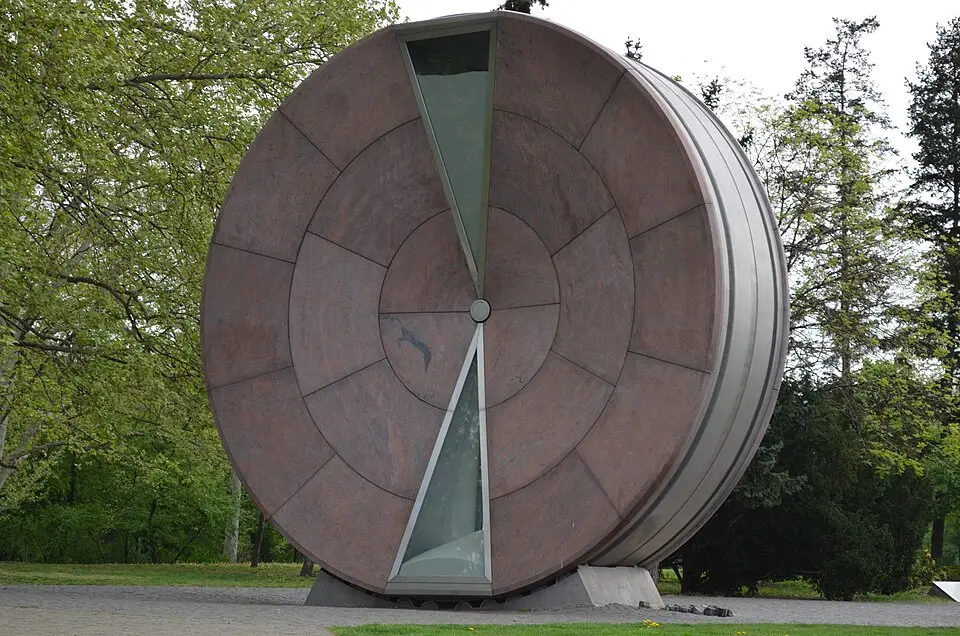
The Időkerék, or Time Wheel, was a monumental hourglass in Budapest that was considered one of the largest of its kind in the world. The wheel, which measured eight meters (26 ft) in diameter and two and a half meters (8 ft) in width, was made of stainless steel, laminated safety glass, and red granite, and weighed sixty metric tons in total. It stood at the edge of City Park near Heroes' Square and symbolically celebrated Hungary's accession to the European Union in 2004. The structure comprised two laminated-glass containers holding 4.5 cubic meters of glass granules. Unlike ordinary sand, these granules consisted of uniformly sized, impact-resistant grains that flowed at a defined rate in pressurized nitrogen and spared the inner surfaces of the containers. A central control mechanism compensated for the effects of weather and accounted for leap years.
The idea for the Time Wheel came from cultural historian János Herner, who had originally conceived it as a movable object that would slowly roll through the city over the course of decades. Because construction projects beneath the streets made this unfeasible, the monument was anchored permanently in the ground. Construction was handled by a specialized stonemasonry firm that had already worked on the restoration of important Budapest landmarks. Particularly challenging was the development of a mechanism that allowed two people to manually rotate the heavy hourglass by 180 degrees once a year on New Year's Eve to restart the cycle. At the unveiling, visitors could symbolically contribute a spoonful of granules and received a certificate with a code that let them follow the progress of their "own time" online.
Despite its showpiece character, the Time Wheel was controversial among the public. Critics accused the government of building an expensive prestige project that also frequently required maintenance. Problems with water seeping in led to shutdowns, which were officially described as necessary repairs. In addition, the surrounding grounds often turned into a bog when it rained, making access difficult. In summer 2021, the hourglass was dismantled as part of a park renovation. Whether and where it will be rebuilt in the future is currently unclear.
At a glance
- Category
- Sight › Monuments
- Rating
- no reviews yet · write a review
- Address
- 56-osok tere
1146 Budapest, Hungary - District
- City Park
- Phone
- —
- Website
- hu.wikipedia.org
- —
- Coordinates
- 47.51322° N · 19.07895° E
- Data quality
- confidence 0.96
- Identifier
- ID 08b1894e-b28…
Location & surroundings
Toggle layersFAQ about Időkerék
quick answersWhat is the Időkerék in Budapest?
The Időkerék, or "Time Wheel," was a monumental hourglass on the edge of City Park (Városliget) in Budapest and was considered one of the largest hourglasses in the world. The wheel had a diameter of eight meters, was two and a half meters wide, and weighed sixty tons in total, built from stainless steel, laminated safety glass, and red granite. It stood near Heroes' Square at 56-osok tere and symbolically celebrated Hungary's accession to the European Union in 2004.
Can you still visit the Időkerék in Budapest today?
No, the Időkerék was dismantled in the summer of 2021 as part of a park renovation in City Park in Budapest. Whether and where the monumental hourglass will be rebuilt in the future is currently unclear.
How did the Időkerék hourglass in Budapest work?
Instead of sand, the Időkerék in Budapest used around 4.5 cubic meters of glass granules in two containers made of laminated glass. The impact-resistant grains, all the same size, trickled at a defined speed through pressurized nitrogen, and a central control mechanism compensated for weather influences and accounted for leap years. Once a year, on New Year's Eve, two people manually turned the heavy clock by 180 degrees to restart the cycle. The idea came from cultural historian János Herner, who originally envisioned the time wheel as an object that would roll through the city over the course of decades.
Why was the Időkerék in Budapest controversial?
Many critics saw the Időkerék in Budapest as an expensive prestige project of the government that also had to be serviced frequently. Water seeping in repeatedly caused shutdowns, which were officially explained as necessary repairs. In addition, the area around the time wheel in City Park often turned into a bog when it rained, making access difficult.
What can you see around the former site of the Időkerék in Budapest?
Several museums and monuments are within walking distance of the former site of the Időkerék in City Park in Budapest. travelguide195 lists, among others, the Museum of Ethnography (Néprajzi Múzeum) about 118 meters away, the Kunsthalle (Műcsarnok) about 123 meters away, the ice hockey memorial collection Pásztor György Magyar Jégkorong Emléktár about 169 meters away, and the Millennium Monument (Millenniumi Emlékmű) on Heroes' Square about 181 meters away. Within a 500-meter radius, travelguide195 also lists around 35 restaurants.
Ratings & comments
none yetNear Időkerék
closest 5 per category · 2 kmSights
Restaurants
Museums
Hotels
More:Monuments in Budapest (92)All sights in Budapest (876)
253 places within 2 km loaded.
You need a free account to leave reviews and photos – that keeps comments genuine and lets you edit them later.
One of the world's largest hourglasses. It is made of granite, steel, and glass, and weighs 60 tons. The "sand" (actually glass granules) flows from the upper to the lower glass chamber for one year. The sand runs out on New Year's Eve and the Timewheel is then turned 180 degrees so the flow of the sand can resume for the next year. The turning is accomplished by four people pulling cables, and takes roughly 45 minutes to complete. The Timewheel was unveiled on 1 May 2004 to commemorate the historic enlargement of the European Union that admitted Hungary (along with nine other countries) to the EU. János Herner thought up and built the Timewheel after an architectural design done by István Janáky.
Source: Wikivoyage, „Budapest/Városliget“ · authors per page history · CC BY-SA 4.0 · as of 6/12/2019