Museum · Art museums
Museum of Fine Arts
Szépművészeti Múzeum, Dózsa György út 41, 1146 Budapest
About Museum of Fine Arts
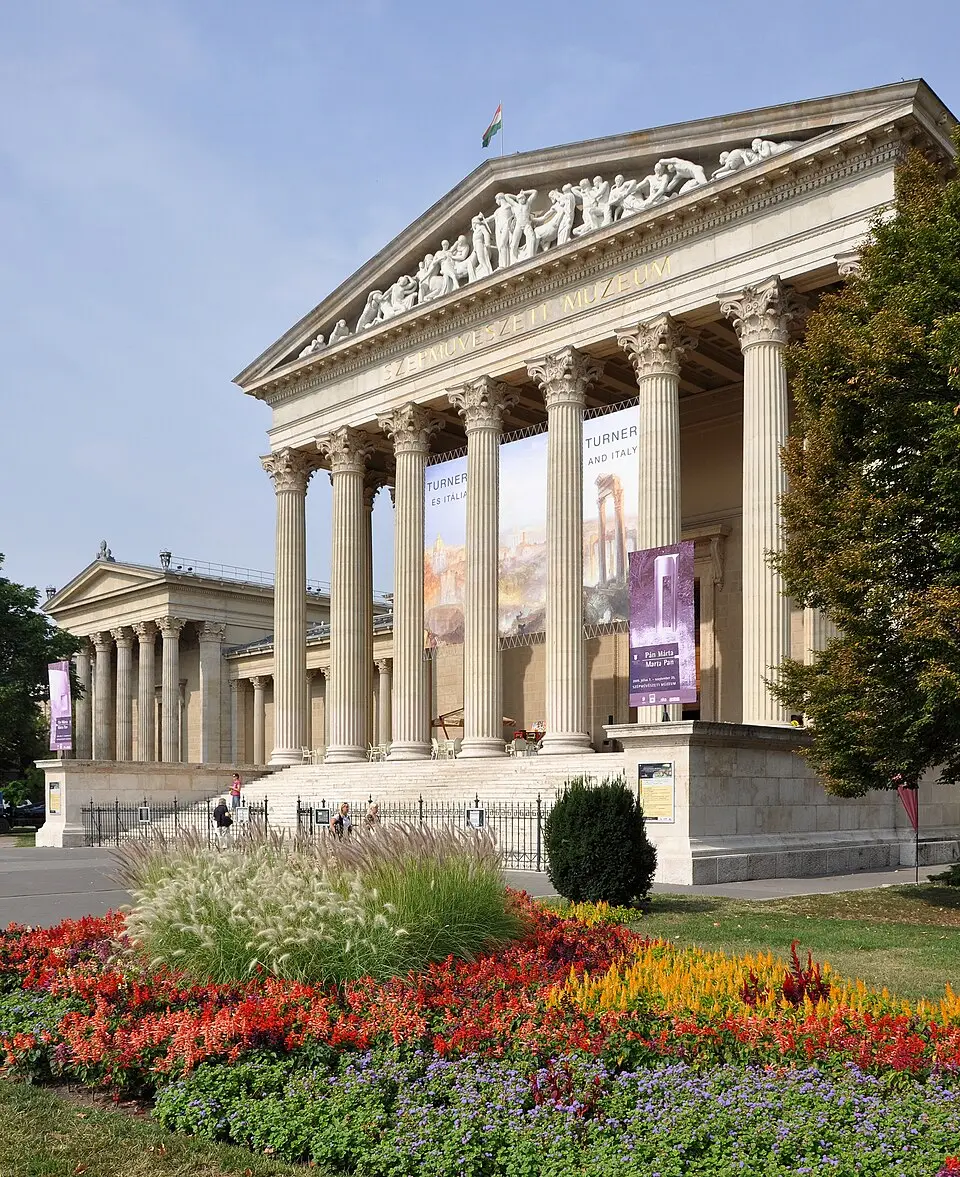
The Szépművészeti Múzeum, often called the Museum of Fine Arts in English, is Hungary's most important art museum and stands on Heroes' Square in Budapest. The neoclassical building was constructed between 1900 and 1906 by the architects Albert Schickedanz and Fülöp Herzog. It was built to mark the country's millennium celebrations and was formally opened on December 1, 1906, in the presence of King Franz Joseph. With a collection of more than 120,000 works of Hungarian and international art ranging from antiquity to the 18th century, the institution is considered one of the most important museums in Europe. Opposite the museum stands the Hall of Art (Műcsarnok), which completes the cultural ensemble of Heroes' Square.
The history of the collection reaches far back to the time before the present building was constructed. As early as the early 19th century, the Hungarian state benefited from donations by private collectors who gave their holdings to the people. It began in 1802, when Count Ferenc Széchényi founded the Hungarian National Museum, which also housed works of art from an early date. Over the following decades, the collection grew steadily through further gifts and purchases. Especially significant were the donations of the Pest collector Miklós Jankovich and of László Pyrker, Archbishop of Eger, which brought in valuable works of non-Hungarian origin.
A milestone in the history of the collection was the Hungarian state's purchase of the world-famous Esterházy collection in 1870 and 1871. This collection comprised hundreds of paintings, thousands of drawings, and tens of thousands of prints, including works by Raphael, Correggio, and Rubens. Because the existing premises were not large enough to present these treasures properly, parliament decided in 1896 to found a national museum of its own for the fine arts and to build a new home for it. The competition for the design was held in 1898, and construction began in the summer of 1900.
After its opening in 1906, the museum displayed an impressive collection of paintings, drawings, and prints from the very start. This was complemented by a collection of plaster casts documenting the development of sculpture from antiquity to the 19th century. In the years leading up to World War II, the museum expanded its holdings continuously. In 1901, for example, it acquired the extensive estate of the painter István Delhaes, which included drawings by German and Austrian artists. Between 1908 and 1913, particular emphasis was placed on enriching the antiquities collection with original Greek, Roman, and Italian sculptures from the Paul Arndt collection in Munich.
Egyptian antiquities also came into Hungarian state ownership during this period, after a Polish Egyptologist excavated them and handed them over to the museum. Other important additions included the bequest from the estate of Count János Pálffy in 1912, which contained Old Master paintings by Titian and Paolo Veronese, as well as the purchase in 1914 of the estate of the Hungarian sculptor István Ferenczy. Among other things, this included the so-called Budapest Horseman, which many regard as an autograph work by Leonardo da Vinci. In the 1930s, holdings from other museums were also transferred to the Szépművészeti Múzeum, since it had been designated by law as the central repository for ancient monuments.
World War II caused severe damage to the museum. In the last months of the war in 1944, the director at the time had the most valuable part of the holdings carried off to Germany, during which many paintings were damaged and some panels remain lost to this day. In 1946 and 1947, however, most of the works returned, and the museum resumed operations immediately after the end of the war. In the postwar period, the museum secured further major works, including paintings from the Herzog collection with works by Corot, Monet, and Renoir. In 1953 it also received a large collection of German, Austrian, and Dutch painting of the 17th and 18th centuries.
From 1964, the museum took part in excavations in Nubia, which expanded the Egyptian collections so much that they had to be rearranged several times. A dramatic event occurred in 1983, when seven valuable paintings from the Old Masters collection were stolen, including works by Raphael and Tintoretto. Fortunately, the paintings were recovered after a short time and returned to the museum. From February 2015 to the end of October 2018, the museum closed for a comprehensive renovation, during which the permanent collections were also redesigned. In 2012, the Hungarian works of art from before 1800, which had been transferred to the Hungarian National Gallery in 1957, were reunited, and in 2018 they were returned to the restored building.
The Egyptian collection gives visitors a good overview of the development of ancient Egyptian art and presents works from almost every era. Highlights include the diorite upper body of a royal statue from the Middle Kingdom and a limestone male head from the New Kingdom, which is regarded as the collection's centerpiece. You can also see numerous stelae, painted mummy coffins, and statuettes. A remarkable necklace from the Ptolemaic period, made up of 36 small gold figures of the goddess Thoeris, forms a transition to the antiquities collection.
The antiquities collection consists mainly of Greek and Roman works of art, along with an important collection of Cypriot antiquities and works from Sicily and North Africa. Notable exhibits include a youth's torso from Perinthos, the so-called Budapest Dancer, and the torso of the Doryphoros by Polykleitos. The collection also contains more than a thousand small terracotta sculptures and ancient vessels. A showpiece is the so-called Grimani Jug, an early bronze jug from the 5th century B.C. The vase collection includes works by famous vase painters such as Exekias and the Andokides Painter.
The Old Masters Gallery is the heart of the museum and now holds more than 2,500 paintings. It presents an extensive overview of European painting from the 13th to the 18th century and ranks among the most important Old Master collections in the world. The collection is divided into national schools, with Italian works especially well represented. Here you will find masterpieces by Raphael, Titian, Paolo Veronese, Jacopo Tintoretto, and Giovanni Battista Tiepolo. Early Netherlandish, German, Flemish, French, Dutch, and Spanish painting are also represented by outstanding works by artists such as Pieter Bruegel the Elder, Albrecht Dürer, Peter Paul Rubens, Claude Lorrain, Rembrandt van Rijn, and Francisco de Goya.
Alongside the paintings, the collection of old sculpture is among the most admired holdings. It houses a large collection of mainly Italian masters, as well as significant works of German and Austrian sculpture from the 14th to the 18th century. The focus is on works from the workshops of Hans Multscher and Tilman Riemenschneider, as well as autograph works by artists such as Georg Raphael Donner and Franz Xaver Messerschmidt. The Italian section shines with works by Andrea del Verrocchio, Jacopo Sansovino, and the Budapest Horseman mentioned above.
With around 10,000 drawings and 100,000 prints, the graphic arts collection is among the largest of its kind in the world. It offers a comprehensive overview of European art history from the 14th to the 20th century. The most important sheets are Leonardo's Heads of Warriors, followed by works by Raphael, Titian, Albrecht Dürer, Rembrandt van Rijn, Paul Cézanne, Edgar Degas, Vincent van Gogh, and Pablo Picasso. This diversity makes the Szépművészeti Múzeum an essential destination for art lovers who want to experience the full breadth of European art history.
At a glance
- Category
- Museum › Art museums
- Rating
- no reviews yet · write a review
- Address
- Szépművészeti Múzeum, Dózsa György út 41
1146 Budapest, Hungary - District
- City Park
- Phone
- +36301508596
- Website
- www.mfab.hu
- info@szepmuveszeti.hu
- Coordinates
- 47.51576° N · 19.07679° E
- Data quality
- confidence 0.53
- Identifier
- ID c56f128b-c5d…
Location & surroundings
Toggle layersRatings & comments
none yetNear Museum of Fine Arts
closest 5 per category · 2 kmSights
Restaurants
Museums
Hotels
More:Art museums in Budapest (41)All museums in Budapest (284)
248 places within 2 km loaded.
You need a free account to leave reviews and photos – that keeps comments genuine and lets you edit them later.
It was built by the plans of Albert Schickedanz and Fülöp Herzog in an eclectic-neoclassical style, between 1900 and 1906. The museum's collection is made up of international art (other than Hungarian), including all periods of European art, and comprises more than 100,000 pieces. It has an incredible range of European artwork from Greek and Roman times to the present. It is best known for its Spanish collection, the largest accumulation of Spanish paintings outside Spain. There is a large Greek and Roman collection, an Egyptian collection, much Italian (also French, German and Dutch) sculpture, including a statue of a man on horseback by da Vinci. The collection is made up of older additions such as those from Buda Castle, the Esterházy and Zichy estates, as well as donations from individual collectors. The museum's collection is made up of six departments: Egyptian, Antique, Old sculpture gallery, Old master paintings gallery, Modern collection, Graphics collection.
Source: Wikivoyage, „Budapest/Városliget“ · authors per page history · CC BY-SA 4.0 · as of 6/11/2019