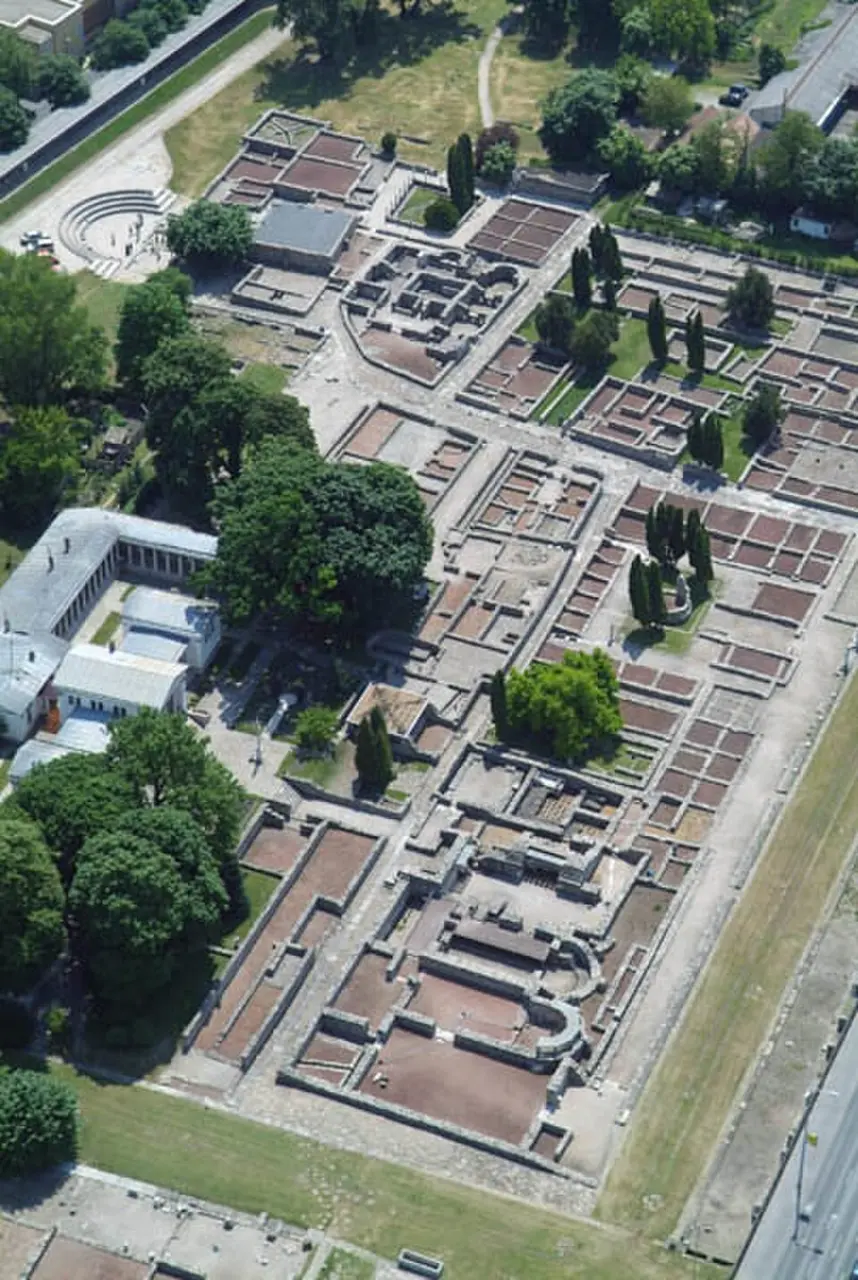
About Aquincum
Aquincum was the Roman predecessor of present-day Budapest. It lay in the northwest of today's city, in the Óbuda district, right on the banks of the Danube. As an important center of the province of Pannonia, the settlement served for centuries as a political, military, and economic hub. Its history was closely tied to its strategic position on the Danube, which formed the imperial frontier, the so-called Limes, during Roman rule. This was the seat of the governor of the province of Lower Pannonia, as well as the main camp of a legion. With several Roman roads converging here, Aquincum became an important crossroads and trading center, supplying not only the Roman province but also the neighboring regions beyond the border.
The natural conditions for the emergence of this city were exceptionally favorable. The site lay at a spot where the Danube, after a bend in its course, was easy to cross, which had made it an important transportation hub since prehistoric times. Sheltered by the Buda Hills and rich in natural resources such as springs and building materials, the location offered ideal conditions for intensive settlement. Human presence in this area goes back to the Middle Paleolithic, with permanent settlements already in the Neolithic. In the late Iron Age, the Celtic Eravisci built a fortified oppidum on Gellért Hill, which served as a central settlement and was known for its high-quality pottery and its own coinage.
The Roman conquest of the region of Pannonia was not a sudden break but a gradual process lasting decades. While the Celtic town on Gellért Hill was abandoned over the course of the first century AD, new settlements sprang up on the plain. At first these were simple villages and settlements of Roman veterans, craftsmen, and traders. Around the middle of the first century, the Romans established military bases and auxiliary camps that became part of the emerging Danube Limes. A major step was the construction of a large legionary fortress in the late first century, probably in AD 89, when the Legio II Adiutrix, with about 6,000 men, was transferred here. This fortress was later rebuilt in stone and remained the military core of the region for almost two centuries.
The stationing of the legion led to rapid development of the settlement. Around the fortified camp, a large civilian settlement grew up, the so-called canabae, where soldiers' families, merchants, and service providers settled. At the same time, a second, legally independent civilian town existed farther north, which received Roman municipal rights in the early second century. This dual structure was typical of many frontier camps of the Roman Empire. The northern town, which was designated a municipium and later a colonia, developed into the political center of the local administrative district. The canabae, by contrast, remained legally under military authority, even though they were often larger and more populous. Emperor Hadrian, who had himself served as a military tribune in Aquincum, granted the civilian town the status of a municipium in the second century, and its rank was later raised to that of a colonia, which brought the inhabitants considerable economic and legal advantages.
At a glance
- Category
- Sight › Historic sites
- Rating
- no reviews yet · write a review
- Address
- Szentendrei út 137
1031 Budapest, Hungary - Phone
- (06 1) 430 1081
- Website
- www.aquincum.hu
- —
- Coordinates
- 47.56376° N · 19.04936° E
- Data quality
- confidence 0.77
- Identifier
- ID fc3c74c1-fd2…
Location & surroundings
Toggle layersFAQ about Aquincum
quick answersWhat is Aquincum in Budapest?
Aquincum is the Roman predecessor of present-day Budapest and one of Hungary's most important historical sites. As the center of the province of Pannonia, it was a political, military, and economic hub for centuries. Aquincum was the seat of the governor of Lower Pannonia, and several Roman roads converged here, making the city an important trading center.
Where is Aquincum in Budapest?
Aquincum lies in the northwest of present-day Budapest in the Óbuda district, right on the banks of the Danube, at Szentendrei út 137. In Roman times, the Danube formed the frontier of the empire, known as the Limes. The site was located where the river bends and could be crossed easily, and it was protected by the Buda Hills and rich in water springs and building materials.
What role did the Roman legion play in Aquincum?
Aquincum was home to the main camp of a Roman legion, which served as the military core of the region for almost two centuries. Probably in AD 89, the Legio II Adiutrix, with about 6,000 men, was transferred here, and the camp was later rebuilt in stone. The civilian settlement of the Canabae grew up around the camp, while farther north there was a legally independent civilian town, which received Roman municipal rights in the early second century.
Who lived on the site of Aquincum before the Romans?
Long before the Romans, the area around Aquincum in Budapest was settled, with the first traces dating back to the Middle Paleolithic. Permanent settlements already existed in the Neolithic. In the late Iron Age, the Celtic Eravisci built a fortified oppidum on Gellért Hill, which was known for high-quality pottery and its own coins and was abandoned over the course of the first century AD.
What can you see around Aquincum in Budapest?
Around Aquincum in Budapest, there are more traces of the Roman era and the city's history. travelguide195 lists the Aquincum Archaeological Park with the legionary town and legionary camp about 124 meters away, the amphitheater of the civilian town (Aquincumi polgárvárosi amfiteátrum) about 429 meters away, and the former Óbudai Gázgyár gasworks about 524 meters away. For a break, travelguide195 also lists 5 restaurants within 500 meters.
Ratings & comments
none yetNear Aquincum
closest 5 per category · 2 kmSights
Restaurants
Hotels
Cocktail bars
None within 2 km.
More:Historic sites in Budapest (767)All sights in Budapest (876)
86 places within 2 km loaded.
You need a free account to leave reviews and photos – that keeps comments genuine and lets you edit them later.