About Andrássy út
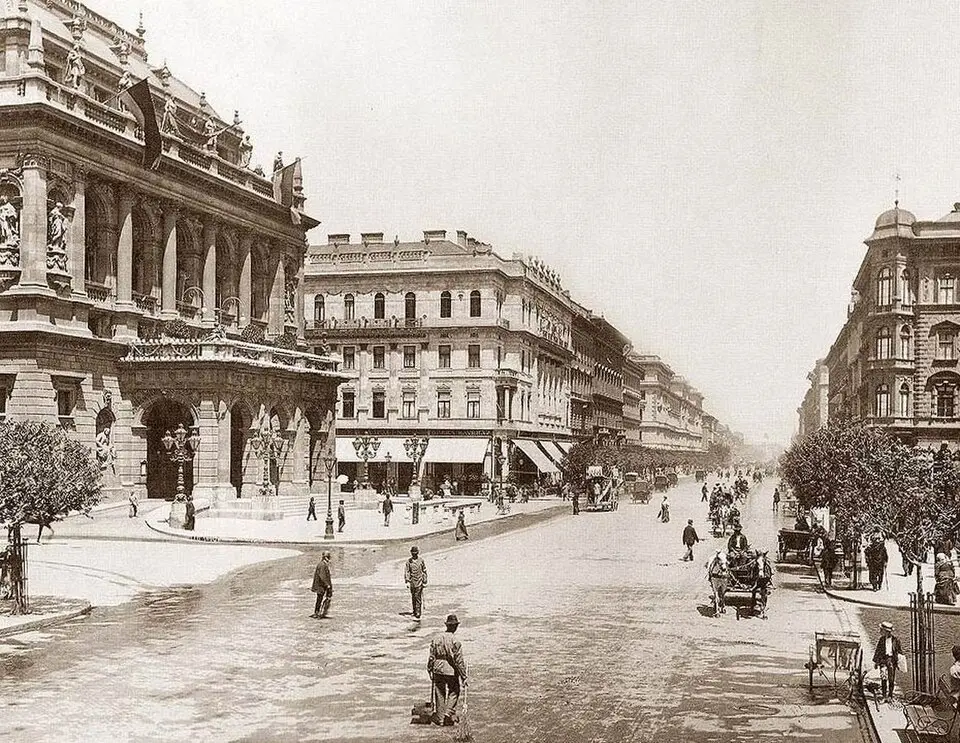
Andrássy út is considered Budapest's most famous grand boulevard, stretching about 1.4 miles (2.3 km) from the city center to Heroes' Square and City Park. Its origins go back to the 19th century, when the narrow Király utca could no longer handle the growing traffic. Inspired by a 1841 essay by Lajos Kossuth, which had proposed a tree-lined avenue between the city center and the parkland, Prime Minister Gyula Andrássy took up the project. After lengthy parliamentary debates, construction began in 1871 under the direction of Frigyes Podmaniczky. The street was designed in the style of eclectic Neo-Renaissance and planned by architects such as Miklós Ybl and István Linczbauer. While the economic crisis of 1873 initially slowed the work, it was later mainly the middle and upper classes as well as the high nobility who built stately buildings, especially in the outer section beyond the Grand Boulevard.
Today the street is divided into three distinct sections. The stretch between Deák Ferenc tér and Oktogon is a closed avenue lined with three-story apartment buildings, while the section up to Kodály körönd has somewhat lower buildings and tree-lined side lanes. In the last part toward Heroes' Square, the street opens into a broad, stately avenue flanked by palaces, villas, and gardens set in open layouts. Among the most important sights are the State Opera House, which opened in 1884, the traditional artists' coffeehouse Művész Kávéház, and the House of Terror, which now serves as a museum. Cultural institutions such as the Hungarian University of Fine Arts, the Hopp Museum of Asiatic Arts, and the Budapest Bábszínház, one of the largest puppet theaters in Europe, are also located along this route.
The historical significance of Andrássy út was recognized in 2002, when it was declared a UNESCO World Heritage Site together with the underground Földalatti, the oldest subway on the European continent. This subway was built in record time ahead of the 1896 millennium celebrations to handle the expected crowds heading to City Park. The street's name changed several times over the course of history, including in honor of Joseph Stalin during the Communist era, before it regained the name of the revolutionary and prime minister Gyula Andrássy after the political change of 1989. Today, visitors experience a mix of historic architecture, cultural attractions, and urban flair that makes up the appeal of this central axis of the Hungarian capital.
At a glance
- Category
- Sight › Historic sites
- Rating
- no reviews yet · write a review
- Address
- Andrássy út
1061 Budapest, Hungary - District
- 6th district
- Phone
- —
- Website
- zh.wikipedia.org
- —
- Coordinates
- 47.51041° N · 19.07160° E
- Data quality
- confidence 0.79
- Identifier
- ID f60e0ca3-220…
Part of the tour
Budapest in One Day: Castle Hill, the Danube and Andrássy út →Location & surroundings
Toggle layersFAQ about Andrássy út
quick answersWhat is Andrássy út in Budapest?
Andrássy út is Budapest's best-known grand boulevard, running about 2.3 kilometers from the city center to Heroes' Square and City Park. It lies in Budapest's 6th district and was designed in the eclectic Neo-Renaissance style. Since 2002, Andrássy út has been a UNESCO World Heritage Site together with the Földalatti beneath it, the oldest subway on the European continent.
How did Andrássy út in Budapest come about?
Andrássy út was built in the 19th century because the narrow Király utca could no longer handle the growing traffic. The idea came from an essay by Lajos Kossuth in 1841, and Prime Minister Gyula Andrássy took up the project later. Construction began in 1871 under the direction of Frigyes Podmaniczky, with plans drawn up by Miklós Ybl and István Linczbauer, among others. During the communist era the street was temporarily named after Joseph Stalin; after the political change of 1989 it was named after Gyula Andrássy again.
What sections does Andrássy út in Budapest have?
Andrássy út is divided into three sections, each with its own character. Between Deák Ferenc tér and Oktogon it is a closed avenue lined with three-story apartment buildings; as far as Kodály körönd, lower buildings and tree-lined side lanes follow. In the final stretch toward Heroes' Square it opens into a broad grand avenue with palaces, villas, and gardens in an open layout.
Which sights are located directly on Andrássy út in Budapest?
Andrássy út is home to some of Budapest's most important cultural institutions, above all the State Opera House, which opened in 1884. There is also the traditional artists' café Művész Kávéház and the House of Terror, which now serves as a museum. Along the route you will also find the Hungarian University of Fine Arts, the Hopp Ferenc Museum of Asiatic Arts, and the Budapest Puppet Theater, one of the largest puppet theaters in Europe.
What else can you visit around Andrássy út in Budapest?
Around Andrássy út in Budapest there are several museums and historic buildings within a short walk. travelguide195 lists, among others, the Zoltán Kodály Memorial Museum about 81 meters away, the Körönd Palace about 220 meters away, Q Contemporary about 222 meters away, the György Ráth Villa about 272 meters away, and the Postal Museum about 275 meters away. travelguide195 also lists around 42 restaurants within 500 meters, and the street is part of the tour "Budapest in One Day: Castle Hill, the Danube, and Andrássy út."
Ratings & comments
none yetNear Andrássy út
closest 5 per category · 2 kmSights
Restaurants
Museums
Hotels
More:Historic sites in Budapest (767)Sights in 6th district (59)All sights in Budapest (876)
293 places within 2 km loaded.
You need a free account to leave reviews and photos – that keeps comments genuine and lets you edit them later.