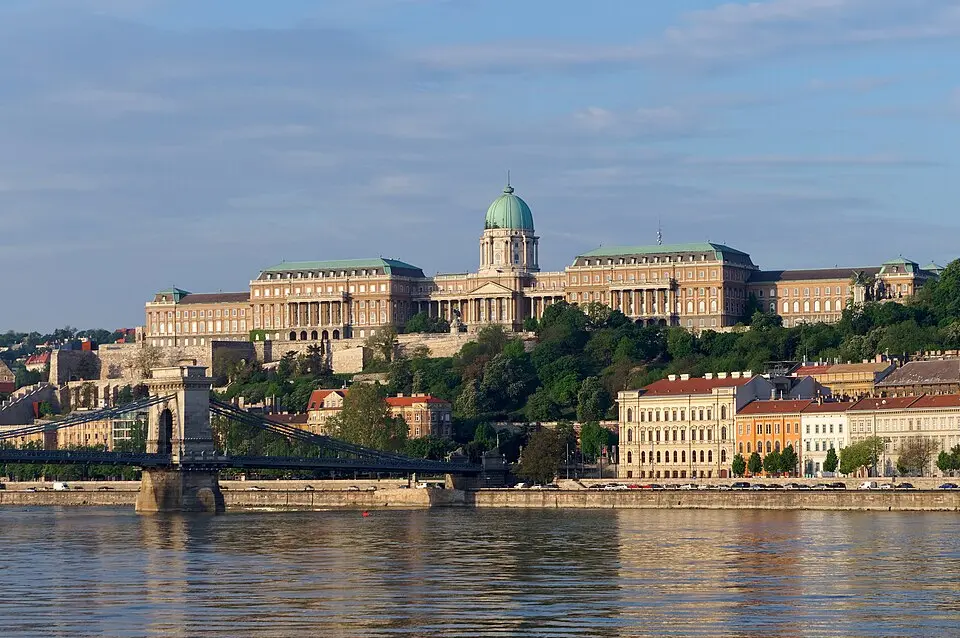
About Buda Castle
Buda Castle Palace in Budapest, known in Hungarian as Budavári Palota, sits atop the highest point of Buda Castle Hill and is considered the largest building in the country. For centuries, this historic complex was the residence and seat of government of the Hungarian kings, and it still defines the capital's skyline today. Since 1987, the palace has been part of a UNESCO World Heritage Site that also includes the banks of the Danube and Andrássy Avenue. The history of the complex dates back to the 13th century, when King Béla IV had a fortified town built on the plateau after the Mongol invasion. Remains of a Gothic palace from this early period are still visible today; it was later expanded by King Louis I.
Under King Sigismund, the castle went through its first major expansion in the early 15th century. The royal chancellery was moved from Visegrád to Buda, which made the palace a permanent residence. New courtyards and wings were added, including the famous Great Hall with its imposing dimensions. The fortified towers of the complex were also built during this era, and their foundations and floor plans can still be seen in the ground of the inner courtyard. Archaeological finds from this period, such as a collection of more than sixty restored Gothic statues, are now on display in the lower level of the National Museum and offer a glimpse into the artistic importance of the medieval residence.
The height of medieval splendor came under King Matthias Corvinus, who had the castle rebuilt in the early Renaissance style. Inspired by Florentine models, Italian craftsmen modernized the interiors with coffered ceilings and fireplaces. On the west side, a hanging garden was created above a barrel-vaulted cistern that still survives today. By attracting humanists, artists, and scholars, Buda Castle became the center of Renaissance culture in Central and Eastern Europe. The king's library, which held thousands of volumes, was famous far beyond the country's borders.
The Ottoman conquest in 1541 marked a deep break in the palace's history. During the following 145 years of occupation, the complex fell increasingly into disrepair. The grand rooms were converted into storerooms, powder magazines, or stables. A tragic event was the explosion of the powder magazine in 1578 after a lightning strike, which destroyed much of the palace and cost thousands of lives. It was not until 1686 that the Christian armies under Duke Charles V of Lorraine managed to retake the castle after a siege lasting months. The fighting left the complex almost completely destroyed, so rebuilding it in its old form was no longer possible.
Reconstruction began in the 18th century under the Habsburgs. After many ruins were cleared away, Charles III had a small Baroque palace built, which was expanded into a large residential palace under Maria Theresa. The completion of the palace was announced in 1770, after 56 years of work on the complex. The castle church dedicated to Saint Sigismund was also built during this period; beneath its crypt lies the Palatine Crypt, where members of the Hungarian branch of the Habsburgs are buried. These building projects gave the complex a new look, though it had not yet taken on the monumental form of later years.
The castle palace received its final Neo-Baroque appearance between 1891 and 1905 under Emperor Franz Joseph I. The court architect Alajos Hauszmann designed the façade and created a monumental suite of rooms in the long Danube wing, with a vestibule, a Great Ballroom, and a Ceremonial Hall. The palace became a four-wing complex that impressed with its magnificent interiors and a dome crowned by the Crown of St. Stephen. Iconic outdoor features were also added at this time, such as the Matthias Fountain, which tells a legend about the young King Matthias Corvinus, and the equestrian statue of Prince Eugene of Savoy on the Savoy Terrace.
World War II brought catastrophic destruction to the palace. During the Battle of Budapest in 1945, the complex became a main focus of the fighting because the German headquarters were housed in Castle Hill. The palace burned down almost completely, and many valuable art treasures were lost. After the war, the communist leadership decided to rebuild the palace, but with no regard for the historic fabric. Plain façades and a simplified dome replaced the Neo-Baroque splendor. Many surviving interiors were deliberately destroyed to make room for modern museum spaces, leading to the further loss of historic furnishings and ceiling paintings.
Despite this destruction, the reconstruction made new archaeological discoveries possible. Uncovering the old foundations beneath the later palace revealed historic rooms that had previously been unknown. The reconstructed Gothic Hall and the castle chapel in particular could be faithfully restored thanks to the surviving ground-floor walls and columns. This work brought a large piece of Budapest's seemingly lost history back to life. Since 1968, the excavated and restored parts of the old castle have been open to the public, and regular excavations continue to deepen the understanding of its complex building history.
Today, the castle palace houses several important cultural institutions. The Hungarian National Gallery occupies three wings and shows works of art from the early Middle Ages to the modern era. The southeastern wing is home to the Budapest History Museum, which documents the city's history from prehistoric times to the present and also sheds light on the development of the three separate towns that existed until 1873. Here you can also see remains of the medieval royal palace and the reconstructed parts of the fortifications, including the Mace Tower and the Gate Tower with its portcullis.
The Széchényi National Library, the largest and most important library in Hungary, has been housed in the northeastern wing since 1985. It holds millions of bibliographic items, including rare manuscripts and maps. A particular highlight is the Budapest Leaves, one of the oldest medieval songbook manuscripts, along with parts of the former library of Matthias Corvinus. The palace is also used for official occasions of the Hungarian government. Since 2014, the palace has been restored to its Neo-Baroque state as part of the National Hauszmann Program. Restoring the façade, the dome with the Crown of St. Stephen, and magnificent interiors such as the Great Throne Room is a long-term project meant to recover the historic dignity of the site.
There are several ways to reach the castle palace, such as via the Széll Kálmán tér metro station and the Várbusz, or the historic funicular that runs up from the Chain Bridge. The surrounding Castle District, with its medieval lanes and churches such as Matthias Church, makes an ideal setting for your visit. On St. George's Square right next to the castle, you will find more sights, including Sándor Palace, the seat of the Hungarian president, and Fisherman's Bastion. Beneath the castle there are also two cave systems dating back to the Turkish occupation and World War II, which can now be visited as a tourist attraction.
At a glance
- Category
- Sight › Castles
- Rating
- no reviews yet · write a review
- Address
- Szent György tér
1014 Budapest, Hungary - District
- Castle District
- Phone
- +3614583000
- Website
- whc.unesco.org
- —
- Coordinates
- 47.49619° N · 19.03961° E
- Data quality
- confidence 0.93
- Identifier
- ID b2012a61-d51…
Part of the tour
Budapest in One Day: Castle Hill, the Danube and Andrássy út →Location & surroundings
Toggle layersFAQ about Buda Castle
quick answersWhat is the Royal Palace (Buda Castle) in Budapest?
The Royal Palace, known in Hungarian as Budavári Palota, is the historic castle complex at the highest point of Buda Castle Hill in Budapest and is considered the largest building in Hungary. For centuries it was the residence and seat of government of the Hungarian kings. You'll find it in the Castle District at Szent György tér. Since 1987, the palace has been part of a UNESCO World Heritage Site that also includes the banks of the Danube and Andrássy Avenue.
What is the history of the Royal Palace in Budapest?
The history of the Royal Palace in Budapest goes back to the 13th century, when King Béla IV had a fortified town built on Castle Hill after the Mongol invasion. Under King Sigismund in the early 15th century, the castle was expanded into a permanent residence, and King Matthias Corvinus turned it into a center of Renaissance culture in Central and Eastern Europe, rebuilding it in the early Renaissance style. After the Ottoman conquest in 1541, the complex fell into disrepair during 145 years of occupation, and in 1578 the explosion of a powder magazine destroyed large parts of the palace. After the reconquest in 1686 under Charles V, Duke of Lorraine, the Habsburgs rebuilt the castle as a Baroque palace in the 18th century under Charles III and Maria Theresa.
What medieval traces can you still see at the Royal Palace in Budapest?
At the Royal Palace in Budapest, remains of a Gothic palace that was expanded under King Louis I are still visible today. Of the fortified towers from the time of King Sigismund, you can make out foundations and floor plans in the ground of the inner courtyard. From the Renaissance under Matthias Corvinus, the barrel-vaulted cistern has been preserved, above which a hanging garden once lay. In addition, a collection of more than sixty restored Gothic statues bears witness to the artistic importance of the medieval residence.
What can you see around the Royal Palace in Budapest?
Around the Royal Palace in Budapest's Castle District, several attractions are just a few steps away. travelguide195 lists, among others, the Statue of Prince Eugene of Savoy (about 46 m), the Lion Courtyard Oroszlános udvar (about 72 m), the Szent István Hall (about 105 m), the Castle Museum BTM Vármúzeum (about 111 m) and the Testőrpalota (about 150 m).
Are there restaurants and tours at the Royal Palace in Budapest?
Yes, travelguide195 lists about 31 restaurants within 500 meters of the Royal Palace in Budapest. If you'd like to combine your visit with other highlights, the palace is part of the tour "Budapest in One Day: Castle Hill, Danube and Andrássy út."
Ratings & comments
none yetNear Buda Castle
closest 5 per category · 2 kmSights
Restaurants
Museums
Hotels
More:All sights in Budapest (876)
291 places within 2 km loaded.
You need a free account to leave reviews and photos – that keeps comments genuine and lets you edit them later.
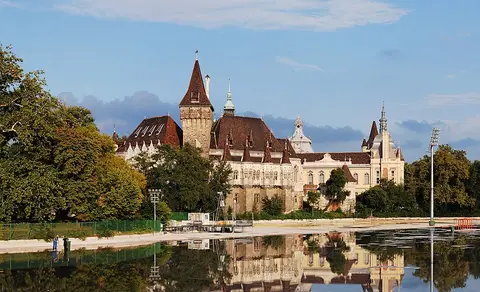
Originally the residence of the kings of Hungary, this palace was rebuilt in 1769 as the main residence of the Austro-Hungarian emperors in Hungary. It now houses the Hungarian National Gallery and the Museum of Budapest, and is a .
Source: Wikivoyage, „Monarchies“ · authors per page history · CC BY-SA 4.0