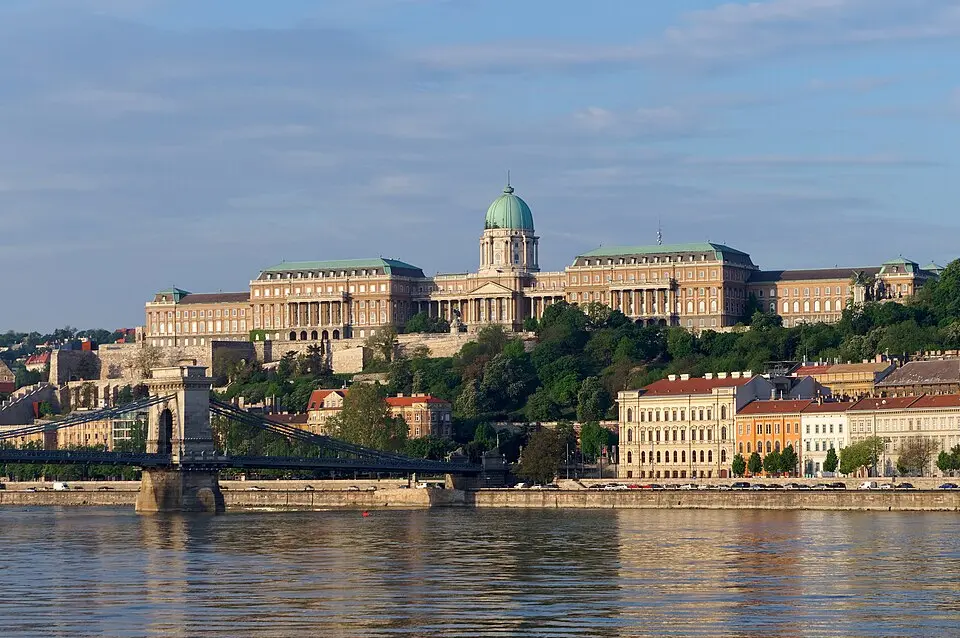
About Budavári Palota
Buda Castle Palace in Budapest, known in Hungarian as Budavári Palota, is the former residence of the Hungarian kings and today the largest building in the capital. It sits atop the highest point of Buda Castle Hill in the historic Castle District, and its massive silhouette defines the city skyline. As part of a UNESCO World Heritage site, the palace draws visitors from around the world, who can experience history, architecture, and art here in a very compact space. The complex is far more than a single building; it comprises an intricate structure of courtyards, wings, and historic remains that were shaped and rebuilt by different rulers over the centuries.
The history of the site goes back to the 13th century. After the Mongol invasion of 1241, King Béla IV had a fortified town built on the plateau to secure the hill. A Gothic palace from this early phase, of which some remains survive, dates from this time. Later, around 1370, King Louis I expanded the complex into a new residence. Under King Sigismund, the palace underwent a major expansion in the early 15th century. The royal chancery was moved to Buda, and the castle became the permanent royal residence. This period saw the creation of the great Sigismund Courtyard, which was separated from the town by a deep moat. The Great Hall built at that time was, given its dimensions, one of the largest buildings of its day.
Another high point in the palace's development was the reign of King Matthias Corvinus in the 15th century. A great patron of the arts, he had the late medieval fortress transformed into a magnificent Renaissance palace. Italian humanists and artists came to Buda and modernized the interiors with coffered ceilings and new windows. The façades were expanded in the Italian style with loggias and balustrades. Matthias Corvinus made the castle a center of Renaissance culture in Central and Eastern Europe. His library, the Bibliotheca Corviniana, was famous far beyond the country's borders at the time.
The Ottoman occupation beginning in 1541 brought a slow decline of the complex. The rooms served as storehouses, powder magazines, or stables. An explosion in the powder magazine in 1578 destroyed large parts of the palace. Although the fortifications were strengthened, the palace itself continued to decay. It was not until 1686 that the castle was recaptured by Christian armies after a long siege. The fighting led to the almost complete destruction of the building. In the years that followed, the palace was not rebuilt; instead, large parts of it were torn down.
Reconstruction began under the Habsburgs. Starting in 1714, Charles III had a small Baroque palace built, which was expanded into a large residential palace under Maria Theresa. After 56 years of construction, the palace was completed in 1770. In the 19th century, the palace took on its present Neo-Baroque form. Emperor Franz Joseph I commissioned the architect Alajos Hauszmann to carry out a comprehensive rebuilding, which lasted from 1891 to 1905. Hauszmann created a monumental sequence of rooms in the Danube wing, consisting of a vestibule, a ballroom, and a ceremonial hall. The complex became a four-wing structure with a striking dome crowned by the Holy Crown of Hungary.
World War II once again brought destruction to the castle. During the Battle of Budapest in 1945, the palace was severely damaged because the German headquarters was located in the caves beneath the castle. After the war, the Communist leadership decided to rebuild the palace only in simplified form. Ornate façades and domes were replaced by plain forms, and many historic interiors were deliberately destroyed to make room for modern use. This reconstruction, carried out under the name of the architect István Janáky, defined the palace's appearance for decades.
Today Buda Castle Palace houses several important cultural institutions. The Hungarian National Gallery occupies three wings and displays works of art from the early Middle Ages to the modern era. The Budapest History Museum is devoted to the history of the city and the region and offers insights into the medieval remains of the royal palace. The National Széchényi Library, the largest library in Hungary, is housed in the northeastern wing. It preserves valuable manuscripts, including the Budapest Fragments, which are among the oldest medieval song manuscripts.
Under the National Hauszmann Program, the palace has been restored to its Neo-Baroque state since 2014. The goal is to recreate the original façade and the dome with the Holy Crown. Interiors such as the Great Ballroom and the Habsburg Hall are being reconstructed. The Riding Hall and the Main Guard building have already been rebuilt. These restoration works are intended to bring back the historic appearance of the Austro-Hungarian monarchy and strengthen the palace as a cultural center.
Visitors can explore the palace and its surroundings in many ways. The medieval Castle District, with its narrow lanes and Matthias Church, lies right next door. The Savoy Terrace offers sweeping views across the Danube. Important monuments stand here as well, such as the equestrian statue of Prince Eugene of Savoy and the figure of the Turul, a mythological bird that plays a central role in Hungarian history. The Matthias Fountain tells the legend of King Matthias and the peasant girl Ilona.
You can reach Buda Castle Palace by taking Metro Line 2 to Széll Kálmán tér station, from where buses or the funicular lead up the hill. At the foot of the hill you will find the restored Castle Garden Bazaar. Beneath the castle lie two cave systems that can be visited. One dates from the Ottoman occupation, while the other served as headquarters in World War II. These caves offer a fascinating glimpse into the military history of the site.
Buda Castle Palace is thus a place where the fortunes of Hungary are reflected across the centuries. From the medieval fortress to the Renaissance palace to the Neo-Baroque palace, the complex tells a story of power, destruction, and rebirth. The ongoing restoration work promises that the palace will shine even more impressively in its historic splendor in the future. For visitors, it is an essential stop for experiencing the cultural and historical depth of Budapest.
At a glance
- Category
- Sight › Castles
- Rating
- no reviews yet · write a review
- Address
- Budai Vár
1014 Budapest, Hungary - District
- Castle District
- Phone
- 06 20 439 7325
- Website
- budavar.btk.mta.hu
- —
- Coordinates
- 47.49620° N · 19.03954° E
- Data quality
- confidence 0.77
- Identifier
- ID 84d2acf5-8b6…
Location & surroundings
Toggle layersRatings & comments
none yetNear Budavári Palota
closest 5 per category · 2 kmSights
Restaurants
Museums
Hotels
More:All sights in Budapest (876)
290 places within 2 km loaded.
You need a free account to leave reviews and photos – that keeps comments genuine and lets you edit them later.
Originally the residence of the kings of Hungary, this palace was rebuilt in 1769 as the main residence of the Austro-Hungarian emperors in Hungary. It now houses the Hungarian National Gallery and the Museum of Budapest, and is a .
Source: Wikivoyage, „Monarchies“ · authors per page history · CC BY-SA 4.0