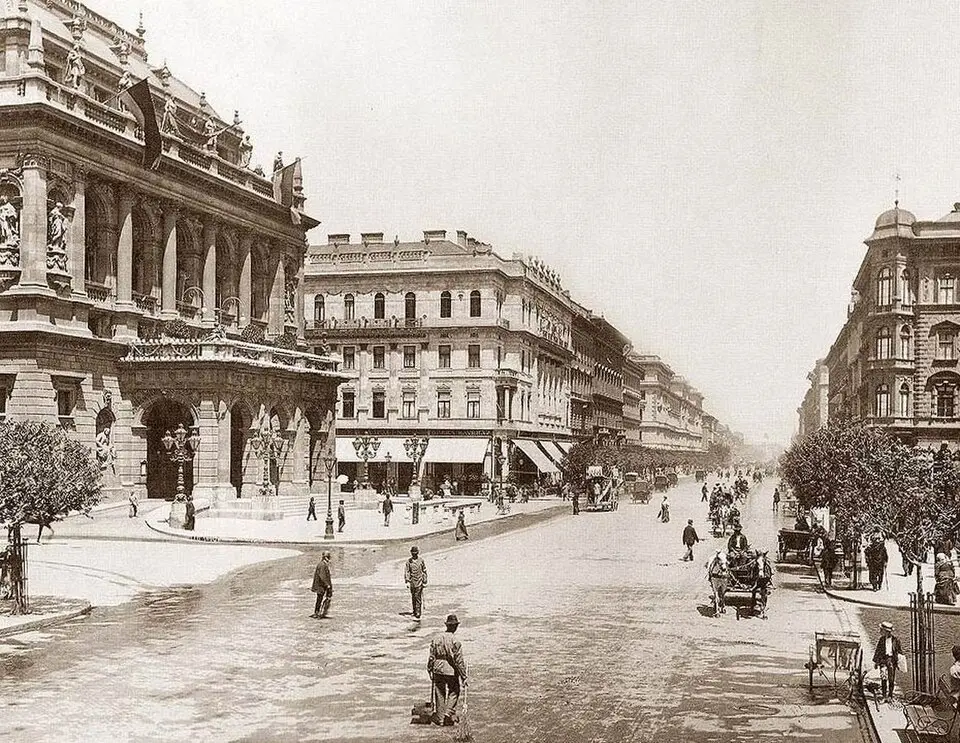
About Avenida Andrássy
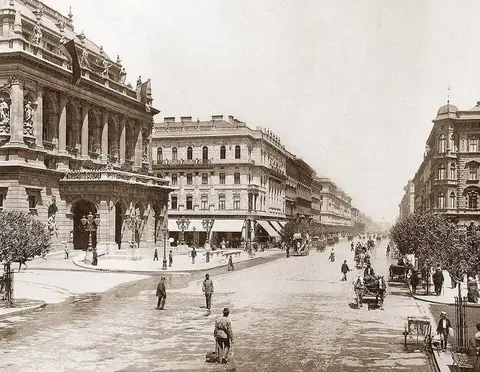
Andrássy Avenue is considered Budapest's most famous boulevard, stretching roughly 2.3 kilometers from the city center to Heroes' Square and City Park. It is named after the revolutionary and later prime minister Gyula Andrássy, who took up the idea of a green avenue between the city center and the park after the narrow Király utca could no longer cope with the growing traffic. Construction began in 1871 under the direction of Frigyes Podmaniczky, with architects such as Miklós Ybl and István Linczbauer ensuring a uniform eclectic Neo-Renaissance style. Despite initial resistance in parliament and the displacement of thousands of residents by demolition work, the avenue opened in 1876. Its original wooden-block paving was meant to spare horses' hooves, while the buildings shift from closed-block apartment houses in the inner section to detached villas and palaces in the outer stretch.
Today, visitors experience the avenue as a blend of historic architecture and lively culture. Between Deák Ferenc tér and Oktogon, three- to four-story buildings line the street, while farther out, palaces and gardens stretch along in an open layout. Notable sights include the State Opera House, which opened in 1884, the traditional artists' café Művész Kávéház, and Villa Schanzer. Cultural institutions such as the Ferenc Hopp Museum of Asiatic Arts, the Budapest Puppet Theater (Bábszínház), and the House of Terror, the former headquarters of the secret police, are also located here. The avenue is also home to the Földalatti, the oldest subway on the European continent, which was built beneath the roadway in record time in 1896 as part of the millennium celebrations.
The historic significance of Andrássy Avenue was recognized in 2002, when it was designated a UNESCO World Heritage Site together with the underground railway line. During the 20th century the avenue was renamed several times, including Sztálin út during the communist era, before regaining its original name after the political change of 1989. Today the avenue invites you to stroll along it and offers an impressive glimpse into Budapest's urban development at the end of the 19th century.
At a glance
- Category
- Sight › Historic sites
- Rating
- no reviews yet · write a review
- Address
- —
Budapest, Hungary - District
- 6th district
- Phone
- —
- Website
- —
- —
- Coordinates
- 47.51056° N · 19.07139° E
- Data quality
- confidence 0.81
- Identifier
- ID 66247222-e4c…
Location & surroundings
Toggle layersRatings & comments
none yetNear Avenida Andrássy
closest 5 per category · 2 kmSights
Restaurants
Museums
Hotels
More:Historic sites in Budapest (767)Sights in 6th district (59)All sights in Budapest (876)
293 places within 2 km loaded.
You need a free account to leave reviews and photos – that keeps comments genuine and lets you edit them later.