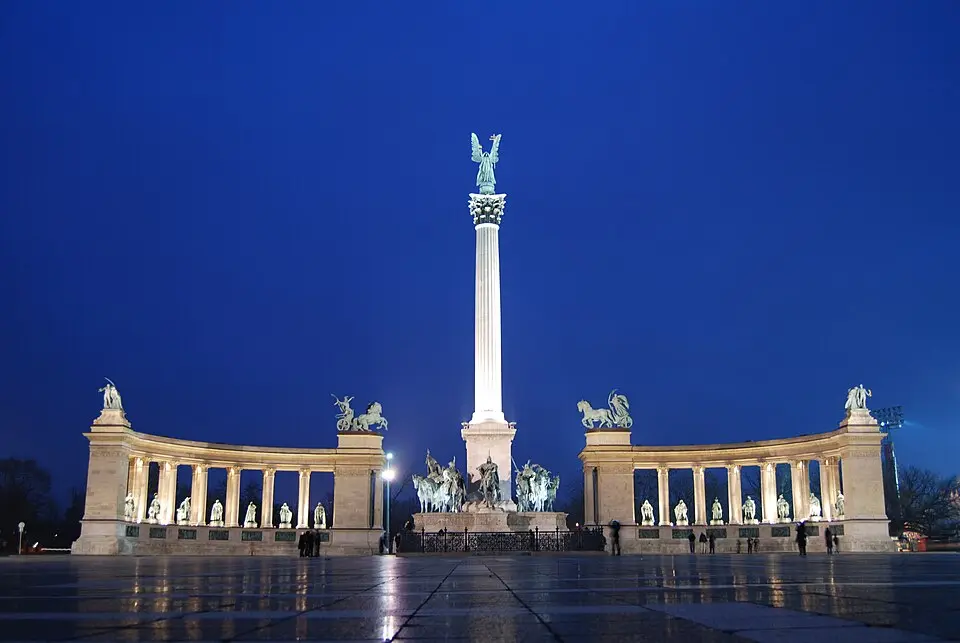
About Millenniumi Emlékmű
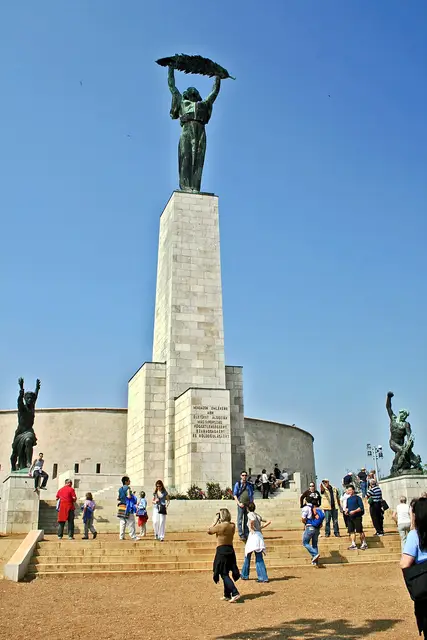
The Millennium Monument on Heroes' Square in Budapest is a major neoclassical ensemble commemorating the country's thousand-year anniversary. Built between 1896 and 1906, it is dominated by a 118-foot (36-meter) column topped by a figure of the Archangel Gabriel. He holds the Hungarian crown and the apostolic double cross, symbols of the legend of the transfer of sovereignty to the Hungarian people. At the foot of the column stand equestrian statues of Prince Árpád and six other tribal chieftains, representing the Hungarian conquest of the Carpathian Basin. Flanking the monument are two semicircular colonnades, each 13 meters (43 feet) high, which serve as a pantheon of Hungarian history. Between the columns stand statues of important figures from the earliest days through the late 19th century. Here you'll find a dense concentration of historical figures who reflect the country's national identity and political upheavals, including the replacement of statues of Habsburg rulers with those of freedom fighters during the Communist era.
At a glance
- Category
- Sight › Monuments
- Rating
- no reviews yet · write a review
- Address
- Budapest, Hősök tere, 1146 Hungary
Budapest, Hungary - District
- City Park
- Phone
- —
- Website
- —
- —
- Coordinates
- 47.51463° N · 19.07775° E
- Data quality
- confidence 0.95
- Identifier
- ID d2868c0f-841…
Location & surroundings
Toggle layersFAQ about Millenniumi Emlékmű
quick answersWhat is the Millenniumi Emlékmű in Budapest?
The Millenniumi Emlékmű, or Millennium Monument, is a neoclassical monument complex on Heroes' Square in Budapest that commemorates Hungary's thousand-year anniversary. It was built between 1896 and 1906. At its center stands a 36-meter-tall column flanked by two semicircular colonnades, each 13 meters high.
Which figures are depicted on the Millennium Monument in Budapest?
At the top of the Millennium Monument's column in Budapest stands the Archangel Gabriel, holding the Hungarian crown and the apostolic double cross. At the foot of the column, equestrian statues show Prince Árpád and six other tribal chieftains, representing the Hungarian conquest of the Carpathian Basin. Between the columns of the two colonnades stand statues of important figures from Hungarian history, from its beginnings to the late 19th century.
Why were statues replaced at the Millennium Monument in Budapest?
During the Communist era, statues of Habsburg rulers at the Millennium Monument in Budapest were replaced with figures of Hungarian freedom fighters. The colonnades serve as a kind of pantheon of Hungarian history. As a result, the figures reflect not only national identity but also the country's political upheavals.
Where is the Millennium Monument in Budapest?
The Millennium Monument stands on Heroes' Square (Hősök tere) in Budapest's City Park district. The address is Hősök tere, 1146 Budapest, Hungary. Within 500 meters, travelguide195 lists around 43 restaurants.
What can you see around the Millennium Monument in Budapest?
Right by the Millennium Monument in Budapest are several museums, most notably the Hall of Art (Műcsarnok), about 60 meters away. The Szépművészeti Múzeum (Museum of Fine Arts) with its Román Csarnok (Romanesque Hall) is roughly 150 to 200 meters away. travelguide195 also lists the Pásztor György Magyar Jégkorong Emléktár, a memorial collection on Hungarian ice hockey, as well as the Időkerék (Time Wheel) monument about 180 meters away.
Ratings & comments
none yetNear Millenniumi Emlékmű
closest 5 per category · 2 kmSights
Restaurants
Museums
Hotels
More:Monuments in Budapest (92)All sights in Budapest (876)
250 places within 2 km loaded.
You need a free account to leave reviews and photos – that keeps comments genuine and lets you edit them later.
This is one of Budapest's emblematic sights, part of the . Made for the 1000th birthday of Hungary in 1896. Dedicated to a handful of outstanding Hungarian statesmen, kings and heroes who tried to make Hungary a better place and a thriving independent country.
Source: Wikivoyage, „Budapest/Városliget“ · authors per page history · CC BY-SA 4.0 · as of 6/12/2019