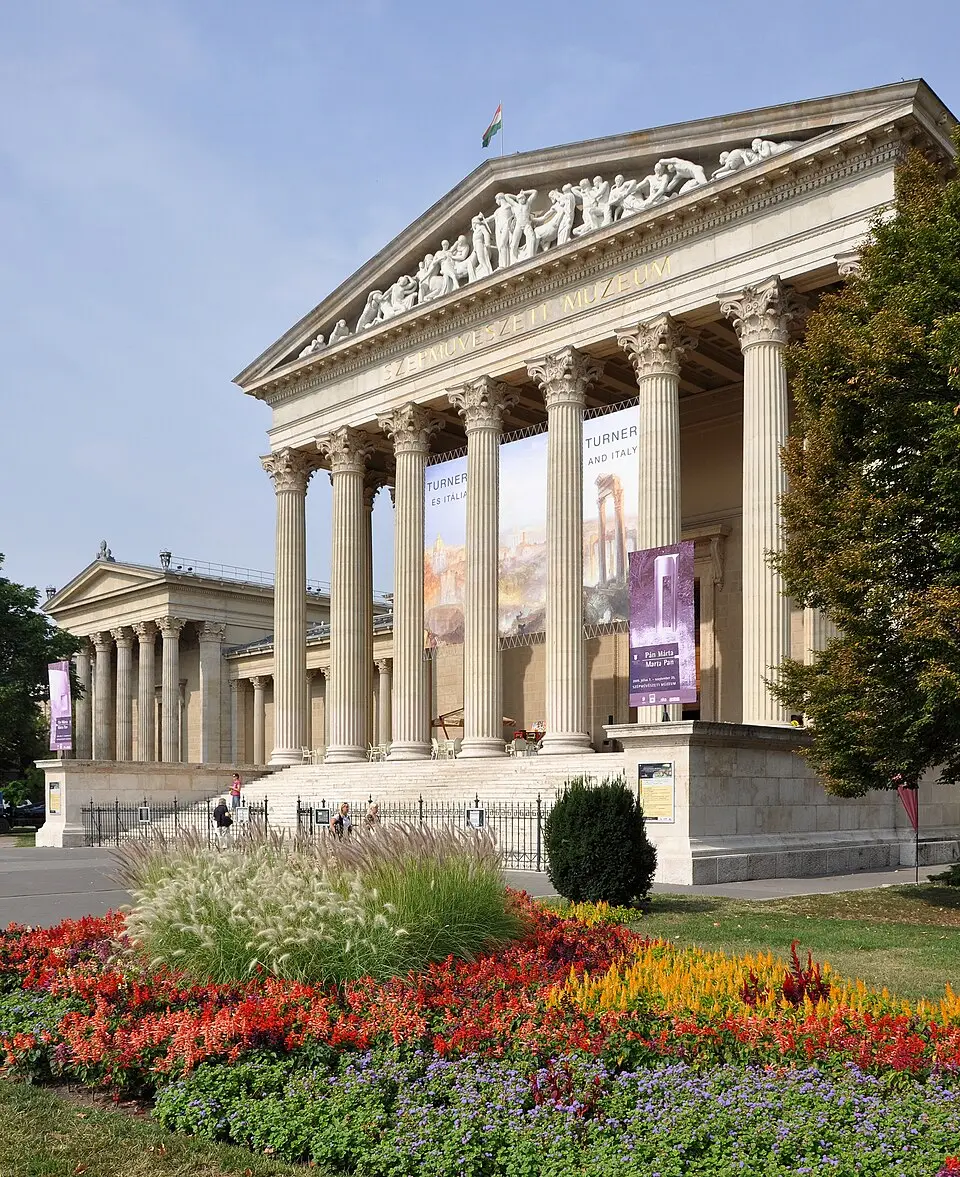
About Szépművészeti Múzeum
The Szépművészeti Múzeum, or Museum of Fine Arts, is Hungary's most important art museum and is located in the capital, Budapest. It stands on Heroes' Square in the 14th district and ranks among the most significant art collections in Europe. The neoclassical building was constructed between 1900 and 1906 and served as a stately showcase for national art during the millennium celebrations. Today it houses more than 120,000 works of Hungarian and international art spanning the period from antiquity to the 18th century. Across from the museum stands the Hall of Art (Műcsarnok), which makes Heroes' Square a cultural hub.
The museum's history reaches far beyond the construction of today's building. As early as 1802, Count Ferenc Széchényi donated the first public collection in Hungary, which later gave rise to the Hungarian National Museum. In the decades that followed, the holdings grew steadily through numerous donations and acquisitions. Particularly significant was the purchase of the world-famous Esterházy collection in 1870 and 1871, which, with hundreds of paintings and thousands of drawings, laid the foundation for a major national picture gallery. When the available space was no longer sufficient, Parliament decided in 1896 to build a new museum building.
The architect Albert Schickedanz designed the building, whose foundation stone was laid in the summer of 1900 and which was completed in 1906. On December 1, 1906, the museum was ceremoniously opened in the presence of King Franz Joseph. From the start, it displayed an impressive collection of paintings, drawings, and prints, as well as a collection of plaster casts documenting the development of sculpture. After an extensive renovation that lasted from 2015 to 2018, the permanent collections were redesigned. In the process, Hungarian artworks that had previously been housed in the National Gallery were returned to the museum.
A central part of the collection is the Old Masters Gallery, which, with more than 2,500 paintings, offers a comprehensive overview of European painting from the 13th to the 18th century. Highlights include works by Raphael, among them the so-called Esterházy Madonna, as well as paintings by Titian, Paolo Veronese, and Jacopo Tintoretto. Dutch and Flemish painting is also well represented, with works by Rembrandt, Frans Hals, and Pieter Bruegel the Elder. German masters such as Lucas Cranach the Elder, Albrecht Dürer, and Hans Baldung are likewise represented with important pieces.
Italian painting is represented by works by Giorgione, Gentile Bellini, and Correggio. Especially noteworthy are Gentile Bellini's portrait of Caterina Cornaro and a portrait of a young man attributed to Giorgione. Spanish artists such as Francisco de Goya and El Greco can also be found in the collection, as can French masters such as Claude Lorrain and Jean-Baptiste Greuze. This diversity makes the gallery one of the most important places for studying the history of European art.
Alongside the paintings, the museum houses a significant collection of old sculptures. It consists mainly of works by Italian masters, but also includes an extensive collection of German and Austrian sculpture from the 14th to the 18th century. Here you can see works from the workshops of Hans Multscher and Tilman Riemenschneider, as well as pieces made by the hand of Georg Raphael Donner. One special piece is the so-called Budapest Horseman, which many consider a work by Leonardo da Vinci. The collection traces the development of sculpture from the Gothic period to the Baroque.
The museum's antiquities collection includes Greek and Roman artworks as well as a significant collection of Cypriot antiquities. Highlights include a torso of a youth from Perinthos, the so-called Budapest Dancer, and the torso of the Doryphoros by Polykleitos. The vase collection is also of great importance, with works by famous vase painters such as Exekias and the Andokides Painter. A showpiece is the so-called Grimani Jug, an early bronze jug from the 5th century B.C. that was made on the Peloponnese.
The Egyptian collection offers a good overview of the development of ancient Egyptian art. It includes works from almost every era, including stelae, painted mummy coffins, and statuettes. A centerpiece of the collection is a limestone head of a man from the New Kingdom. Also remarkable is a necklace from the Ptolemaic period made up of 36 small gold figures of the goddess Thoeris. This collection was greatly expanded by excavations in Nubia in the 1960s and is now one of the most important of its kind in Central Europe.
The graphic arts collection is among the largest in the world and comprises roughly 10,000 drawings and 100,000 prints. It offers a comprehensive look at European art history from the 14th to the 20th century. Among the most significant sheets are Leonardo da Vinci's Heads of Warriors. The collection also contains works by Albrecht Dürer, Rembrandt van Rijn, Paul Cézanne, Edgar Degas, and Pablo Picasso. This diversity of media and eras makes the graphic arts collection an indispensable part of a museum visit.
At the Szépművészeti Múzeum, you'll experience a unique combination of architectural splendor and art-historical depth. The building itself bears witness to Hungarian national consciousness at the end of the 19th century. The redesigned permanent exhibitions allow a smooth transition between the various collections and eras. Whether you're interested in the fine details of Dutch still lifes, the dramatic power of Italian Baroque painting, or the timeless beauty of ancient sculpture, the museum has something for every art lover. It is a place where the history of European art comes alive.
At a glance
- Category
- Museum › Art museums
- Rating
- no reviews yet · write a review
- Address
- Dózsa György út 41.
1146 Budapest, Hungary - District
- City Park
- Phone
- (06 1) 469 7100
- Website
- www.szepmuveszeti.hu
- info@szepmuveszeti.hu
- Coordinates
- 47.51608° N · 19.07649° E
- Data quality
- confidence 0.77
- Identifier
- ID 14c09a43-a2d…
Part of the tour
Budapest's Great Art Collections in One Day →Location & surroundings
Toggle layersRatings & comments
none yetNear Szépművészeti Múzeum
closest 5 per category · 2 kmSights
Restaurants
Museums
Hotels
More:Art museums in Budapest (41)All museums in Budapest (284)
248 places within 2 km loaded.
You need a free account to leave reviews and photos – that keeps comments genuine and lets you edit them later.
It was built by the plans of Albert Schickedanz and Fülöp Herzog in an eclectic-neoclassical style, between 1900 and 1906. The museum's collection is made up of international art (other than Hungarian), including all periods of European art, and comprises more than 100,000 pieces. It has an incredible range of European artwork from Greek and Roman times to the present. It is best known for its Spanish collection, the largest accumulation of Spanish paintings outside Spain. There is a large Greek and Roman collection, an Egyptian collection, much Italian (also French, German and Dutch) sculpture, including a statue of a man on horseback by da Vinci. The collection is made up of older additions such as those from Buda Castle, the Esterházy and Zichy estates, as well as donations from individual collectors. The museum's collection is made up of six departments: Egyptian, Antique, Old sculpture gallery, Old master paintings gallery, Modern collection, Graphics collection.
Source: Wikivoyage, „Budapest/Városliget“ · authors per page history · CC BY-SA 4.0 · as of 6/11/2019