About Amis du Louvre
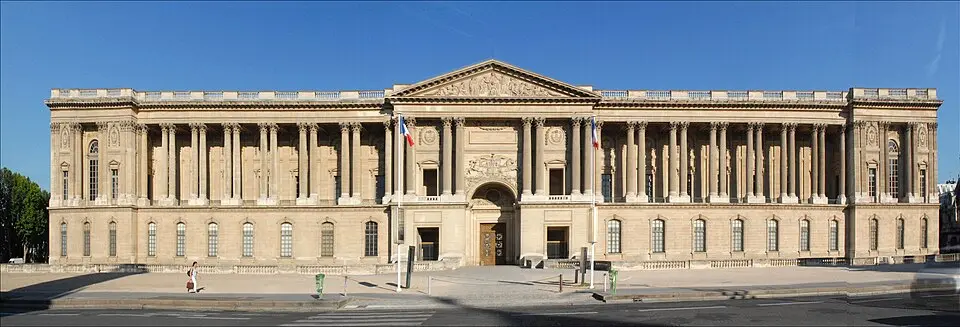
The Louvre Colonnade forms the east façade of the Louvre Palace in Paris and is considered one of the greatest masterpieces of French classical architecture. It was built mainly between 1667 and 1674 under the direction of the so-called Petit Conseil, a committee made up of Louis Le Vau, Charles Le Brun, and Claude Perrault. The design follows the strict rules of the ancient Roman architect Vitruvius and interprets them in a restrained, classicizing manner. Its most distinctive feature is the flat roofline, previously unknown in France and strongly influenced by Italian models. The façade presents a cool classicism, with a central pavilion and two flanking ones. The main entrance recalls a triumphal arch or a temple front, while the paired Corinthian columns rest on a high podium. This architectural concept, reminiscent of Bramante's House of Raphael, creates the impression of an ancient Roman temple whose façades have been flattened into a single plane.
The history of the planning was marked by controversial debates. Jean-Baptiste Colbert initially invited the Italian architect Gian Lorenzo Bernini, but the French architects rejected him. A committee was then appointed to draw up a new design, which King Louis XIV ultimately chose. The final form, in particular the doubling of the width of the south wing, is largely due to Claude Perrault. Today the colonnade overlooks the Place du Louvre, for which buildings had previously been demolished to create the necessary urban space. The pediment holds a sculpture by François-Frédéric Lemot that originally depicted Napoleon; his head was later replaced with that of Louis XIV, though the face was retained.
Inside the wing behind the colonnade, the architects Percier and Fontaine created monumental staircases and ceremonial rooms between 1807 and 1811. The architectural sculpture of the south staircase was created in the early 1810s by artists such as François Gérard. The façade took on a special historical note in 1964, when the dry moat in front of the colonnade was excavated again. This revealed the original podium, which had previously been filled in. Over the centuries, the Louvre Colonnade had an enormous influence on architecture and served as a model for numerous important buildings in Europe and America, including the U.S. Capitol in Washington, D.C., and the Metropolitan Museum in New York City.
At a glance
- Category
- Museum › Museums (general)
- Rating
- no reviews yet · write a review
- Address
- Palais du Louvre
75001 Paris, France - District
- 1st Arrondissement
- Phone
- +33140205334
- Website
- www.amisdulouvre.fr
- contact@amisdulouvre.fr
- Coordinates
- 48.86001° N · 2.33962° E
- Data quality
- confidence 0.91
- Identifier
- ID 712c8621-f98…
Location & surroundings
Toggle layersRatings & comments
none yetNear Amis du Louvre
closest 5 per category · 2 kmRestaurants
Museums
Hotels
More:Museums in 1st Arrondissement (59)All museums in Paris (525)
300 places within 2 km loaded.
You need a free account to leave reviews and photos – that keeps comments genuine and lets you edit them later.