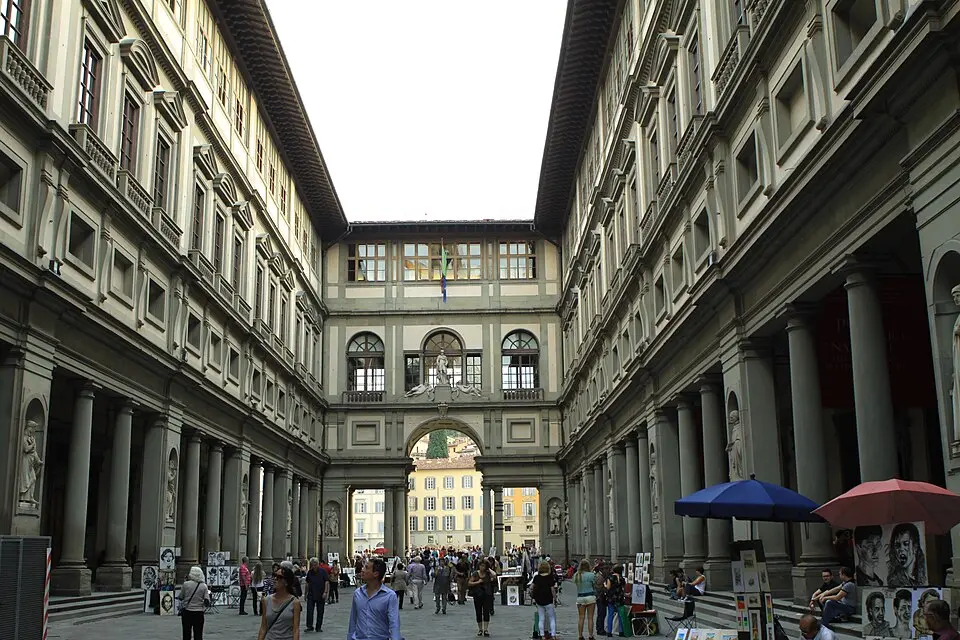
About Gli Uffizi
The Galleria degli Uffizi in Florence is one of the world's most important art museums and is considered the most visited cultural attraction in Italy. The complex of buildings was constructed between 1560 and around 1580 to plans by Giorgio Vasari, Bernardo Buontalenti, and Alfonso Parigi the Younger. The building, whose name derives from the Italian "uffizi," meaning offices, originally housed the most important ministries and offices of the Grand Duke of Tuscany. An entire city district was demolished to make way for the new construction, including the Romanesque church of San Piero Scheraggio. Vasari unified the jumble of old and new buildings by adding façades in front of them, creating a square that connects the Piazza della Signoria with the banks of the Arno. The ground floor once housed the workshops of craftsmen who worked for the princely court. It was here that the instrument maker Bartolomeo Cristofori developed the prototype of the piano from the harpsichord around 1698 by inventing the hammer action, making the Uffizi the birthplace of this instrument.
The collection itself goes back to the Medici family, who initially displayed their art treasures in the Palazzo Vecchio. Beginning in 1580, the famous Tribuna, an octagonal room open to the public, was built on the upper floor of the Uffizi. At the same time, the family's holdings were exhibited in the arcaded corridor of the galleria. Until 1737, the Medici added to their collection with works of painting and sculpture. After the death of the last Grand Duke, Anna Maria Luisa de' Medici bequeathed the family's personal property to the city of Florence on the condition that it never be removed from the city. As a result, the collections became permanently open to the public in 1743. Art historians often call the Uffizi the first museum in Europe, and the term "gallery" for a collection of paintings is also attributed to this place.
Today, the museum houses one of the most important art history collections on the third floor, with a focus on the painting and sculpture of the Italian Renaissance. The holdings also include works from the 13th to the 18th centuries by Flemish, Dutch, French, and German artists such as Hans Holbein the Younger, Rembrandt, and Jean Siméon Chardin. A special feature of the exhibition is the chronological arrangement of the rooms, which gives visitors a logical introduction to the art history of Western Europe. It begins with ancient Greek and Roman sculptures and leads through religious icons to the Renaissance and the modern era. Among the best-known exhibits is the Medici Venus, an ancient statue embodying the Venus pudica type. The Vasari Corridor, which connects the Uffizi with the Palazzo Pitti, also features an extensive collection of self-portraits. On the second floor is the collection of drawings and prints founded by Leopoldo de' Medici.
At a glance
- Category
- Sight › Historic sites
- Rating
- no reviews yet · write a review
- Address
- Piazzale degli Uffizi, 6
50122 Florence, Italy - District
- Quartiere 1
- Phone
- +390554939867
- Website
- —
- —
- Coordinates
- 43.76869° N · 11.25477° E
- Data quality
- confidence 0.26
- Identifier
- ID 591d2fcf-ace…
Location & surroundings
Toggle layersRatings & comments
none yetNear Gli Uffizi
closest 5 per category · 2 kmSights
Restaurants
Museums
Hotels
More:Historic sites in Florence (306)Sights in Quartiere 1 (320)All sights in Florence (418)
300 places within 2 km loaded.
You need a free account to leave reviews and photos – that keeps comments genuine and lets you edit them later.