About Patroclo e Menelao
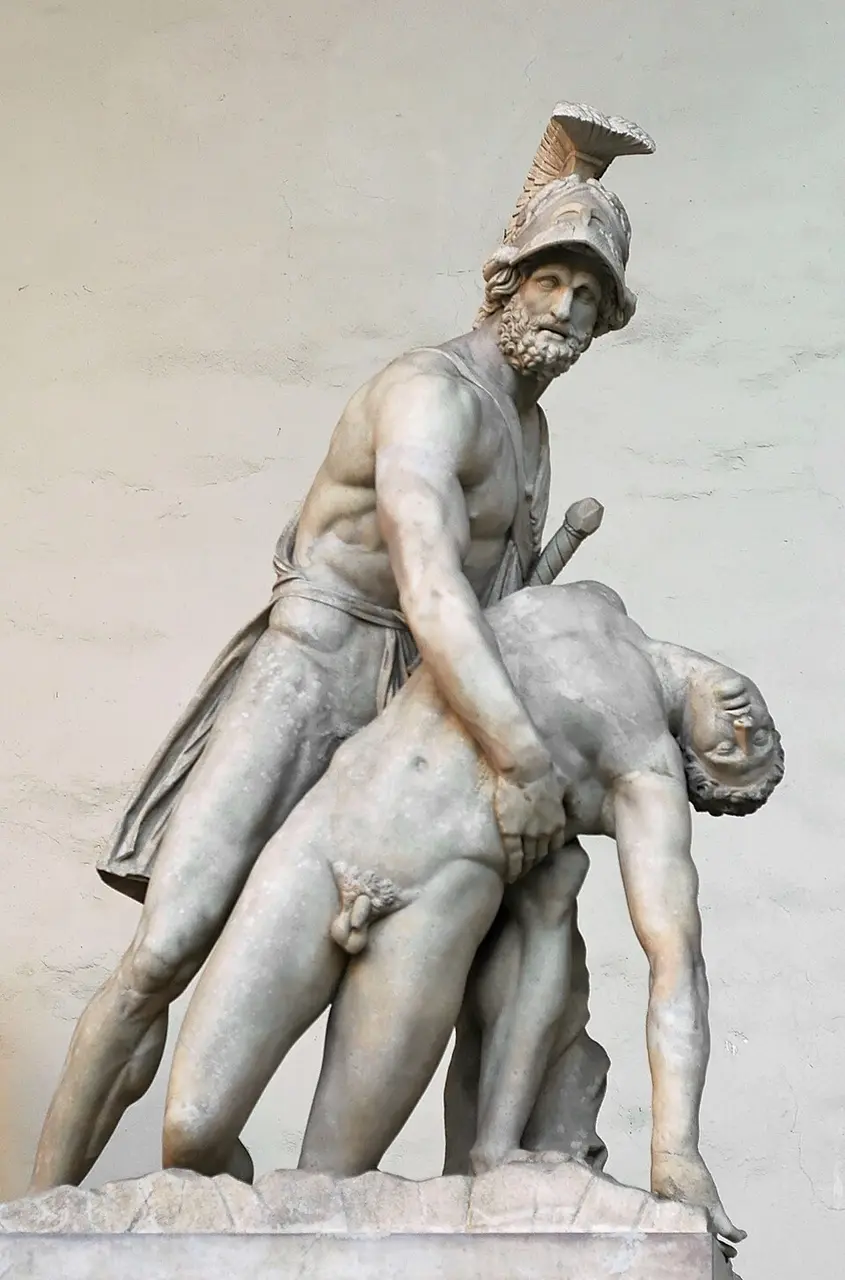
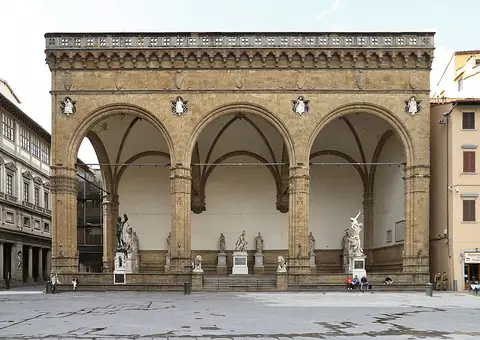
In the Loggia dei Lanzi on the Piazza della Signoria in Florence stands one of the city's best-known marble sculptures, a group referred to as Achilles and Patroclus or Ajax and Achilles. The work is a Roman copy of a Hellenistic bronze original from the period around 200 to 150 B.C. The history of this particular version is closely tied to the Medici dynasty. Grand Duke Cosimo I acquired the ancient fragment shortly after its discovery in Rome and had it brought to Florence. Since the figure of the bearer survived only as a headless torso, his successor Ferdinando II commissioned the sculptor Pietro Tacca to complete it. Lodovico Salvetti carried out the work based on Tacca's model. The sculpture originally stood on the south side of the Ponte Vecchio before it was moved to its present location in the Loggia in 1838.
Today you can admire the dramatic composition, which shows a dying warrior being carried by a companion. Particularly striking is the lifeless left arm of the dying figure, hanging down as if dislocated. This detail, however, does not date from antiquity but is part of the early modern restoration by Tacca and Salvetti. Other elements, such as the raised left leg of the bearer and the mound-like base, are also the result of later interventions. In the 18th century, the Neoclassical painter Anton Raphael Mengs tried to restore the originally ancient parts through casts and a plaster reconstruction, but the work remained forgotten for a long time until, after further adjustments by Stefano Ricci in the 19th century, it was made accessible to the public again.
The identification of the figures was disputed for centuries. While earlier authors interpreted the dead man as Hercules or Alexander the Great, the identification as Achilles, carried from the battlefield at Troy by Ajax or Odysseus, is now widely accepted. A second, similar version of the sculptural group is located in the Cortile dell'Ajaco of the Palazzo Pitti, where it was installed in 1570 as a gift from Paolo Antonio Soderini. This second group, said to have been found at the Mausoleum of Augustus, rounds out the picture of the Florentine collections and underscores the great importance the Medici family attached to the reconstruction of ancient masterpieces.
At a glance
- Category
- Sight › Historic sites
- Rating
- no reviews yet · write a review
- Address
- P.za della Signoria
50122 Florence, Italy - District
- Quartiere 1
- Phone
- —
- Website
- —
- —
- Coordinates
- 43.76915° N · 11.25564° E
- Data quality
- confidence 0.86
- Identifier
- ID 359b3aa0-2f2…
Location & surroundings
Toggle layersRatings & comments
none yetNear Patroclo e Menelao
closest 5 per category · 2 kmSights
Restaurants
Museums
Hotels
More:Historic sites in Florence (306)Sights in Quartiere 1 (320)All sights in Florence (418)
300 places within 2 km loaded.
You need a free account to leave reviews and photos – that keeps comments genuine and lets you edit them later.