About Campanile di Giotto
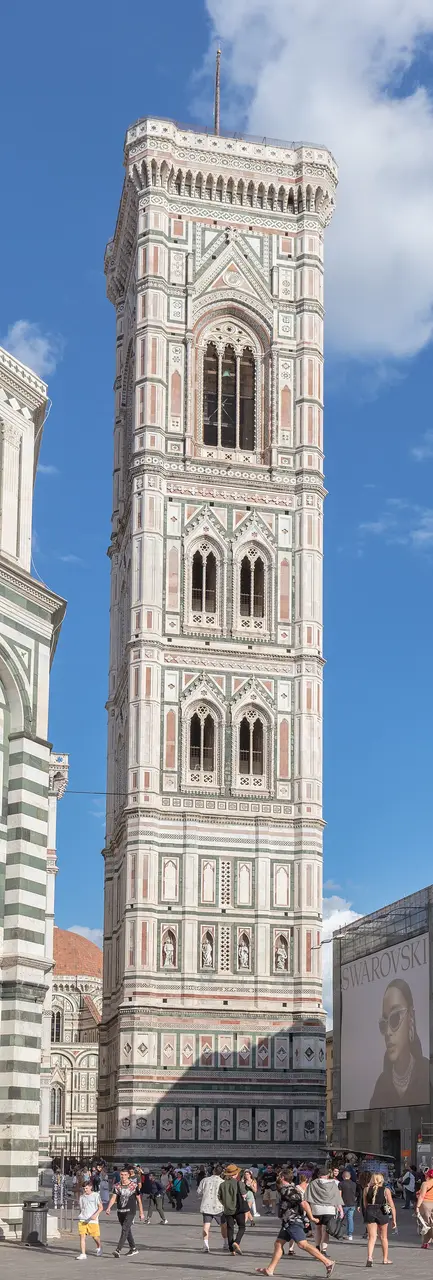
Giotto's Campanile is a freestanding bell tower that, together with the Cathedral of Santa Maria del Fiore and the Baptistery of St. John, forms the ensemble on the Piazza del Duomo in Florence. One of the outstanding examples of Florentine Gothic architecture, the tower impresses with its rich sculptural decoration and its multicolored marble cladding. The slender, square structure measures 14.45 meters on each side and rises to a height of 84.7 meters. Polygonal buttresses support the building at the corners, and the tower is divided horizontally into five stories. It stands right next to the cathedral and the baptistery, forming a harmonious architectural whole with them that dominates the view of the square.
The history of the tower begins in 1334, when Giotto di Bondone, then 67 years old, was appointed successor to Arnolfo di Cambio. Giotto, who had already established himself as a significant architect by this time, laid the first stone on July 19 of that year. His design took up the multicolored look of the cathedral and used marble in geometric patterns to create a painted effect, rather than the delicate skeletal structure typical of Gothic architecture. By the time Giotto died in 1337, only the lower story had been completed, with its exterior cladding of white marble from Carrara, green marble from Prato, and red marble from Siena. This level is decorated on three sides with hexagonal relief panels depicting scenes from Genesis and the development of the arts and sciences.
After Giotto's death, Andrea Pisano took over as master builder and continued the work strictly according to the original design. He added a second band of diamond-shaped panels and built two further stories with niches, which now hold statues of prophets and patriarchs. Construction was interrupted, however, by the plague in 1348. Francesco Talenti finally completed the tower in 1359 by building the top three levels with large windows. He dispensed with the spire Giotto had planned, which reduced the tower to its present height. The uppermost stories are designed to appear the same size when seen from a distance, creating an optical effect that compensates for perspective.
Visitors can climb 414 steps to the observation platform, which offers a wide panorama over Florence and the surrounding hills. The original works of art, including the reliefs and statues, were removed between 1965 and 1967 and can now be seen in the Museo dell'Opera del Duomo behind the cathedral. The tower holds copies of these works, which depict medieval philosophy and the development of humankind in allegorical form. The seven bells inside round out the historic character of this important monument.
At a glance
- Category
- Sight › Monuments
- Rating
- no reviews yet · write a review
- Address
- Piazza Duomo
50122 Florence, Italy - District
- Quartiere 1
- Phone
- +390552302885
- Website
- ilgrandemuseodelduomo.it
- opera@operaduomo.firenze.it
- Coordinates
- 43.77320° N · 11.25525° E
- Data quality
- confidence 0.99
- Identifier
- ID cc9a1668-fc2…
Part of the tour
Florence in One Day: Duomo, David and Piazza della Signoria →Location & surroundings
Toggle layersFAQ about Campanile di Giotto
quick answersWhat is Giotto's Campanile in Florence?
Giotto's Campanile is the freestanding bell tower of Florence Cathedral on Piazza del Duomo in the historic center. Together with the Cathedral of Santa Maria del Fiore and the Baptistery of St. John, it forms a unified architectural ensemble. The tower is considered an outstanding example of Florentine Gothic architecture and is known for its rich sculptural decoration and its facing of white, green, and red marble. Seven bells hang inside.
How tall is Giotto's Campanile and how many steps lead to the top?
Giotto's Campanile in Florence is 84.7 meters tall, and you climb 414 steps to reach the viewing platform. The slender, square tower measures 14.45 meters on each side and is divided into five levels. From the top, you get a sweeping panorama over Florence and the surrounding hills.
Who built Giotto's Campanile?
Three master builders worked on Giotto's Campanile in Florence in succession: Giotto di Bondone, Andrea Pisano, and Francesco Talenti. Giotto laid the first stone on July 19, 1334, but only the lower level was finished by the time he died in 1337. Andrea Pisano continued construction following Giotto's design until the plague interrupted the work in 1348. Francesco Talenti completed the tower in 1359 with the top three levels, omitting the spire that Giotto had planned.
Where can you see the original reliefs and statues of Giotto's Campanile?
The original reliefs and statues of Giotto's Campanile are now in the Museo dell'Opera del Duomo behind Florence Cathedral. They were removed from the tower between 1965 and 1967 and replaced with copies. They include the hexagonal relief panels with scenes from Genesis and the development of the arts and sciences, as well as the statues of prophets and patriarchs from the niches.
What can you see around Giotto's Campanile?
Right next to Giotto's Campanile on Piazza del Duomo in Florence are several other major sights. travelguide195 lists, among others, the Baptistery of St. John about 22 meters away with the Gates of Paradise, the tomb of Antipope John XXIII, the Column of San Zanobi, and the Loggia del Bigallo and Museo del Bigallo about 41 to 47 meters away. Within a 500-meter radius, travelguide195 lists around 516 restaurants, and the tower is part of the tour "Florence in One Day: Cathedral, David, and Piazza della Signoria."
Ratings & comments
none yetNear Campanile di Giotto
closest 5 per category · 2 kmSights
Restaurants
Museums
Hotels
More:Monuments in Florence (47)Sights in Quartiere 1 (320)All sights in Florence (418)
300 places within 2 km loaded.
Don't miss in Florence
All sights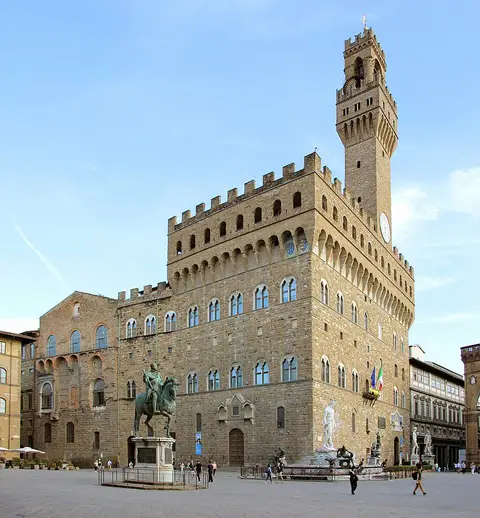 Historic sites01
Palazzo Vecchio
Piazza Della Signoria · Florence● Website● Phone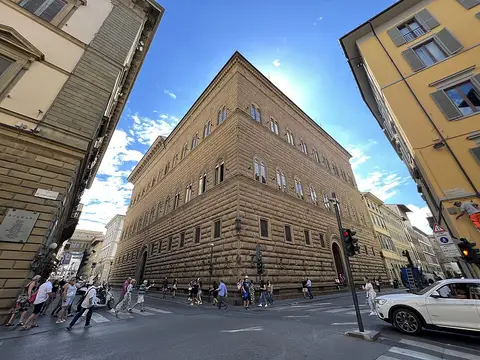 Palaces02
Palazzo Strozzi
Piazza Strozzi, s.n.c. · Florence● Website● Phone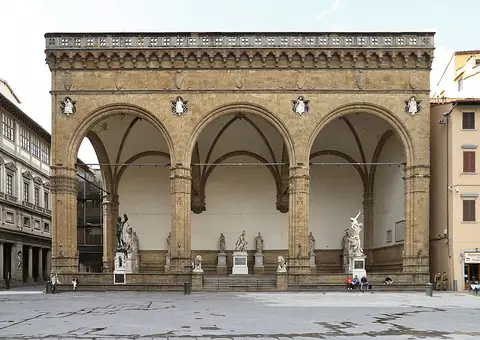 Historic sites03
Loggia dei Lanzi
P.za della Signoria · Florence● Website● Phone Historic sites04
You need a free account to leave reviews and photos – that keeps comments genuine and lets you edit them later.
Adjacent to the Duomo, you can climb the tower for a magnificent 360-degree view of the Duomo, Florence, and the surrounding area. It requires some tenacity to climb the 414 steps. Ezio climbed the outside of the tower to the top as it was a viewpoint for the entire San Marco District.
Source: Wikivoyage, „Assassin's Creed tour“ · authors per page history · CC BY-SA 4.0