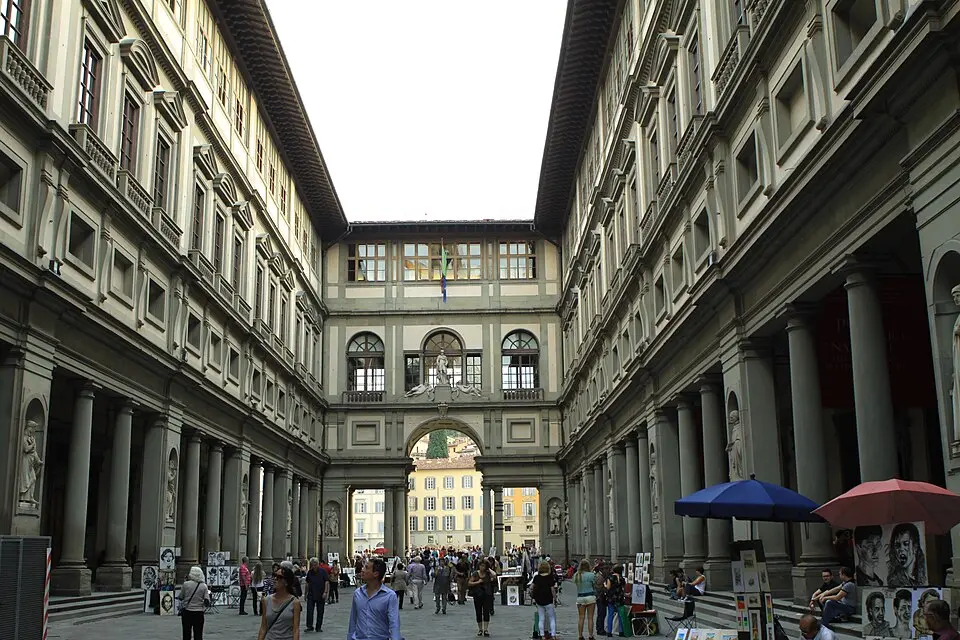
About Cortile degli Uffizi
The Uffizi Gallery in Florence is far more than just a museum: it is an architectural masterpiece and one of the world's most important art collections. The ensemble of buildings was erected in the late 16th century to plans by Giorgio Vasari and later architects in order to bring the administrative offices of the Grand Duke of Tuscany together under one roof. Originally conceived as an office complex, the structure now houses a collection that focuses on Renaissance painting and sculpture. Here you experience not only the artworks themselves but also the historic fabric of the site. On the ground floor, for example, you can still see the remains of a Romanesque church that was demolished to make way for the Uffizi. A particular highlight is the Vasari Corridor, which connects the Uffizi to the Palazzo Pitti by way of the Ponte Vecchio and today houses an extensive exhibition of self-portraits.
The history of the collection is inseparably linked to the House of Medici. The artworks were gathered by the grand dukes over the course of centuries and were eventually bequeathed to the city of Florence by the last representative of the house, Anna Maria Luisa de' Medici, on the condition that they never be removed from the city. In the 18th century, this made the collection one of the first public museums in Europe. The arrangement of the exhibits follows a logical, chronological narrative that leads you from ancient Greek and Roman sculptures through religious icons to the freedom of Renaissance painting. Among the most famous pieces is the Medici Venus, an ancient marble statue that embodies the type of the modest Venus and influenced artists such as Botticelli. The collection also includes works by Titian, Veronese, Holbein, and Rembrandt.
A tragic chapter in the history of the Uffizi is the bomb explosion of 1993, which severely damaged the Niobe Room. Despite such setbacks, the site remains a major draw for millions of visitors every year. The Uffizi is considered the most-visited cultural institution in Italy and is also known as the birthplace of the piano, since the instrument maker Bartolomeo Cristofori developed the prototype of the instrument in the workshops on the ground floor around 1698. Today the museum is under the direction of Simone Verde, who has driven forward comprehensive renovation plans for the building complexes, including the Palazzo Pitti and the Boboli Gardens, in order to better manage visitor flows and safeguard the preservation of the works.
At a glance
- Category
- Sight › Historic sites
- Rating
- no reviews yet · write a review
- Address
- —
Florence, Italy - District
- Quartiere 1
- Phone
- —
- Website
- —
- —
- Coordinates
- 43.76830° N · 11.25540° E
- Data quality
- confidence 0.73
- Identifier
- ID c2934f92-7e2…
Location & surroundings
Toggle layersRatings & comments
none yetNear Cortile degli Uffizi
closest 5 per category · 2 kmSights
Restaurants
Museums
Hotels
More:Historic sites in Florence (306)Sights in Quartiere 1 (320)All sights in Florence (418)
300 places within 2 km loaded.
You need a free account to leave reviews and photos – that keeps comments genuine and lets you edit them later.