About St.Sulpice
Saint-Sulpice is a major Catholic parish church in Paris's Quartier de l'Odéon, in the 6th arrondissement. Dedicated to Saint Sulpicius II of Bourges, it measures 118 meters long and 57 meters wide, making it one of the largest religious buildings in the city. Only Notre-Dame Cathedral is somewhat larger, which has earned Saint-Sulpice a reputation as the second-largest church in Paris. The Austrian playwright Franz Grillparzer even called it the most beautiful church in the city after Notre-Dame. The immense footprint is complemented by an extensive system of crypts beneath the naves, covering an area nearly equal to that of the church itself. These underground chambers hold the tombs of numerous historical figures, including members of the royal family such as Louise Élisabeth d'Orléans, as well as the composer Charles-Marie Widor. Famous noble families such as the Condés, Contis and Luynes also chose this site as their final resting place.
The history of the building reaches back to the 12th century, when a Romanesque predecessor was built; it was largely demolished in the 17th century. Construction of the new church began in 1646 to plans by Christophe Gamard, before Louis Le Vau took over as master builder. After his resignation, Daniel Gittard continued the work from 1660. The dimensions of the project were designed to suit the parish of the time, which had about 100,000 inhabitants. A lack of funds interrupted construction in 1678, leaving only the choir, ambulatory, chapels and north transept complete. The nave, crossing and south transept arm were not finished until between 1719 and 1736 by Gilles-Marie Oppenordt, with an unusual lottery helping to fund the work.
Architecturally, Saint-Sulpice is a three-aisled basilica with an ambulatory choir and a barely projecting transept. Chapels are set between the buttresses, with the Lady Chapel at the head of the choir standing out in particular. The nave has two levels: below are pier arcades fronted by a Corinthian pilaster order, and above them the vaulted zone with a longitudinal barrel vault and lunettes for the clerestory windows. The overall layout can be understood as a reduced version of the Gothic cathedral of Notre-Dame, mediated through the parish church of St-Eustache. Details such as profiles resembling ridge ribs and keystone-like rosettes in the older parts of the building also recall Gothic models.
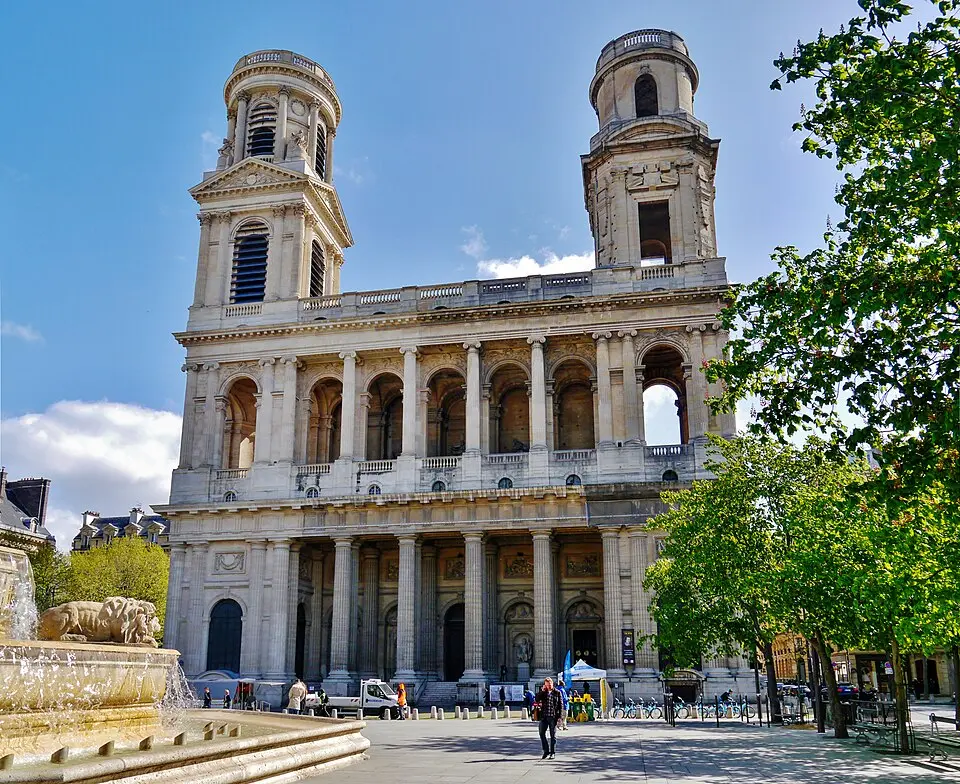
The twin-towered western facade belongs stylistically to a later era. In 1732 the theater architect Giovanni Niccolò Servandoni won a competition for its design. As built, his design gained a grandeur in the ancient Roman manner and already points ahead to early Neoclassicism, a tendency continued by Jean-François Chalgrin with his design for new upper tower stages. Servandoni, known for his Baroque stage and festival decorations, sought a theatrical splendor here, but on a church facade it is often seen as disproportionate. The two large, stacked colonnades are not sufficiently unified by the towers, which gives the building an ambivalent character.
A central part of the church's history is the founding of the Sulpician congregation and the seminary by Jean-Jacques Olier in 1642. The seminary provided academic and spiritual training for priests and still exists today. It was an intellectual stronghold of the French Revolution, producing leading figures such as Sieyès and Talleyrand. During the Revolution the church was briefly renamed the Temple of Victory and plundered. During the restoration work, Eugène Delacroix decorated the first south chapel between 1858 and 1861 with two frescoes depicting Jacob wrestling with the angel and the story of Heliodorus.
The church's musical importance is underscored by its two organs. The great main organ in the west gallery is a world-famous masterpiece. It goes back to an instrument built by François-Henri Clicquot between 1776 and 1781. The monumental case was designed by the architect Jean-François Chalgrin. Between 1857 and 1862, Aristide Cavaillé-Coll fundamentally rebuilt the instrument, retaining about 40 percent of the original pipework by Clicquot and Callinet. It was inaugurated in 1862 with 100 stops on five manuals and pedal. At the time it was the largest organ in France and one of the largest in Europe. Today it is regarded as the principal work of French Romantic organ building, as it harmoniously combines original Baroque stops with pipework added in the 19th century. Its almost entirely original state is thanks to its titular organists, including Louis-James-Alfred Lefébure-Wély, Charles-Marie Widor, Marcel Dupré, Jean-Jacques Grunenwald and Daniel Roth.
Every Sunday at 10 a.m., an organ recital takes place in the church before the service. The acoustics, with both a choir organ and a main organ, inspired composers such as Charles-Marie Widor and Louis Vierne to write Masses. Alongside its musical history, the noonday gnomon of 1727 is another remarkable detail. It was built by the English clockmaker Henry Sully. At midday, sunlight passes through a hole in the south wall onto a brass line on the floor and then up an 11-meter-high obelisk. The line is scaled with calendar dates and shows not only the time of noon but also astronomical dates such as the solstices and equinoxes. This feature has also gained literary fame, as it plays a central role in Dan Brown's novel "The Da Vinci Code," where it is wrongly described as an Egyptian astronomical device.
In front of the church stands the Visconti Fountain, built in 1844 to plans by Louis Visconti. It is also known as the Fontaine des Quatre Évêques or Fontaine des Quatre Points Cardinaux. The four churchmen depicted – Jacques Bénigne Bossuet, François Fénelon, Jean-Baptiste Massillon and Esprit Fléchier – never became cardinals, which led to the mocking nickname "fountain of those who were never cardinals." The lions at the feet of the statues display an aggressive demeanor that departs from the usual classical dignity but is very convincing in this form. After the fire at Notre-Dame in 2019, Saint-Sulpice temporarily took over the role of a cathedral for diocesan liturgical events, underscoring its central importance in the religious life of Paris.
At a glance
- Category
- Sight › Historic sites
- Rating
- no reviews yet · write a review
- Address
- 6e Place Saint-Sulpice
75006 Paris, France - District
- 6th Arrondissement
- Phone
- —
- Website
- pss75.fr
- —
- Coordinates
- 48.85111° N · 2.33472° E
- Data quality
- confidence 0.89
- Identifier
- ID 80f36609-3b2…
Location & surroundings
Toggle layersFAQ about St.Sulpice
quick answersWhat is Saint-Sulpice in Paris?
Saint-Sulpice is a major Catholic parish church on the Place Saint-Sulpice in the Quartier de l'Odéon in Paris's 6th arrondissement. The church is dedicated to Saint Sulpicius II of Bourges and measures 118 meters long and 57 meters wide. Only Notre-Dame Cathedral is slightly larger, which is why Saint-Sulpice is considered the second-largest church in Paris. The Austrian playwright Franz Grillparzer even called it the most beautiful church in the city after Notre-Dame.
Who is buried in the crypt of Saint-Sulpice in Paris?
Beneath the church of Saint-Sulpice in Paris lies an extensive crypt system containing the tombs of numerous historical figures. They include members of the royal family such as Louise Élisabeth d'Orléans, as well as the composer Charles-Marie Widor. The noble families of the Condés, Contis, and Luynes also chose this place as their final resting place. The footprint of the crypts is almost as large as that of the church itself.
When was Saint-Sulpice in Paris built?
The present building of Saint-Sulpice in Paris dates from 1646 onward and stands on the site of a Romanesque predecessor from the 12th century. The plans were drawn up by Christophe Gamard, after which Louis Le Vau took over as head of construction, and from 1660 Daniel Gittard continued the work. A lack of funds halted construction in 1678, when only the choir, ambulatory, chapels, and north transept had been completed. Gilles-Marie Oppenordt finished the nave, crossing, and south transept arm between 1719 and 1736, with financial support from a lottery.
What is special about the architecture of Saint-Sulpice in Paris?
Saint-Sulpice in Paris is a three-aisled basilica with an ambulatory choir, whose basic layout is a simplified version of the Gothic cathedral of Notre-Dame. The nave has pier arcades with Corinthian pilasters below and a barrel vault with lunettes above; the Lady Chapel at the head of the choir is especially striking. The western twin-tower façade was designed by the theater architect Giovanni Niccolò Servandoni, who won the competition for it in 1732. Its antique Roman style anticipates early Neoclassicism, which Jean-François Chalgrin continued with his design for new tower stories.
What can you see around Saint-Sulpice in Paris?
Around Saint-Sulpice in Paris's 6th arrondissement, you'll find several museums and monuments within a few minutes' walk. travelguide195 lists, for example, the Place August Strindberg about 72 meters away, the Mundolingua Museum about 108 meters away, and the Musée - Librairie du Compagnonnage about 133 meters away. travelguide195 also lists around 386 restaurants within 500 meters of the church.
Ratings & comments
none yetNear St.Sulpice
closest 5 per category · 2 kmSights
Restaurants
Museums
More:Historic sites in Paris (1,524)Sights in 6th Arrondissement (33)All sights in Paris (1,859)
300 places within 2 km loaded.
You need a free account to leave reviews and photos – that keeps comments genuine and lets you edit them later.
a Roman Catholic church on the east side of the Place Saint-Sulpice within the rue Bonaparte, in the Luxembourg Quarter of the VIe arrondissement. At 113 metres long, 58 metres in width and 34 metres tall, it is only slightly smaller than Notre-Dame and thus the second largest church in the city. It is dedicated to Sulpitius the Pious. During the 18th century, an elaborate gnomon, the Gnomon of Saint-Sulpice, was constructed in the church. In front of the church itself is the magnificent Place Saint-Sulpice which contains the 'Fountain of the Four Bishops'. The church has a long-standing tradition of talented organists that dates back to the eighteenth century. In 1862, Aristide Cavaillé-Coll reconstructed and improved the existing organ built by François-Henri Clicquot. Though using many materials from Clicquot's French Classical organ, it is considered to be Cavaillé-Coll's magnum opus, featuring 102 speaking stops, and is perhaps the most impressive instrument of the romantic French symphonic-organ era. Its organists have also been renowned, starting with Nicolas Séjan in the 18th century, and continuing with Charles-Marie Widor (organist 1870-1933) and Marcel Dupré (organist 1934-1971), both great organists and composers of organ music. The current organists are 'titulaire' Daniel Roth (since 1985) and 'assistant titulaire' Sophie-Véronique Cauchefer-Choplin. In Saint-Sulpice Sunday organ recitals are held on a regular basis (Auditions du Dimanche, following the High Mass, usually from 11:30am till 12:05pm, during the subsequent mass, a visit of the organ loft is possible).
Source: Wikivoyage, „Paris/6th arrondissement“ · authors per page history · CC BY-SA 4.0