Budapest: A Capital on Both Banks of the Danube
Travel guide · editorialIf you're planning a vacation in Budapest, you'll discover a city that only grew together in 1873 from three towns: hilly Buda, flat Pest, and old Óbuda. The Danube divides and connects them at once, and in few places in Europe do thermal springs, coffeehouses, and grand architecture sit so close together.
Two Halves of a City, One River
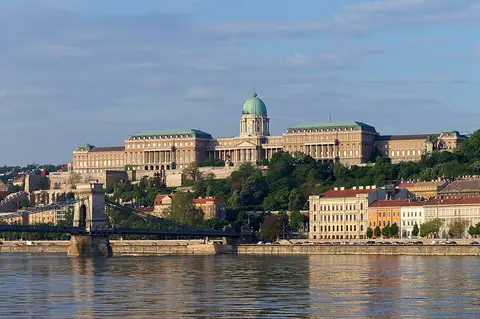
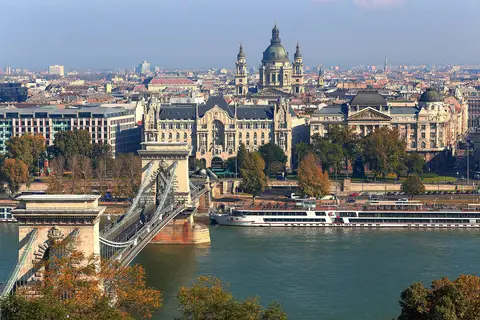
On the west side, the Buda Hills rise up, with villa neighborhoods, forests, and Castle Hill, which has towered over the city for centuries. Pest, to the east, is flat and densely built, crisscrossed by broad ring roads laid out in the late 19th century on the model of Vienna and Paris. The Danube flows between them, spanned today by nine road and rail bridges. The Chain Bridge of 1849 was the first permanent link; its stone lions are among the most photographed sights in the city. In the middle of the river lies Margaret Island, a car-free park with a running track, a rose garden, monastery ruins, and a large outdoor swimming complex.
Sights in Budapest
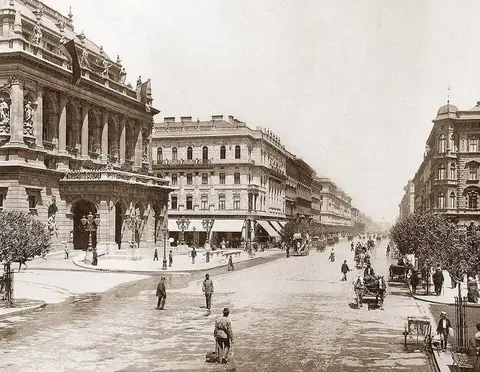
The Parliament Building on the Pest riverbank, completed in 1904, is one of the largest parliament buildings in the world; the Holy Crown of Hungary is kept inside. Across the river rises the Castle District with Matthias Church, whose colorfully glazed tile roof gleams from afar, and the Fisherman's Bastion, whose terraces offer views over the whole city. The Royal Palace houses the National Gallery and the History Museum. St. Stephen's Basilica in Leopoldváros is exactly as tall as Parliament, 96 meters, a nod to the year 896, associated with the Hungarian conquest of the Carpathian Basin. At the end of Andrássy Avenue, which together with the oldest subway on the European continent is a UNESCO World Heritage Site, Heroes' Square opens up with the Millennium Monument. Behind it begins City Park, with Vajdahunyad Castle and the new House of Hungarian Music.
Baths and Coffeehouses
Budapest sits on more than a hundred thermal springs, and bathing here is part of everyday life, not just a tourist attraction. In the neo-Baroque Széchenyi Baths, older men play chess in the steaming outdoor pool, even in winter. The Gellért Baths at the foot of Gellért Hill are an Art Nouveau complex with mosaics and colonnaded halls, while the Rudas and Király Baths date back to Ottoman times in the 16th and 17th centuries, with octagonal pools beneath domes. Coffeehouse culture is just as firmly rooted: at the New York Café, at Gerbeaud on Vörösmarty Square, or at the quieter Centrál, you sit beneath stucco ceilings over a slice of Dobos torte or Esterházy cake.
Neighborhoods with Their Own Character
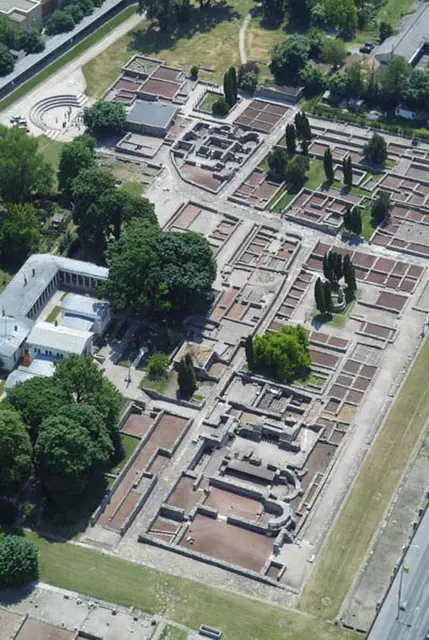
The former Jewish Quarter in the 7th district is now the city's nightlife hub. After 2000, the so-called ruin pubs sprang up in dilapidated courtyards, most famously Szimpla Kert, furnished with discarded furniture and old Trabant cars. A few steps away stands the Great Synagogue on Dohány Street, the largest in Europe, with the metal Holocaust Memorial Tree in its courtyard. On the Danube embankment, bronze shoes commemorate the victims of the Arrow Cross in the winter of 1944–45. If you want to see the socialist legacy, head to Memento Park on the edge of the city, where the statues of Lenin and Marx that once stood in public squares have been gathered. Things are quieter in Óbuda, where the remains of Roman Aquincum have been excavated.
Eating and Drinking
The Great Market Hall on Fővám Square is the best introduction to Hungarian cuisine: paprika in every degree of heat, salami, goose liver, pickled vegetables, and, upstairs, lángos, fried flatbread with sour cream and cheese. In Hungary, goulash (gulyás) is a soup, hearty and flavored with caraway; other staples include chicken paprikash with dumplings, stuffed cabbage, and pörkölt. To finish, there's pálinka made from apricots or pears, or a sweet Tokaji. Budapest now also has a distinguished fine-dining scene with several Michelin stars, and in the wine bars of the city center you can try grape varieties such as Furmint, Kadarka, and Kékfrankos.
Getting There and Best Time to Visit
Ferenc Liszt Airport lies about 20 kilometers southeast of the city center and is directly connected by the 100E bus. Long-distance trains from Vienna, Munich, or Berlin arrive at Keleti Station, whose hall dates from the late 19th century. Once you're in town, the best way to get around is by metro, tram, and bus; tram line 2 along the Danube is considered one of the most beautiful routes in Europe. The best time to visit Budapest is spring and fall, when it's pleasantly warm and the baths aren't overcrowded. Summers are often hot, but that's when festivals like the Sziget Festival on Óbuda Shipyard Island take place. In December, the Christmas markets on Vörösmarty Square and in front of the basilica are a draw, and a soak in a hot outdoor pool in freezing weather is an experience all its own.