About New Town Hall, Munich
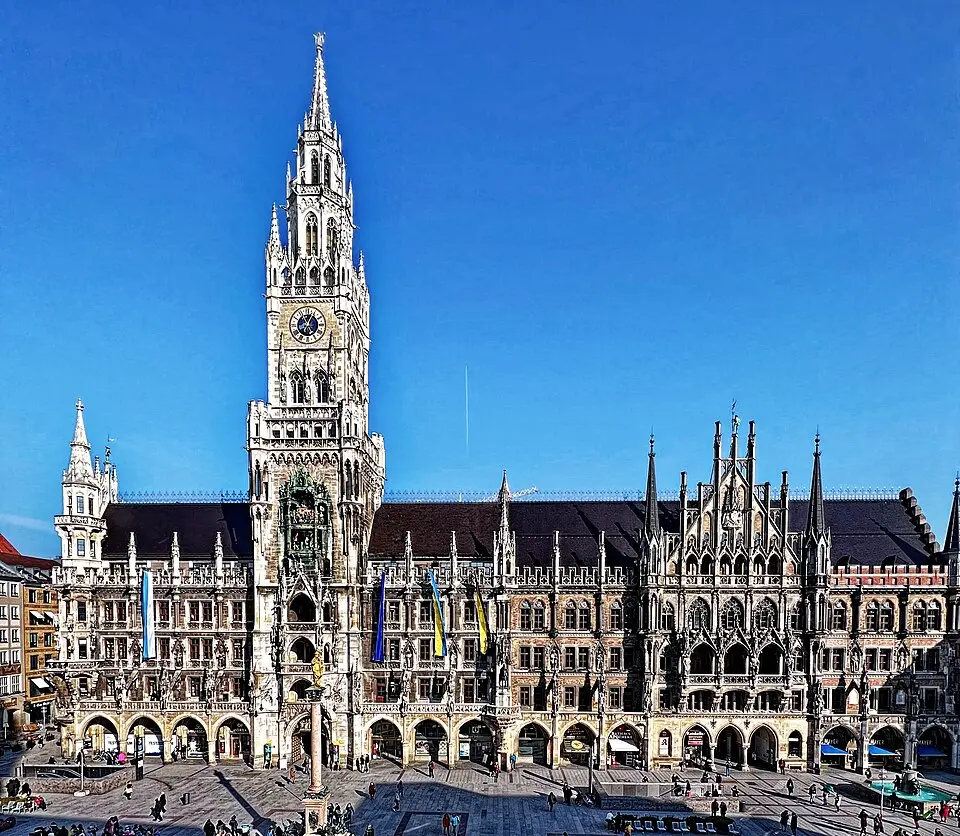
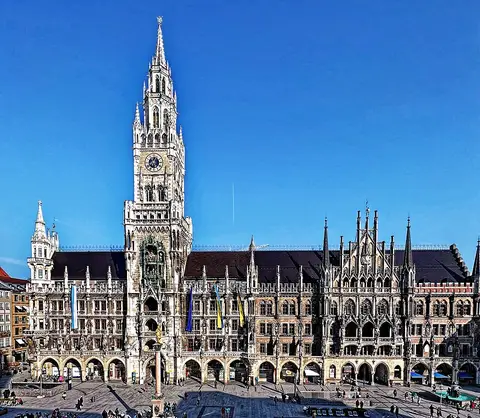
The New Town Hall (Neues Rathaus) in Munich is one of the best-known landmarks of the Bavarian state capital and sits majestically on Marienplatz in the Altstadt-Lehel district. As the seat of the mayor, the city council, and large parts of the city administration, the building serves not only as an administrative center but also as a architectural highlight of the Neo-Gothic style. The imposing secular building was constructed between 1867 and 1905 by the architect Georg von Hauberrisser. The decision to build a new town hall came in the 1860s, driven by a pressing shortage of space in the old town hall buildings. The site on the north side of Marienplatz, where the so-called Landschaftshäuser had previously stood, was chosen to create a strong architectural contrast to the royal buildings. The foundation stone was laid on August 25, 1867, the birthday of King Ludwig II, and construction dragged on for several decades, as the building was expanded in three major phases to keep pace with growing administrative needs.
The facade of the town hall is a masterpiece of Neo-Gothic design and stretches nearly a hundred meters. Unlike many Gothic originals, the outer skin is not made of solid natural stone but of brick, clad in a fine layering of brick and shell limestone. The facade is rich in sculptures and displays the most extensive cycle of princes on any German town hall. It honors the line of Wittelsbach rulers in Bavaria, beginning with the Welf duke Henry the Lion. Between the two main construction sections on Marienplatz, an equestrian statue of Prince Regent Luitpold dominates the scene. At the corners and along the facades, you'll find numerous Neo-Gothic gargoyles in the form of grotesque faces and masks, allegorical depictions, and scenes from the lives of saints and folk legends. Many colorful stained-glass windows with local, national, and religious motifs adorn the building and let a warm light fall into the interior rooms in daylight.
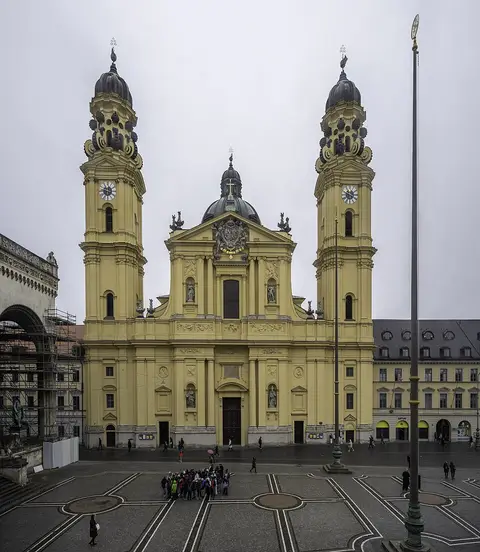
Special attention goes to the 85-meter-tall town hall tower, whose design clearly draws on the Brussels town hall tower. The tower is crowned by the famous Münchner Kindl, a figure designed by Anton Schmid and hammered in copper by Hygin Kiene. The artist's son served as the model for the statue. Below the viewing gallery, which is conveniently reached by elevator, is the world-famous glockenspiel. On clear days, the gallery offers a spectacular panoramic view: to the south rise the Alpine chain, St. Peter's Church (Alter Peter), and the Church of the Holy Spirit, while to the north you can see the Theatine Church and the Olympic Tower. To the west, you look toward the Church of Our Lady (Frauenkirche) and St. Paul's Church.
The glockenspiel itself is the fifth largest of its kind in Europe and draws numerous visitors every day. It chimes at 11 a.m. and 12 p.m., and from March to October also at 5 p.m. Forty-three bells play a variety of melodies, to which 32 figures reenact historical scenes. In the upper part of the oriel, a knights' tournament is depicted, held for the wedding of Bavarian Duke William V and Renata of Lorraine in 1568. Heralds, jesters, and fanfare trumpeters accompany the medieval contest of skill. The lower level shows the Schäfflertanz (Coopers' Dance), which commemorates the end of the plague from 1515 to 1517. The colorfully dressed coopers lured the frightened citizens back out onto the streets. Late in the evening, at 9 p.m., there is a special light show in which a night watchman makes his rounds and the Münchner Kindl is led to rest by a guardian angel, accompanied by music by Wagner and Brahms.
Inside the town hall, which contains around 400 rooms, you'll find a mix of administration and culture. The Great Council Chamber is the largest room and is dominated by Carl Theodor von Piloty's colossal painting "Monachia." This enormous work depicts 128 figures from 700 years of Munich's history and was returned to the end wall after a thorough restoration in 2004. On the second floor (first floor in German usage) is a hexagonal memorial room commemorating the dead of the world wars and the victims of political persecution. A gold-colored stone mosaic and marble tablets lend this chapel-like room a dignified atmosphere. The Law Library is also worth a visit; its reading room is designed in the Art Nouveau style and forms an interesting contrast to the Neo-Gothic style of the rest of the building.
The Prunkhof (Grand Courtyard), entered through the tower portal, is another highlight. It is dominated by the mighty spiral staircase tower of the Staircase of the Ages of Life. During Advent and the Christmas season, you can see the historic nativity scene by the wood sculptor Reinhold Zellner here, right next to the Christkindlmarkt. This nativity scene, created for the market in 1954, consists of 33 figures and 28 animals and is a popular destination for families and tourists. The former cashier's hall now serves as the Rathausgalerie and is used for exhibitions, while the Grützner Stube and the Ratstrinkstube are available for city celebrations and press conferences.
The Ratskeller, located in the basement, is one of Munich's oldest and best-known restaurants. It was built in three phases and officially opened in 1874. The walls are painted with historical scenes, including motifs originally intended for another project by the architect Hauberrisser. Although the Ratskeller closed as a restaurant at the end of 2025, it remains a historic place in the city's memory. The balcony of the New Town Hall also has a tradition of its own: since 1975, successful Munich athletes and teams have been honored here, a practice that underscores the city's pride in its sporting achievements.
The New Town Hall is thus far more than just an administrative building. It is a living monument to Munich's history that unites architecture, art, and tradition. The combination of the imposing facade, the famous glockenspiel, the artfully designed interiors, and the central location on Marienplatz makes it an essential stop for every visitor to the Bavarian metropolis. Whether you come for the daily glockenspiel performance, the view from the viewing gallery, or a tour through the historic halls, the New Town Hall offers insights into Munich's rich culture and history.
At a glance
- Category
- Sight › Historic sites
- Rating
- no reviews yet · write a review
- Address
- Marienplatz 8
80331 Munich, Germany - District
- Altstadt-Lehel
- Phone
- +498923300
- Website
- www.muenchen.de
- —
- Coordinates
- 48.13693° N · 11.57503° E
- Data quality
- confidence 0.94
- Identifier
- ID 6a095121-f40…
Location & surroundings
Toggle layersRatings & comments
none yetNear New Town Hall, Munich
closest 5 per category · 2 kmSights
Restaurants
Museums
Hotels
More:Historic sites in Munich (291)Sights in Altstadt-Lehel (114)All sights in Munich (375)
300 places within 2 km loaded.
You need a free account to leave reviews and photos – that keeps comments genuine and lets you edit them later.