About Neues Rathaus
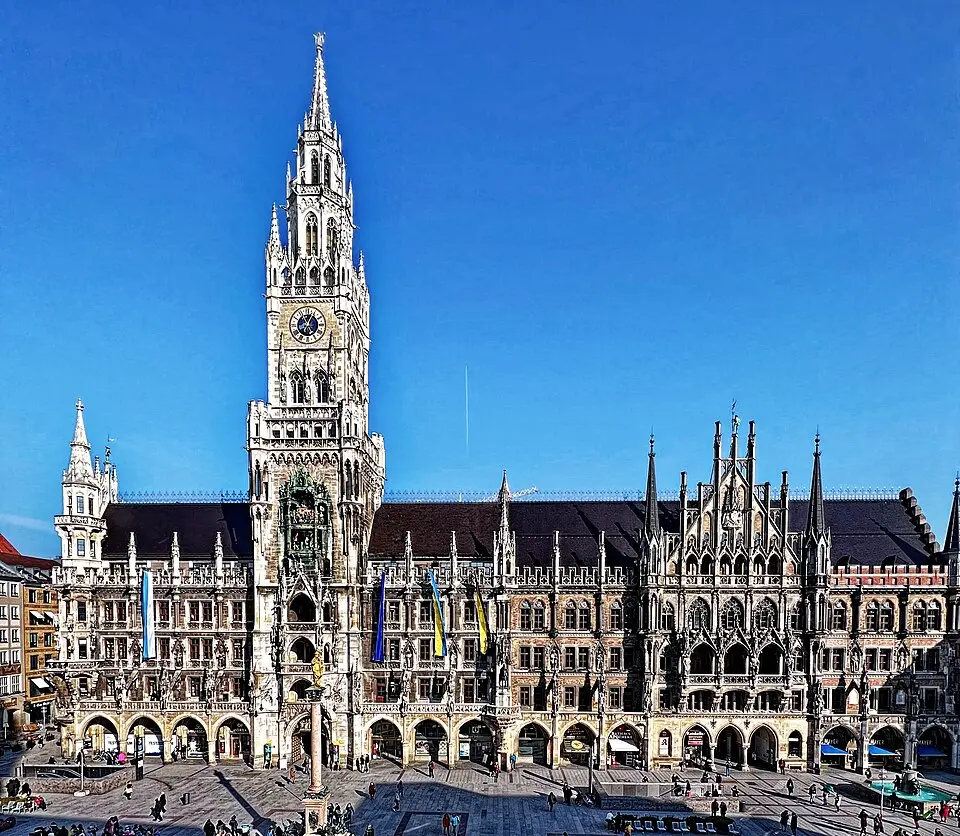
The New Town Hall (Neues Rathaus) in Munich is a striking architectural landmark on Marienplatz in the Altstadt-Lehel district. As the seat of the mayor, the city council, and large parts of the city administration, it forms the administrative heart of the Bavarian state capital. The imposing secular building in the Neo-Gothic style was constructed between 1867 and 1905 by the architect Georg von Hauberrisser. The decision to build a new town hall arose in the 1860s from an urgent shortage of space in what was then the Old Town Hall and in the Small Town Hall at Petersbergl. The city council chose the north side of Marienplatz as the building site, where the so-called Landschaftshäuser had previously stood, which historically served as the representation of the Bavarian estates before the duke or elector.
The building was erected in several stages. The first construction phase on Marienplatz, which today forms the southeastern part of the complex, followed an ideas competition that Hauberrisser won. His design made a strong statement through its deliberate architectural contrast to the buildings of the royal house. The foundation stone was laid on August 25, 1867, the birthday of King Ludwig II. As the administration grew, the city bought up neighboring plots from 1887 onward in order to expand the building. The second construction phase on Dienerstrasse followed between 1889 and 1892. In 1897 it was finally decided to expand the town hall into a four-sided complex, with the town hall tower and the remaining wings completed by 1905. The architect drew inspiration, among other sources, from the town hall in Brussels and the New Town Hall in Vienna.
The exterior of the town hall impresses with its rich ornamentation. The complex, built of brick and shell limestone, encompasses six inner courtyards. The main facade facing Marienplatz, nearly a hundred meters long, is decorated with an extensive cycle of princes depicting Henry the Lion and the Wittelsbach line in Bavaria. At its center, an equestrian statue of Prince Regent Luitpold presides over the middle of the facade. Numerous Neo-Gothic gargoyles in the form of grotesque faces and masks, allegorical figures, and stained-glass windows with local and religious motifs adorn the exterior walls. Above the arcades and windows, coats of arms of Bavarian cities are also displayed, underscoring the building's historical connections.
A particular highlight for visitors is the 85-meter-tall town hall tower, which is modeled architecturally on its Brussels counterpart. At the top of the tower stands the Münchner Kindl, a copper figure designed by Anton Schmid and hammered into shape by Hygin Kiene. From the viewing gallery, which can be reached by elevator, you get a sweeping panorama in clear weather. To the south you look out toward the Alps, Old Peter, and the Church of the Holy Spirit, while to the north you can see the Theatine Church and the Olympic Tower. To the west, views open up toward the Frauenkirche and St. Paul's Church.
The tower is home to the world-famous Glockenspiel, considered the fifth largest of its kind in Europe. It chimes daily at 11 a.m. and noon, and in summer also at 3 p.m. Forty-three bells play various melodies, accompanied by a total of 32 figures that act out historical scenes. On the upper level, a knights' tournament is reenacted in honor of the wedding of Duke William V and Renata of Lorraine in 1568. On the lower level, the Schäffler (coopers) dance to commemorate the end of the plague in the 16th century. At 9 p.m. there is a special variation in which a night watchman with his dog makes his rounds and the Münchner Kindl is guided to rest by a guardian angel, accompanied by music by Wagner and Brahms.
Inside the town hall, which houses around 400 rooms, you will find several significant halls. The Great Council Chamber is dominated by Carl Theodor von Piloty's colossal painting "Monachia," which shows 128 figures from 700 years of Munich history. The Small Council Chamber is used mainly for city council meetings and receptions. A solemn memorial room commemorates the victims of the world wars and of political persecution under National Socialism. The Law Library, whose reading room is in the Art Nouveau style, forms an interesting contrast to the Neo-Gothic building as a whole and is open to the public.
The Prunkhof (Grand Courtyard), entered through the tower portal, is dominated by the mighty spiral staircase tower of the Staircase of the Ages of Life. This is also where you will find the entrance to the former cashier's hall, which is now used as the Rathausgalerie for exhibitions. During Advent and the Christmas season, the traditional Nativity scene by the sculptor Reinhold Zellner, made up of numerous figures and animals, can be viewed in the Prunkhof. The Ratskeller, which takes up almost the entire basement level, was long a popular restaurant with historic painted decoration, but closed as an inn at the end of 2025.
The New Town Hall is not only an administrative seat but also a venue for civic celebrations. On the town hall balcony, successful athletes and teams are traditionally honored, a tradition that has existed since 1975. After World War II, during which the building suffered minor damage, it was renovated, and an additional floor was hidden behind the Neo-Gothic balustrade in order to preserve the original appearance. A comprehensive renovation in the late 1990s restored details such as the Neo-Gothic ornamental ironwork on the roof. Today the building stands at the center of city life as a testament to Munich's history and architecture.
At a glance
- Category
- Sight › Monuments
- Rating
- no reviews yet · write a review
- Address
- Marienplatz 8
80331 Munich, Germany - District
- Altstadt-Lehel
- Phone
- +498923300
- Website
- www.muenchen.de
- —
- Coordinates
- 48.13758° N · 11.57579° E
- Data quality
- confidence 0.99
- Identifier
- ID 32677646-1a1…
Part of the tour
Getting to Know Munich: From Stachus to the Siegestor →Location & surroundings
Toggle layersFAQ about Neues Rathaus
quick answersWhat is the New Town Hall in Munich?
The New Town Hall (Neues Rathaus) is a Neo-Gothic landmark at Marienplatz 8 in Munich's Altstadt-Lehel district and the seat of the mayor, the city council, and large parts of the city administration. This makes it the administrative heart of Munich, the capital of Bavaria. The complex of brick and shell limestone ashlar includes six inner courtyards.
When and by whom was the New Town Hall in Munich built?
The New Town Hall in Munich was built between 1867 and 1905 to designs by the architect Georg von Hauberrisser. The foundation stone was laid on August 25, 1867, the birthday of King Ludwig II, because the Old Town Hall and the Small Town Hall at the Petersbergl offered too little space. After the first construction phase on Marienplatz, the section along Dienerstrasse followed from 1889 to 1892, and from 1897 the building was expanded into a four-sided complex with the town hall tower. Models included the town hall in Brussels and the New Town Hall in Vienna.
What can you see on the facade of the New Town Hall in Munich?
The main facade of the New Town Hall facing Munich's Marienplatz, almost a hundred meters long, shows a cycle of rulers featuring Henry the Lion and the line of the Wittelsbachs in Bavaria. In the center stands an equestrian statue of Prince Regent Luitpold. You'll also spot Neo-Gothic gargoyles in the form of grotesque faces and masks, allegorical figures, stained-glass windows with local and religious motifs, and coats of arms of Bavarian cities above the arcades and windows.
What can you see from the tower of the New Town Hall in Munich?
From the observation gallery of the 85-meter-high town hall tower on Munich's Marienplatz, you get a wide panorama over the city all the way to the Alps on a clear day. To the south you can see St. Peter's Church (Alter Peter) and the Church of the Holy Spirit, to the north the Theatine Church and the Olympic Tower, and to the west the Church of Our Lady (Frauenkirche) and St. Paul's Church. The gallery is reached by elevator, and at the top of the tower stands the Münchner Kindl, a copper figure by Anton Schmid, hammered by Hygin Kiene.
What can you visit around the New Town Hall in Munich?
Around the New Town Hall on Munich's Marienplatz, several historic sights are within walking distance. travelguide195 lists, among others, the town hall Glockenspiel at about 25 meters, the Fischbrunnen fountain at about 53 meters, the Old Town Hall at about 115 meters, St. Peter's Church and the memorial plaque for the November pogrom of 1938 at about 125 meters, and the Talburgtor gate at about 128 meters away. Within a 500-meter radius, travelguide195 also lists around 323 restaurants, and the New Town Hall is part of the tour "Getting to Know Munich: From Stachus to Siegestor."
Ratings & comments
none yetNear Neues Rathaus
closest 5 per category · 2 kmRestaurants
Museums
Hotels
More:Monuments in Munich (68)Sights in Altstadt-Lehel (114)All sights in Munich (375)
300 places within 2 km loaded.
You need a free account to leave reviews and photos – that keeps comments genuine and lets you edit them later.
This was built in phases from 1867 to 1909. It's still a busy city chambers, with access only on business, but you can ride the lift to the observation deck of the tower. For most visitors the ornate neo-Gothic exterior is experience enough. At 11:00, 12:00 and 17:00 the Glockenspiel cranks into life: medieval minstrels parade, knights joust (the knight in Bavarian blue always wins) and Morris dancers pirouette to the sound of the bells. They all freeze en tableaux to the tune of "I don't have a wooden heart" (Elvis Presley, 1960) which alas they do.
Source: Wikivoyage, „Munich/Altstadt“ · authors per page history · CC BY-SA 4.0 · as of 10/18/2022