About Feldherrnhalle
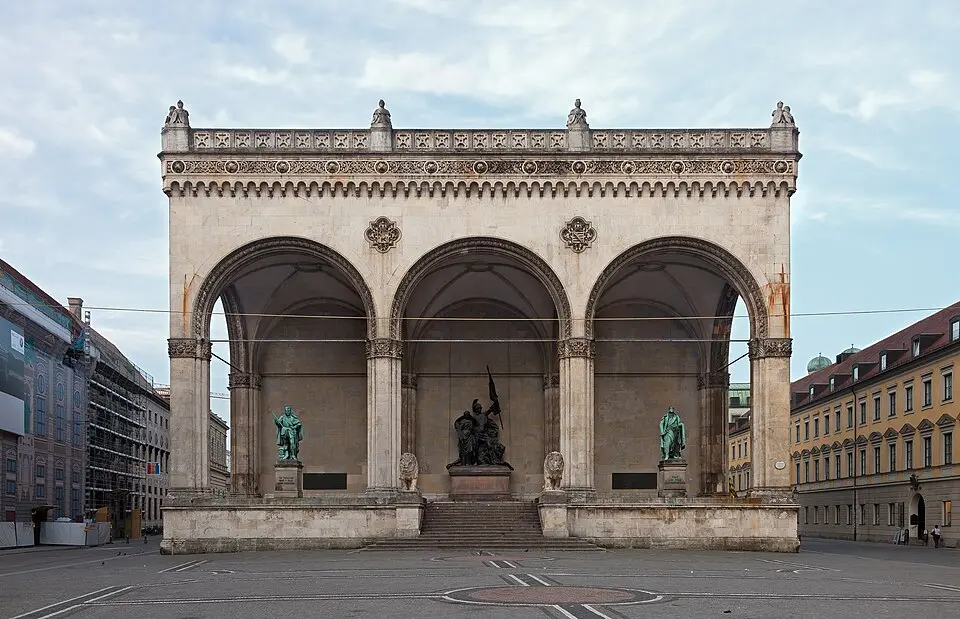
The Feldherrnhalle (Field Marshals' Hall) is a striking neoclassical monument that shapes the look of Odeonsplatz in Munich's Altstadt-Lehel district. The building was constructed of Kelheim limestone between 1841 and 1844 on the orders of King Ludwig I. The architect Friedrich von Gärtner modeled the design on the Loggia dei Lanzi in Florence, though without creating an exact copy. Thanks to the raised outdoor staircase, the structure makes an even more monumental impression than its Italian predecessor. The hall originally served as the southern gateway to Ludwigstrasse, making the transition from the historic old town to the new grand boulevard more harmonious and softening the urban axes. In this way it architecturally corresponds with the Victory Gate (Siegestor), which lies one kilometer away.
Inside the hall, you'll find two important monuments to Bavarian military history. Beneath the eastern arch stands the Tilly Monument, honoring Field Marshal Johann T'Serclaes von Tilly, who led the troops of the Catholic League during the Thirty Years' War. The western arch is dedicated to the Wrede Monument, which commemorates Field Marshal Carl Philipp von Wrede, who led Bavaria into the Wars of Liberation in 1813. Both works were designed by Ludwig von Schwanthaler in 1844 and cast by Ferdinand von Miller. In the middle of the back wall there is also an Army Monument, installed in 1892 at the request of Prince Regent Luitpold. This sculpture shows an ancient warrior holding a shield over an allegory of peace. The depiction deliberately avoids aggressive battle scenes and imperial symbolism in order to emphasize the defensive character of the Bavarian army and the peace that followed the wars of the 19th century.
The history of this site is inseparably linked to the events of the 20th century. On November 9, 1923, the march of Adolf Hitler and his followers ended in bloodshed in front of the Feldherrnhalle when the Bavarian State Police stopped the putsch. Four police officers, thirteen putschists, and one uninvolved onlooker lost their lives in the shooting. After the Nazis seized power in 1933, the site became a central stage for propaganda. A memorial plaque for the slain putschists, guarded by an SS honor guard, forced passersby to give the Nazi salute. Many Munich residents therefore bypassed the hall via Viscardigasse, which is still jokingly called the Drückebergergassl ("shirkers' alley") to this day. After World War II, the propagandistic elements were removed, and the damage from the air raids, which was relatively minor, was repaired over the following decades.
Today the Feldherrnhalle is an important historical site that helps visitors understand the complex history of Bavaria and Germany. Since 2025, the structure has been undergoing a comprehensive overhaul that is expected to take three years. The two marble lions, which have flanked the staircase since 1906 and were originally intended for a monument in Nuremberg, complete the picture. A memorial plaque on the opposite west side of the Residenz now commemorates the four police officers killed in the 1923 putsch, after a floor plaque previously laid in front of the hall was removed so that the tribute could be consolidated in a more fitting location.
At a glance
- Category
- Sight › Historic sites
- Rating
- no reviews yet · write a review
- Address
- Residenzstraße 1
80333 Munich, Germany - District
- Altstadt-Lehel
- Phone
- +4989290671
- Website
- www.schloesser.bayern.de
- —
- Coordinates
- 48.14177° N · 11.57736° E
- Data quality
- confidence 0.95
- Identifier
- ID d8394f11-104…
Part of the tour
Getting to Know Munich: From Stachus to the Siegestor →Location & surroundings
Toggle layersFAQ about Feldherrnhalle
quick answersWhat is the Feldherrnhalle in Munich?
The Feldherrnhalle is a neoclassical monument on Odeonsplatz in Munich's Altstadt-Lehel district (Residenzstraße 1). King Ludwig I had it built from Kelheim limestone between 1841 and 1844; the architect Friedrich von Gärtner designed it after the model of the Loggia dei Lanzi in Florence. It marks the southern start of Ludwigstraße and architecturally echoes the Siegestor (Victory Gate), about a kilometer away.
Which monuments stand in the Feldherrnhalle in Munich?
The Feldherrnhalle in Munich houses the Tilly Monument, the Wrede Monument, and an Army Monument. Under the eastern arch, the Tilly Monument commemorates Field Marshal Johann T'Serclaes von Tilly; under the western arch, the Wrede Monument honors Field Marshal Carl Philipp von Wrede. Ludwig von Schwanthaler designed both in 1844, and Ferdinand von Miller cast them. The Army Monument on the back wall was erected in 1892 at the wish of Prince Regent Luitpold and shows an ancient warrior holding a shield over an allegory of peace.
What happened at the Feldherrnhalle in 1923, and why is Viscardigasse called Drückebergergassl?
On November 9, 1923, the Bavarian State Police stopped the march of Adolf Hitler and his followers in front of the Feldherrnhalle in Munich. Four police officers, thirteen putschists, and one uninvolved onlooker died in the shooting. From 1933 on, a memorial plaque for the putschists at the Feldherrnhalle, guarded by the SS, forced passersby to give a salute, which is why many Munich residents took a detour through Viscardigasse, still jokingly known today as Drückebergergassl ("Shirkers' Alley").
Is the Feldherrnhalle in Munich currently being renovated?
Yes, the Feldherrnhalle in Munich has been undergoing a comprehensive renovation since 2025. The work is expected to take three years. If you visit the hall, you should therefore expect some restrictions due to the construction site.
What can you see around the Feldherrnhalle in Munich?
Right around the Feldherrnhalle in Munich's Altstadt, you'll find several historic buildings and museums. travelguide195 lists, among others, the Preysing Palais (about 115 ft away), Viscardigasse (about 180 ft), Odeonsplatz (about 270 ft), the Egyptian Museum (about 330 ft), and the Palais Moy (about 355 ft). Within 500 meters, travelguide195 also lists around 122 restaurants, and the Feldherrnhalle is part of the tour "Getting to Know Munich: From Stachus to Siegestor."
Ratings & comments
none yetNear Feldherrnhalle
closest 5 per category · 2 kmSights
Museums
Hotels
More:Historic sites in Munich (291)Sights in Altstadt-Lehel (114)All sights in Munich (375)
300 places within 2 km loaded.
You need a free account to leave reviews and photos – that keeps comments genuine and lets you edit them later.