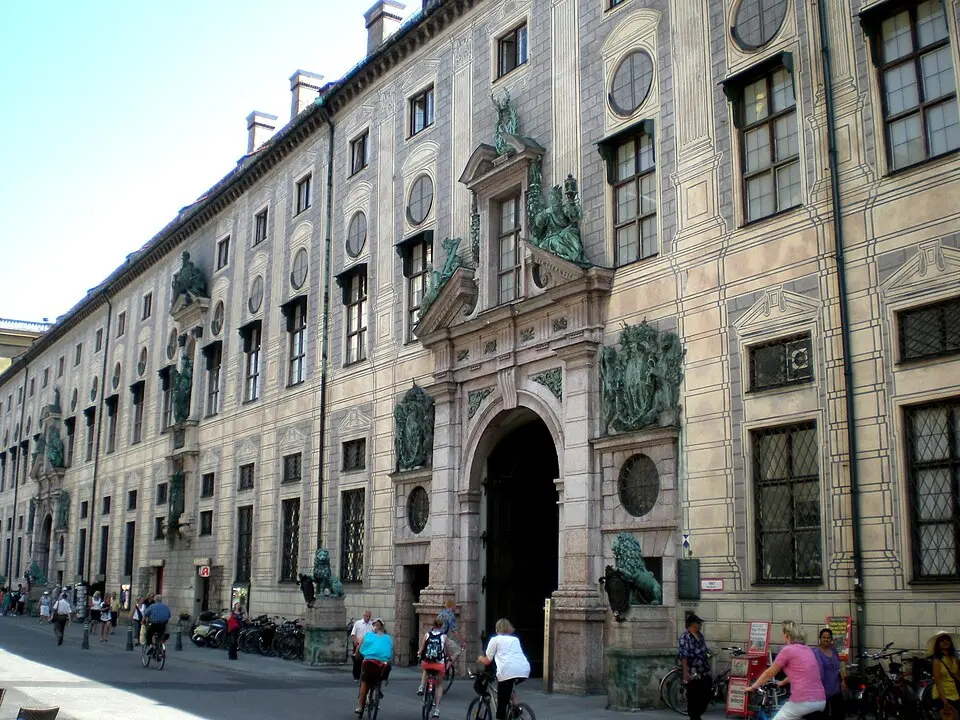
About Residenz Museum
The Munich Residenz is the largest city palace in Germany and served for more than four centuries as the seat of the Bavarian Wittelsbach dynasty, from the dukes to the kings. One of the most important palace museums in Europe, it draws visitors with its monumental architecture and rich history. The complex covers an area of more than 40,000 square meters and includes not only the palace buildings themselves but also the Hofgarten, the Marstall (royal stables), and the All Saints' Court Church (Allerheiligen-Hofkirche). Originally conceived as a small fortified castle, the complex was expanded by generations of architects in the Renaissance, Baroque, Rococo, and Neoclassical styles into an imposing four-wing complex.
The roots of the site reach far back in history, even before the first castle was mentioned. Archaeological finds attest to settlement since the Bronze Age, while the first documentary mention of a fortified site dates to 1336. In the late 14th century, the so-called Neuveste, a Gothic moated castle, was built in the northeast corner; from the city it could be reached only by a fortified bridge. This fortress initially served as a defense against the townspeople before it gradually lost its military character and was converted into the ducal residence. Even today, the vaulted cellars and foundation walls beneath the Apothekenhof, marked by red stones in the paving, bear witness to this early phase.
The transition to a modern-era residence began under Duke William IV, who moved his seat to the Neuveste and had the first Hofgarten laid out. Under his successor Albrecht V, the complex expanded northward with the construction of the Antiquarium. This hall, the largest Renaissance hall north of the Alps, housed the court library and the sculpture collection. Construction continued with the addition of further courtyards such as the Grottenhof and the Brunnenhof, which served as settings for court festivities and receptions. The architecture of this period reflects the court's growing desire for grandeur and display.
Under Duke Maximilian I, the Residenz experienced another great boom. He had the Maximilian Residence built and the Kaiserhof (Imperial Court) designed, which was decorated with frescoes and magnificent door frames. The four bronze lions in front of the entrance symbolize the virtues of rulers and are a well-known landmark of the site. The Kaiserhof served as the highest-ranking guest apartments for imperial visitors. This building phase gave the Residenz a grandeur that impressed contemporary observers and made it one of the most important palaces in Europe.
The Baroque and Rococo splendor was expanded further under Elector Charles Albert and his consort Henriette Adelaide. The Electress's apartment, known as the Papal Rooms, and the Rich Rooms (Reiche Zimmer) with the Green Gallery testify to the court's luxurious lifestyle. Especially noteworthy is the Cuvilliés Theater, a Rococo-style theater with tiered boxes that was reserved exclusively for the court. It was built as a freestanding structure in the Hofgarten to minimize the risk of fire, and it featured a lifting mechanism that made it possible to raise the floor and use the space as a banquet hall.
With the elevation of Bavaria to a kingdom in the 19th century, the Neoclassical expansion began under King Ludwig I. The architect Leo von Klenze designed the Königsbau on Max-Joseph-Platz and the Festsaalbau (Banqueting Hall Building) on the Hofgarten. The Königsbau, inspired by Italian palaces, now houses the Nibelungen Halls with the first monumental depictions of the Nibelungenlied, as well as the King's Apartments. The Festsaalbau, with its long façade facing the Hofgarten, once housed the Great Throne Room and the Imperial Halls, which were used for state functions and ceremonies.
The All Saints' Court Church, also a work by Klenze, completes the ensemble on the east side. It was built in the Byzantine-Romanesque style and served as the palace chapel. The Marstall, built opposite the east side, housed the royal riding school and the stables. The Court Riding School, with its monumental round-arched portal, is considered one of Klenze's most accomplished early works and is now used as a theater. These buildings gave the Residenz its final, stately character.
After its destruction in World War II, in which almost the entire roof and many interior rooms were lost, the Residenz was rebuilt under the direction of Otto Meitinger and other experts. The reconstruction was possible only because much of the furniture and wall paneling had been moved to safety before the bombing raids. Today the Residenz is a museum with more than 150 showrooms documenting the history and wealth of the Wittelsbachs. You can explore the state rooms, the kings' living quarters, and the various apartments.
A highlight of the museum is the Treasury (Schatzkammer), housed on the ground floor of the Königsbau. It holds the Wittelsbach family jewels of Bavaria, including goldsmiths' work, jewels, and regalia from the early Middle Ages to the Neoclassical period. Among the most famous pieces are the crown of Empress Kunigunde, the Crown of Henry (Heinrichskrone), and the Palatinate Crown. The collection comprises more than 1,200 individual pieces and ranks among the most precious in the world. The Porcelain Rooms and the Miniatures Cabinet are also exhibitions worth seeing, underscoring the diversity of the collection.
The Hofgarten, which extends north of the Festsaalbau, offers a quiet contrast to the splendor of the interiors. It was laid out in the 16th century and later expanded. In the middle of the garden stands the Temple of Diana, a pavilion designed by Heinrich Schön the Elder. The garden is a popular spot for strolling and offers insight into the garden architecture history of the Residenz. Together with the historic buildings, the Hofgarten forms an important part of the overall picture of the Munich Residenz.
Today the Residenz is not only a museum but also a living place of cultural significance. The Herkulessaal in the Festsaalbau is used as a concert hall, and the Nibelungen Halls are open to the public. The audio guide, available in several languages, helps you better understand the history and the works of art. The Residenz is a testament to Bavarian history and an important cultural treasure that reflects the development of architecture and court life over the centuries.
At a glance
- Category
- Sight › Palaces
- Rating
- no reviews yet · write a review
- Address
- Residenzstraße 1
80333 Munich, Germany - District
- Altstadt-Lehel
- Phone
- +498929067219
- Website
- www.residenz-muenchen.de
- —
- Coordinates
- 48.14043° N · 11.57836° E
- Data quality
- confidence 0.99
- Identifier
- ID e470de3a-1da…
Part of the tour
Getting to Know Munich: From Stachus to the Siegestor →Location & surroundings
Toggle layersFAQ about Residenz Museum
quick answersWhat is the Residenz Museum in Munich?
The Residenz Museum in Munich is the palace museum inside the Munich Residenz, the largest city palace in Germany. For more than four centuries the Residenz was the seat of the Bavarian Wittelsbach dynasty, from the dukes to the kings, and it is considered one of the most important palace museums in Europe. The complex covers more than 40,000 square meters and includes not only the palace buildings but also the Hofgarten, the Marstall (former royal stables) and the Allerheiligen-Hofkirche (All Saints' Court Church).
How did the Munich Residenz come to be?
The Munich Residenz grew from a small fortified castle into a four-wing complex combining Renaissance, Baroque, Rococo and Neoclassical styles. A fortified site (Burgstall) is first mentioned in documents in 1336, and in the late 14th century the Neuveste was built, a Gothic moated castle reachable only by a fortified bridge. Duke William IV moved his residence into the Neuveste, Albert V had the Antiquarium built, and Maximilian I erected the Maximilian Residenz with the Kaiserhof (Imperial Court). Red stones in the paving of the Apothekenhof (Pharmacy Courtyard) still mark the foundations of the early castle today.
What are the highlights of the Residenz Museum in Munich?
Highlights of the Residenz Museum in Munich include the Antiquarium, the largest Renaissance hall north of the Alps, which once housed the court library and a sculpture collection. Also worth seeing are the Grottenhof (Grotto Courtyard), the Brunnenhof (Fountain Courtyard) and the fresco-adorned Kaiserhof, which served as the highest-ranking guest apartment for imperial visitors. The Papal Rooms and the Rich Rooms with the Green Gallery showcase Baroque and Rococo splendor. The four bronze lions in front of the entrance, which symbolize the virtues of a ruler, are a well-known landmark of the Residenz.
What can you see around the Residenz Museum in Munich?
Around the Residenz Museum in Munich, several museums and historic sites are within walking distance. travelguide195 lists the State Coin Collection (Staatliche Münzsammlung) (about 90 m), the Palais Toerring-Jettenbach (about 120 m), the Allerheiligen-Hofkirche (about 130 m) and the Preysing Palais (about 140 m), among others. Also nearby are the Viscardigasse, the Drückebergergasse and the Feldherrnhalle, about 170 m away.
Where is the Residenz Museum in Munich?
The Residenz Museum is located at Residenzstrasse 1 in Munich's Altstadt-Lehel district, in the heart of the city center. travelguide195 lists around 188 restaurants within 500 meters. The Residenz is also a stop on the tour "Getting to Know Munich: From Stachus to Siegestor."
Ratings & comments
none yetNear Residenz Museum
closest 5 per category · 2 kmSights
Restaurants
Museums
Hotels
More:Sights in Altstadt-Lehel (114)All sights in Munich (375)
300 places within 2 km loaded.
You need a free account to leave reviews and photos – that keeps comments genuine and lets you edit them later.
Royal Palace and seat of government of the Wittelsbach dynasty, bombed in wartime but rebuilt. The two principal areas are the Treasury and the Museum (separate admission €9 each). The Treasury ( Schatzkammer ) has a huge collection of ecclesiastical and secular bling, such as the royal crowns, orb and sceptre. In the Museum, the Antiquarium is the barrel-vaulted banqueting hall. The Papal Rooms accommodated Pius VI on his visit to Munich and are Baroque. The Ancestral Gallery, Porcelain Cabinet and Ornate Rooms are Rococo. The neo-classical Königsbau, added in the 19th century, houses the Charlotte Rooms, the royal apartments and the Halls of Battles. There's an additional charge for the Cuvilliés Theatre.
Source: Wikivoyage, „Munich/Altstadt“ · authors per page history · CC BY-SA 4.0 · as of 10/19/2022