About Toy Museum Munich
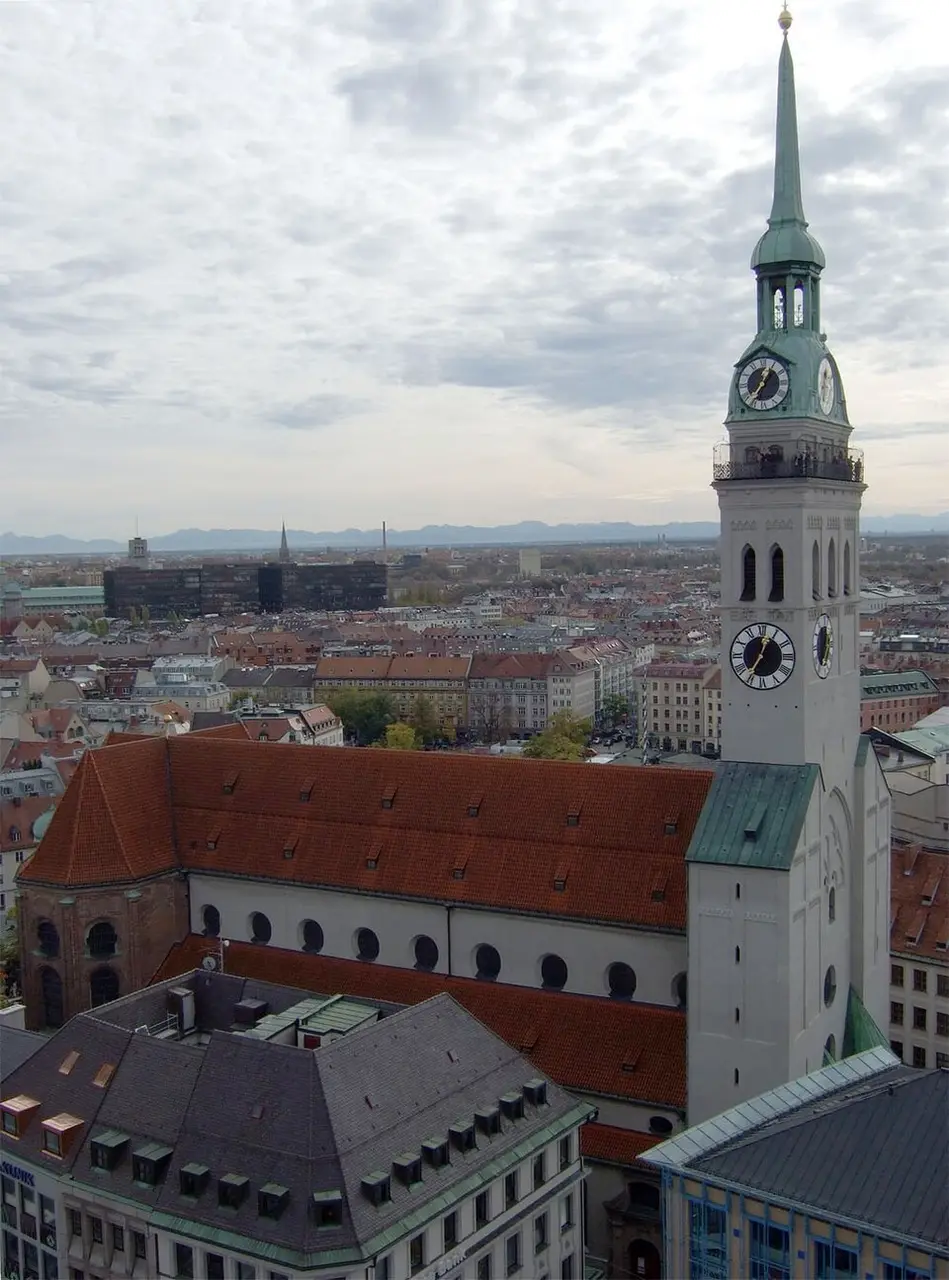
St. Peter's Church, also known as Peterskirche, is the oldest parish church in the Bavarian capital and one of Munich's central landmarks. It sits atop the Petersbergl, the only notable rise within the historic Old Town. From this elevated position, visitors enjoy a sweeping view over the city's rooftops, with Marienplatz to the northwest, the Viktualienmarkt to the southeast, and the Rindermarkt to the southwest. The origins of the sacred building go back to the 12th century, with the earliest documented reference dating from 1225 or 1226. At that time, in connection with a visit by Duke Ludwig of Kelheim, the church was referred to as ecclesia sancti Petri Muonichen.
The building's present form goes back to a Gothic reconstruction that began in 1278 and was consecrated by Bishop Emicho of Freising in 1294. This new building was not primarily driven by the needs of a growing congregation, since the parish district had previously shrunk, but served to preserve the parish's prestige. A major city fire in 1327 largely destroyed the east choir and the towers, leading to a reconstruction in which the church was lengthened and expanded with side chapels. These chapels were often endowed by patrician families and also served as burial places. In the 14th century the westwork was remodeled, and the original twin-tower design was replaced by a single, massive tower, known today as the "Alter Peter" (Old Peter).
Over the centuries the church underwent several stylistic transformations. After a lightning strike in 1607, the tower received a new crown. In the 17th century the Gothic east choir was demolished and replaced by a Baroque triconch choir to ease the lack of space. The church's real flowering of splendor, however, came in the 18th century, when the choir and nave were redesigned in the Late Baroque style. Artists of national renown such as Egid Quirin Asam and Johann Baptist Zimmermann took part in this remodeling, which gave the interior its richly decorated appearance today.
The exterior of the three-aisled basilica is characterized by round-arched windows and circular windows. While the walls and the tower are plastered, the massive choir complex is built of exposed brick. The 91-meter-high tower is flanked by two early Gothic tower stumps that recall the original facade. A special attraction for visitors is the viewing platform at a height of 56 meters, reached by 306 steps. On a clear day, the view from there extends up to 100 kilometers. The platform was formerly the site of the tower keeper's room, where a fire watchman was on duty until the 20th century.
Inside, the magnificent Baroque high altar, created between 1730 and 1734, dominates. It is one of the most important altar creations of Bavarian Baroque and combines the works of several masters. At its center stands a Late Gothic figure of St. Peter by Erasmus Grasser, taken over from the earlier altar. Grouped around it are figures of the Church Fathers, created by Egid Quirin Asam. The tiara on the figure of Peter is a Baroque addition, traditionally removed during a sede vacante and put back on when a new pope takes office. The Rococo tabernacle is the work of the goldsmith Joseph Friedrich I. Canzler.
The ceiling frescoes in the nave, which depict scenes from the life of the Apostle Peter, were painted by Johann Baptist Zimmermann. After their destruction in World War II, they were reconstructed from 1999 to 2000 by the fresco painter Hermenegild Peiker. The stucco work is also by Zimmermann and lends the space an illusionistic depth. Other art treasures in the church include the so-called Schrenk Altar, the oldest surviving Gothic sandstone altar in Munich, as well as various epitaphs and reliquary shrines that recall the history of the city and its citizens.
The organ installation of St. Peter's is another highlight. The current main organ was built in 2003 by the Klais company of Bonn and has 58 stops on four manuals and pedal. It can be connected to the choir organ on the north gallery, completed in 2011. This choir organ is mounted on rails and can be used as a mobile echo division. It has special stops such as a tubular bell glockenspiel and a birdsong stop that imitates the song of a nightingale.
The church's history is inseparably linked with the destruction of World War II. In the bombing raids of 1944 and 1945, St. Peter's was largely destroyed, leaving only the burned-out tower stump and the outer walls of the choir standing. Reconstruction began in 1946 and was financed by donations from around the world. In 1951 the cross was put back on the tower spire, and in 1954 Cardinal Wendel consecrated the newly built high altar. The reconstruction of the interior, especially the ceiling frescoes, was not completed until 2000.
The bells of St. Peter's consist of eight bells, including four historic ones. The oldest is the Provisurglocke, cast after the city fire of 1327. It was formerly rung for deaths and executions. The largest bell, the Jubilee Bell, was cast in 1958 for Munich's 800th anniversary and is one of the lowest-pitched bells in Bavaria. The peal forms one of the largest and deepest-toned ensembles in the city and is used today according to a detailed ringing order for various liturgical occasions.
St. Peter's also houses three confraternities that have existed for centuries and maintain particular liturgical traditions. These include the Corpus Christi Archconfraternity, the Maria Hilf Confraternity, and the Confraternity of St. Isidore and Notburga. These communities contribute to the living tradition of solemn liturgy, which remains at the heart of St. Peter's. Mass is still celebrated at the high altar facing east, underscoring the church's historical continuity.
For visitors, St. Peter's is not only a place of devotion but also a cultural center that documents Munich's history in an impressive way. The combination of Gothic architecture, Baroque furnishings, and modern restoration makes it a unique experience. The view from the tower, the artful frescoes, and the historic organ invite you to explore the depth of the city's history. St. Peter's thus remains an indispensable part of Munich's cultural heritage and a symbol of the city's resilience and artistic tradition.
At a glance
- Category
- Museum › History museums
- Rating
- no reviews yet · write a review
- Address
- Marienplatz 15
80331 Munich, Germany - District
- Altstadt-Lehel
- Phone
- +4989294001
- Website
- www.spielzeugmuseummuenchen.de
- spielzeugmuseummuenchen@gmail.com
- Coordinates
- 48.13672° N · 11.57693° E
- Data quality
- confidence 1.00
- Identifier
- ID a7679c4c-66a…
Location & surroundings
Toggle layersRatings & comments
none yetNear Toy Museum Munich
closest 5 per category · 2 kmSights
Museums
Hotels
More:Museums in Altstadt-Lehel (34)All museums in Munich (164)
300 places within 2 km loaded.
You need a free account to leave reviews and photos – that keeps comments genuine and lets you edit them later.