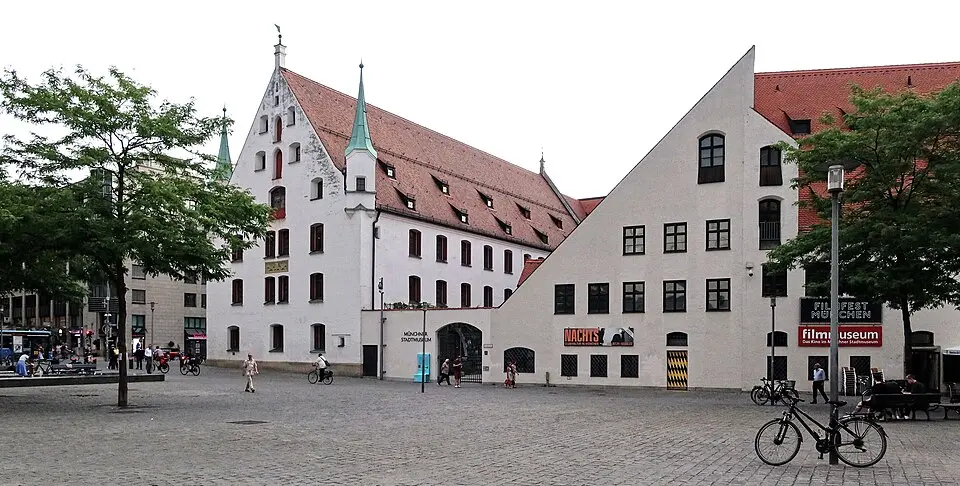
About Münchner Stadtmuseum
The Munich City Museum (Münchner Stadtmuseum) on St.-Jakobs-Platz in the Old Town is considered the material memory of the Bavarian state capital. It was founded in 1888 by the city archivist at the time, Ernst von Destouches, who was inspired to create the institution after acquiring a historic collection of pictures. Originally housed in the former Zeughaus (arsenal), a late medieval building dating from 1500, the museum grew steadily over the course of the 20th century. Several extensions, including the wings by Hans Grässel, Hermann Leitenstorfer, and Gustav Gsaenger, created a sprawling complex that now occupies the entire city block between St.-Jakobs-Platz, Oberanger, and Rosental. The ensemble combines historic fabric with modern museum technology and includes, in addition to the restored Zeughaus, the Marstall (royal stables), which was rebuilt after World War II, as well as more recent additions.
The museum's collections reflect how the city has seen itself in the past and sees itself today. At the heart of the permanent exhibition "Typisch München!" are around 400 objects from the museum's own holdings, illuminating the city's cultural history from its founding legend to the present day. Highlights include Erasmus Grasser's Moriskentänzer (Morris dancers), a city model from 1570, and the four original figures from the Mariensäule (Marian Column). Other focal points include the extensive photography collection with around three million objects, the collection of prints and paintings with works by important Munich artists, and the departments devoted to applied arts, musical instruments, and puppet theater. A separate department is dedicated to the history of National Socialism in Munich, while the Filmmuseum, Germany's first municipal cinema, screens outstanding works from film history.
Since early 2024, the museum has been closed for a comprehensive renovation and redesign. As part of this project, the main entrance will be moved to the north side facing Rindermarkt to open the museum up to the city. The inner courtyard will receive a large glass roof that will serve as an open museum lobby. While construction continues, which is expected to last until 2031, the collections are being stored temporarily in depots. The museum is using the time to try out new formats, including interim exhibitions at other locations in Munich and an open-air display along the construction fence that offers insights into the history of the museum and the city.
At a glance
- Category
- Museum › History museums
- Rating
- no reviews yet · write a review
- Address
- Sankt-Jakobs-Platz 1
80331 Munich, Germany - District
- Altstadt-Lehel
- Phone
- +4989233722370
- Website
- www.muenchner-stadtmuseum.de
- dultladen@web.de
- Coordinates
- 48.13494° N · 11.57299° E
- Data quality
- confidence 1.00
- Identifier
- ID 02c34a0b-d5a…
Location & surroundings
Toggle layersRatings & comments
none yetNear Münchner Stadtmuseum
closest 5 per category · 2 kmSights
Museums
Hotels
More:Museums in Altstadt-Lehel (34)All museums in Munich (164)
300 places within 2 km loaded.
You need a free account to leave reviews and photos – that keeps comments genuine and lets you edit them later.
Extensive museum, occupying most of a city block; absorbing but signage is only in German. The oldest part of the building is an armory of 1500, the newest is the former Uhlfelder department store (all bombed in wartime, but the collections had been taken to safety), and it's growing still. The permanent exhibitions are "Typically Munich!" (how the city acquired its identity), Migration, National Socialism (the movement was launched here), Puppets and Fairground, and Music. "Collections" (whose highlights may figure in exhibitions) include photography, applied arts, graphics, textiles and music. Temporary exhibitions are generally on site for a year or so. There's also a film museum and theatre with daily screenings. Check ahead online for gallery closures, and search the online catalogue.
Source: Wikivoyage, „Munich/Altstadt“ · authors per page history · CC BY-SA 4.0 · as of 10/7/2022