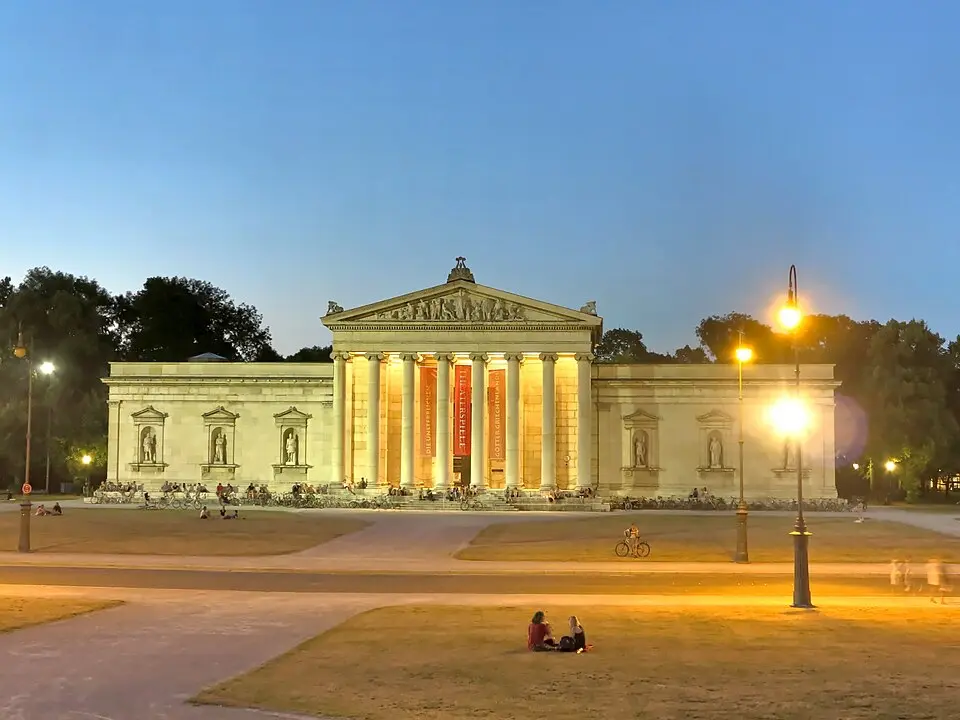
About Maxvorstadt
Maxvorstadt, Munich's third city district, stretches directly north of the Old Town between Odeonsplatz and Stachus. It is bordered by the English Garden to the east, while Georgenstraße marks the boundary with Schwabing. Bavaria's first planned city expansion, it was conceived between 1805 and 1810 under King Maximilian I Joseph. Most of the actual construction, however, did not take place until after 1825 under Ludwig I, in the Neoclassical style. The street network follows a square grid, with Ludwigstraße and Schleißheimer Straße serving as the central north-south axes, crossed by several east-west connections such as Theresienstraße and Gabelsbergerstraße.
Culturally, the district is defined by the Kunstareal München (Munich Art Quarter), which offers an extraordinary concentration of museums and collections. Here you'll find the Alte and Neue Pinakothek, the Lenbachhaus with the Kunstbau, the State Graphic Collection, the Glyptothek, the Antikensammlung (Museum of Classical Antiquities), and the Museum of Sacred Art in the Georgianum. These are complemented by the Pinakothek der Moderne and the Museum Brandhorst. The district is also home to the Academy of Fine Arts, the University of Music and Performing Arts, Ludwig Maximilian University, and the Technical University. This concentration of educational institutions makes Maxvorstadt a typical academic and student neighborhood, where far more people are out and about during the day than actually live there.
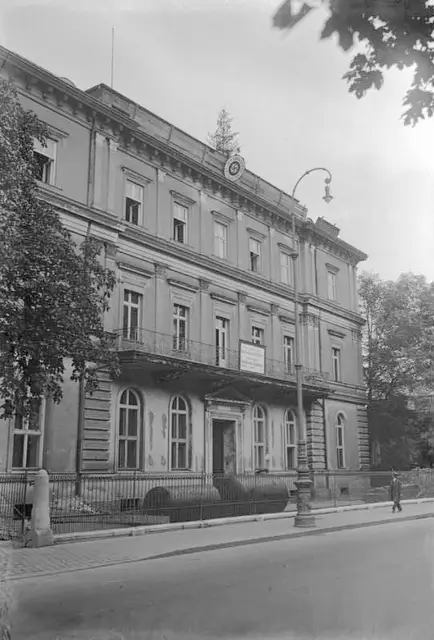
The district's history is inseparably tied to the Nazi era. Hitler's early apartment was located on Schleißheimer Straße, while the "Brown House" on Brienner Straße housed the Nazi Party headquarters. Today, the NS Documentation Center stands on this site as a reminder of the past. Other historic sites include Königsplatz, which served as a parade ground, and the Wittelsbach Palace, which housed the Gestapo headquarters. The two Neoclassical buildings on Königsplatz, including the so-called "Führerbau," where the Munich Agreement was signed, also bear witness to this era.
Besides its cultural and historical highlights, Maxvorstadt is home to striking religious buildings such as St. Joseph's Church, St. Ludwig, and the Protestant university church of St. Markus. The Old Northern Cemetery, where no burials have taken place since 1939, is now used as a park. In the south of the district, the Löwenbräu and Spaten-Franziskanerbräu breweries sit right next to each other. In recent decades, the character of the neighborhood has continued to change as former industrial and commercial areas have been converted into residential and working quarters. New housing, offices, and educational facilities have sprung up on land that became available, underscoring the district's dynamic development.
At a glance
- Category
- Sight › Historic sites
- Rating
- no reviews yet · write a review
- Address
- —
Munich, Germany - District
- Kunstareal
- Phone
- —
- Website
- —
- —
- Coordinates
- 48.15000° N · 11.56944° E
- Data quality
- confidence 0.77
- Identifier
- ID 033cc46f-dd6…
Location & surroundings
Toggle layersRatings & comments
none yetNear Maxvorstadt
closest 5 per category · 2 kmSights
Museums
Hotels
More:Historic sites in Munich (291)All sights in Munich (375)
300 places within 2 km loaded.
You need a free account to leave reviews and photos – that keeps comments genuine and lets you edit them later.