About Alte Pinakothek
The Alte Pinakothek in Munich is one of the most important art museums in the world and forms the historic heart of Munich's Kunstareal, or art district. As part of the Bavarian State Painting Collections, it houses one of the most extensive collections of European painting from the Middle Ages to the mid-18th century. The museum, which opened in 1836, is known not only for its priceless holdings but also for its groundbreaking architecture: the building is considered the first museum in history designed purely for the display of paintings. Here you will find a dense concentration of masterpieces assembled over the centuries by the Wittelsbach dukes and kings.
The history of the collection goes back to the 16th century, when Duke Albrecht V of Bavaria had a Kunstkammer, or cabinet of curiosities, built. His father, Duke Wilhelm IV, had already commissioned important history paintings, including the famous Battle of Alexander by Albrecht Altdorfer. Under Maximilian I, the collection grew through the acquisition of works by Albrecht Dürer and large hunting scenes by Peter Paul Rubens. The holdings suffered heavy losses during the Thirty Years' War, however, when Swedish troops carried numerous paintings off to Stockholm. Another important boost came from Maximilian II Emanuel, who as governor of the Netherlands acquired large quantities of Dutch and Flemish painting, including many works from Rubens's personal estate.
A substantial part of today's collection comes from the Palatinate galleries, which came to Munich after Bavaria and the Palatinate were united. The Düsseldorf Gallery, which rose to become one of the best in Europe under Elector Johann Wilhelm, brought valuable treasures with it, including Raphael's Holy Family from the House of Canigiani, which had come to the family as a wedding gift. The Mannheim and Zweibrücken collections were also absorbed into the holdings, the latter having been moved to Munich to escape the French revolutionary armies. This merging of various princely collections explains the gallery's particular strengths in certain regions and periods, as well as the gaps that arose from the changing tastes of the individual collectors.
King Ludwig I of Bavaria is regarded as the true founder of the Pinakothek as a public museum. Driven by the ideal of public education, he commissioned his architect Leo von Klenze to build an imposing museum on the northern edge of the city. Ludwig I also purchased masterpieces deliberately, particularly Old German and Italian Renaissance art. The acquisition of the collections of the Boisserée brothers and the Prince of Wallerstein laid the foundation for the now much-admired holdings of Old German painting. The museum's opening on October 16, 1836, marked the beginning of a new era in which art treasures were made accessible to a broad public for the first time.
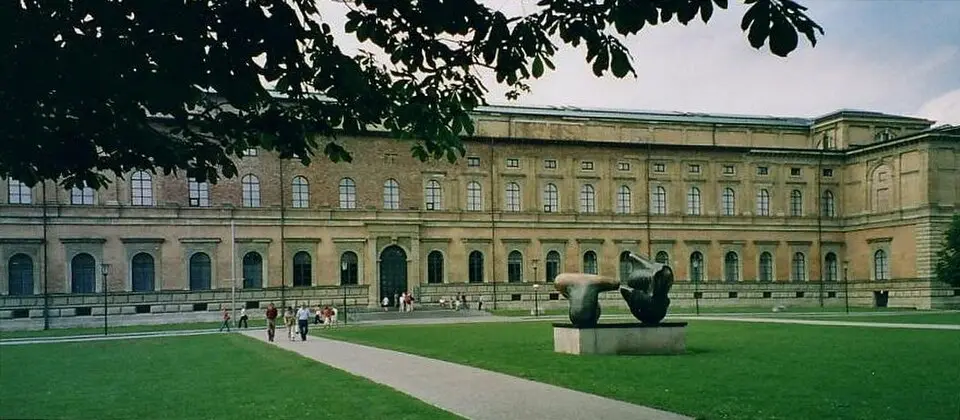
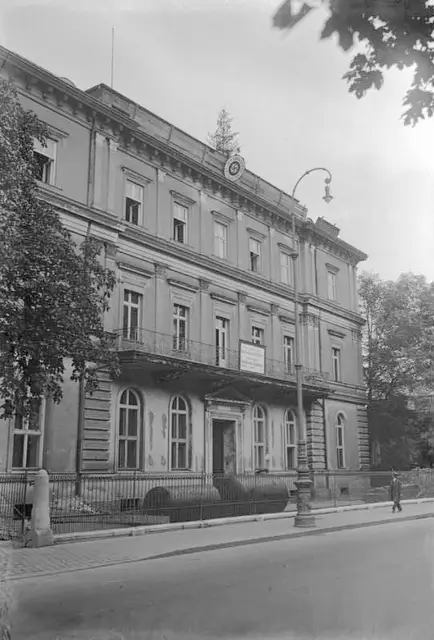
The building itself, designed by Leo von Klenze, was the largest museum building in the world when it was completed. It broke with the tradition of palace-like museums and set new standards in museum architecture. Skylights and the special arrangement of north-lit cabinets created ideal lighting for the paintings, which was revolutionary for its time. This conceptual and technical innovation made the Alte Pinakothek a model for many other galleries across Europe. The exterior of the building is closely tied to its function as a pure gallery and stands out clearly from other structures of the early 19th century.
During World War II, the building, especially its central section, was badly damaged. The reconstruction led by Hans Döllgast between 1952 and 1957 is still a subject of debate today. Döllgast moved the main entrance to the north side and converted the vestibule and the main staircase into exhibition rooms. A bomb hit in the south facade was not restored true to the original but closed with a deliberately different infill so that the destruction remains visible. This approach to rebuilding is often rated in monument preservation circles as an outstanding achievement because it honestly reflects the building's history, but it draws mixed opinions from the public.
The exhibition rooms are spread across the ground floor and the first floor, with most of the works on view upstairs. The rooms are divided into large halls and smaller cabinets. The halls primarily display important or large-format works, while the cabinets, which open toward the sculpture park, show smaller and often lesser-known paintings. This layout lets you view the artworks in a quiet atmosphere and experience the different periods and styles separately. The green and red wall coverings, a tradition since the building was constructed, were renewed in the 2000s and contribute to the dignified presentation of the paintings.
Upstairs, the journey through art history begins with Early Netherlandish painting, which is among the finest collections in the world. Here you will find masterpieces by Rogier van der Weyden, Hans Memling, and Dieric Bouts. One highlight is the fragment of a Last Judgment by Hieronymus Bosch. In Old German painting, the Pinakothek holds the most extensive collection of its kind, with works by Albrecht Dürer, Matthias Grünewald, Albrecht Altdorfer, and Lucas Cranach the Elder. Altdorfer's Battle of Alexander and Dürer's Self-Portrait in a Fur-Collared Robe especially draw the eye of visitors.
A central focus of the gallery is Flemish painting of the 16th and 17th centuries, which fills the large halls. The Rubens collection of 72 paintings is the largest in any permanent exhibition in the world. Highlights include The Great Last Judgment, the largest painting on display in the museum, as well as works by Anthony van Dyck and Pieter Bruegel the Elder. Dutch Baroque painting forms another focus, with important works by Rembrandt, Frans Hals, Pieter Lastman, and other masters of the era. The variety of genres, from portraits to landscapes to still lifes, offers a comprehensive look at 17th-century art.
Italian painting is represented from the Gothic period to the Baroque. Among the earliest works is Giotto's Last Supper, followed by Renaissance masterpieces by Leonardo da Vinci, Raphael, Titian, and Sandro Botticelli. Leonardo da Vinci's Madonna of the Carnation is one of the best-known exhibits. In Venetian painting, you will find works by Tintoretto and Paolo Veronese. Spanish painting is also represented by great names such as El Greco, Velázquez, and Murillo; this is the smallest department, but it includes all the major masters of the school.
Finally, the Alte Pinakothek also shows French painting of the 17th and 18th centuries, which forms a smaller department despite the Wittelsbachs' close ties to France. Works by Nicolas Poussin, Claude Lorrain, François Boucher, and Jean-Honoré Fragonard are on view here. The gallery thus offers a comprehensive overview of the development of European painting over several centuries. Alongside the permanent exhibition of more than 700 paintings, special exhibitions regularly explore individual artists or themes in greater depth. The Alte Pinakothek is therefore not only a place of preservation but also a vibrant space for art education that attracts visitors from around the world.
At a glance
- Category
- Museum › Art museums
- Rating
- no reviews yet · write a review
- Address
- Barer Str. 27
80333 Munich, Germany - District
- Kunstareal
- Phone
- +498923805216
- Website
- www.pinakothek.de
- info@pinakothek.de
- Coordinates
- 48.14834° N · 11.57031° E
- Data quality
- confidence 0.99
- Identifier
- ID f316cfc7-213…
Location & surroundings
Toggle layersRatings & comments
none yetNear Alte Pinakothek
closest 5 per category · 2 kmRestaurants
Museums
Hotels
More:Art museums in Munich (21)All museums in Munich (164)
300 places within 2 km loaded.
You need a free account to leave reviews and photos – that keeps comments genuine and lets you edit them later.
Contains hundreds of great European masterworks dating from the 14th to the 18th centuries, including the largest Rubens collection in the world. The Alte Pinakothek underwent a major four-year closing and renovation, but reopened in 2017.
Source: Wikivoyage, „European art“ · authors per page history · CC BY-SA 4.0