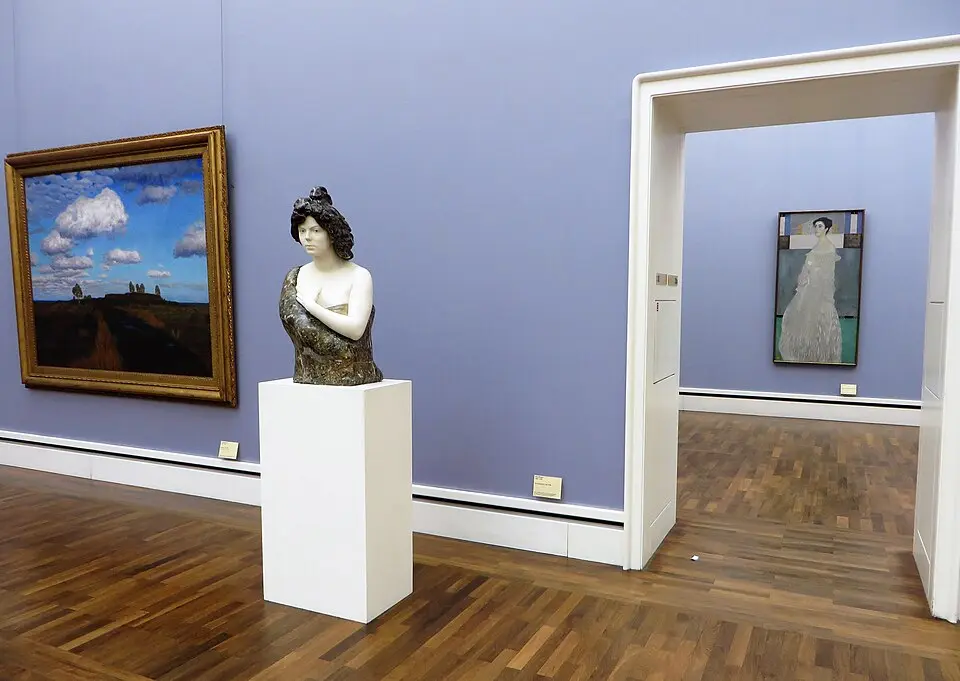
About Neue Pinakothek
The Neue Pinakothek in Munich is one of the most important museums of 19th-century European art. It is located in Munich's Kunstareal (art district) and, together with the Alte Pinakothek and the Pinakothek der Moderne, forms an ensemble of architectural and art-historical significance. While the Alte Pinakothek is devoted to the Old Masters and the Pinakothek der Moderne presents the art of the 20th and 21st centuries, the Neue Pinakothek spans the period from the Enlightenment to the dawn of modernism. The name derives from the Greek word for a hall in which paintings are kept. The museum is part of the Bavarian State Painting Collections, which oversee a major portion of the art holdings of the Free State of Bavaria.
The museum's history begins with King Ludwig I, who opened the gallery in 1853. He wanted to make his private collection of contemporary art accessible to the public and to create a counterpart to the collection of Old Masters. The first building was constructed to designs by Friedrich von Gärtner and stood opposite the Alte Pinakothek. At the outset, the focus was on the Munich School and German Romanticism, though dynastic interests also played a role, for example in the display of paintings depicting Greece, which was ruled by Ludwig's son. Under the direction of Hugo von Tschudi from 1909, the focus shifted increasingly to French artists, leading to the creation of an impressive collection of Impressionists, which was expanded by a donation after Tschudi's death in 1911.
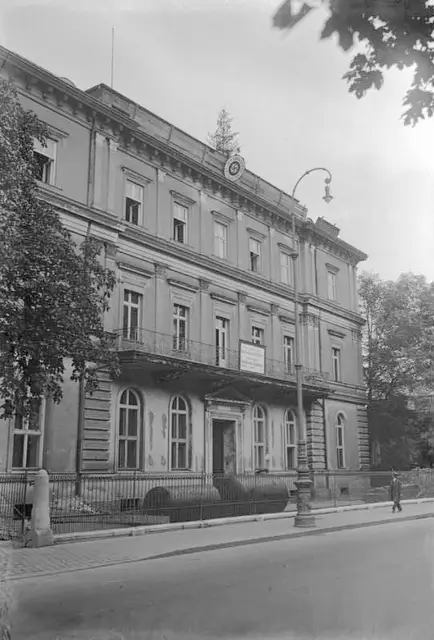
The original building was heavily damaged in World War II and burned out completely in 1944. Because the painting collection had largely been moved to safe storage, it survived the war, but the building itself was demolished. The site lay empty for almost three decades before a decision was made to build anew. After a design competition, the architect Alexander von Branca was commissioned with the design. The foundation stone for the postmodern new building was laid in 1975, and the museum reopened on March 28, 1981. The new building was intended to reconnect the two Pinakotheken both topographically and conceptually.
Alexander von Branca's architecture remains the subject of controversial debate to this day. The exterior consists of a modern reinforced-concrete structure clad in a natural-stone facade. Critics see in this the illusion of a historic stone building, while supporters point to the historical tradition in which facades were often made of decorative materials. The building presents itself through interlocking cubes and elements such as round-arched windows, oriels, and exterior staircases, deliberately borrowed from architectural history. Inside, by contrast, the architect placed great emphasis on the specific needs of museum architecture. The gallery rooms have classical proportions and are equipped with skylights, which are ideal for illuminating paintings.
The tour through the Neue Pinakothek is designed so that visitors can follow the 19th century in a largely chronological order. The sequence of rooms is laid out in the shape of a figure eight, complemented by a parallel system of corridors used to display sculptures. This arrangement allows visitors to follow the natural flow of the exhibition without getting lost, and offers the chance to return to the central foyer at any time. In the exhibition rooms, the architecture deliberately takes a back seat to give the artworks the space they need. Since the opening of the Pinakothek der Moderne in 2002, the Neue Pinakothek has focused even more strongly on 19th-century painting and sculpture, while the boundaries with the neighboring museums are kept open.
The building is currently closed for a comprehensive renovation, which is expected to last until 2030. During this time, selected works can be seen in the east wing of the Alte Pinakothek and in the Sammlung Schack. As part of the renovation, structural changes are also being made to improve access for people with disabilities and to make the foyer more visitor-friendly. A previously inaccessible inner courtyard will be roofed over and made usable for receptions and art education. These measures are intended to improve the quality of the visitor experience, while the exhibition space will essentially remain the same.
The collection of the Neue Pinakothek comprises more than 6,000 works, including over 3,000 paintings and 300 sculptures. In the 22 galleries and ten smaller cabinet rooms, a changing selection of more than 400 works is always on view. The holdings range from international art of the late 18th century, with works by Francisco de Goya and Jacques-Louis David, through German Romanticism with Caspar David Friedrich, to the French Impressionists and Post-Impressionists. Particularly noteworthy is the extensive collection of English painting, which includes works by Thomas Gainsborough, William Turner, and John Constable.
At the Neue Pinakothek, you can gain deep insight into the artistic development of the 19th century. The collection covers various styles, including Neoclassicism, Romanticism, Biedermeier, Realism, Impressionism, and Art Nouveau. Highlights include works by Vincent van Gogh, Paul Cézanne, Claude Monet, and Edvard Munch. The sculpture department also offers impressive pieces by artists such as Auguste Rodin, Bertel Thorvaldsen, and Pablo Picasso. The museum serves not only as a place of preservation but also of education, offering art education programs to deepen your understanding of the works on display.
At a glance
- Category
- Museum › Art museums
- Rating
- no reviews yet · write a review
- Address
- Barer Str. 29
80799 Munich, Germany - District
- Kunstareal
- Phone
- +498923805195
- Website
- www.pinakothek.de
- info@pinakothek.de
- Coordinates
- 48.14968° N · 11.57108° E
- Data quality
- confidence 0.95
- Identifier
- ID a3dff1fa-2ea…
Location & surroundings
Toggle layersRatings & comments
none yetNear Neue Pinakothek
closest 5 per category · 2 kmSights
Restaurants
Museums
Hotels
More:Art museums in Munich (21)All museums in Munich (164)
300 places within 2 km loaded.
You need a free account to leave reviews and photos – that keeps comments genuine and lets you edit them later.
The Neue Pinakothek's collection includes 19th-century European paintings and sculptures. Perhaps the most popular of the Pinakotheks, there is also a very nice café here. Closed for renovation as of September 2026.
Source: Wikivoyage, „European art“ · authors per page history · CC BY-SA 4.0