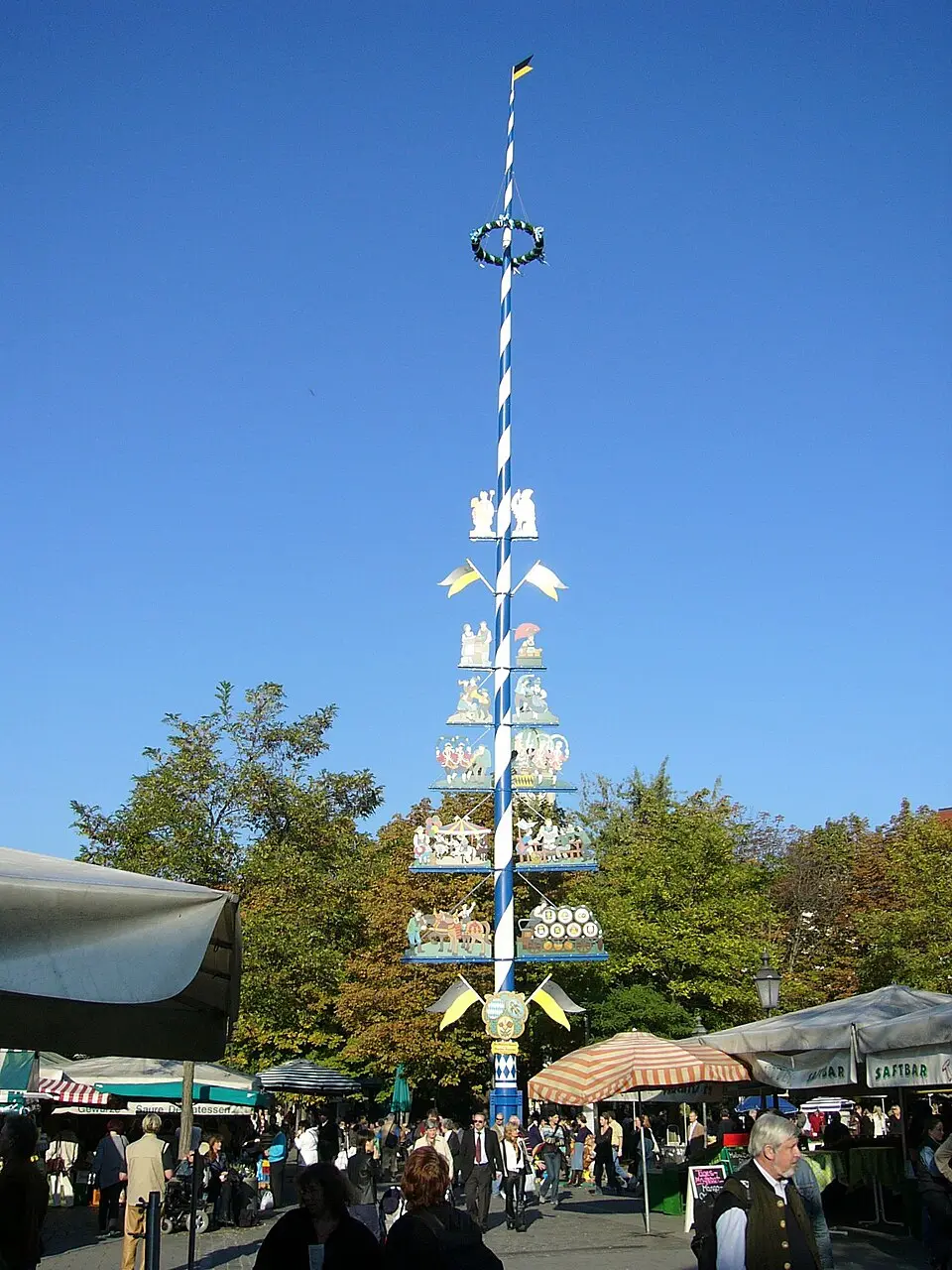
About Maibaum Viktualienmarkt
The Viktualienmarkt in Munich's Old Town is far more than just a place to shop. It is regarded as the city's living room and casts its spell on locals and tourists alike. The market covers more than two hectares (about five acres) and is characterized by permanent stalls with generous displays as well as seasonal pop-up stands. At its heart is a large beer garden, around which the various sections are grouped. The market has been held daily since 1807, though it stays closed on Sundays and public holidays. The name derives from the Latin word for provisions, which was fashionable among the educated middle class in the 19th century. Originally, the site was simply called Marktplatz or Grüner Markt (Green Market).
The market's history is closely tied to the development of Munich. It came about when the old city market on what is now Marienplatz, which had become too small for the trade in grain and agricultural products, was relocated. In 1807, King Max I Joseph ordered the move to the area between the Church of the Holy Spirit and Frauenstraße. Over the following decades, the market grew steadily. In 1885, the old Holy Spirit Hospital was torn down, giving the square a new look. Until 1870, selling spots were still reassigned every day, before permanent stalls were introduced. Over time, halls for butchers, tripe, bread, and fruit were added. In 1890, the market reached its present size.
During World War II, the square was badly damaged in air raids. There was even talk of abandoning the market and building high-rises on this valuable site. But the city administration saved the Viktualienmarkt and rebuilt it. A dramatic episode was the so-called Egg Battle on August 2, 1948, when angry citizens pelted the vendors with food over high prices. From the 1950s on, the market developed into a gourmet destination. In 1969, ahead of the Olympic Games, the market and its stalls were completely renovated. Today the square is home to 107 vendors offering everything from bread and flowers to fish, meat, and handicrafts.
A central landmark is the maypole, which has been donated since 1962 by Munich's six largest breweries through the Association of Munich Breweries. It towers over the market and is renewed at regular intervals by a local young men's club. The beer garden in Section IV, which seats around 1,000, is supplied by the different breweries in turn. The beer is served in plain mugs, and a sign at the tap indicates which brewery is currently supplying it. This arrangement was created so as not to favor any one brewery. Besides the maypole and the beer garden, this section also includes the fish hall and the Waldmarkt (forest market).
The market is also a place of remembrance for Munich's folk singers and comedians. Since 1953, commemorative fountains have enriched the square. The first three fountains were built for Karl Valentin, Weiß Ferdl, and Liesl Karlstadt, initiated by Gustl Feldmeier, who felt that Munich's heart beats strongest right here. Fountains for Ida Schumacher, Elise Aulinger, and Roider Jackl were added later. These six fountain monuments recall the city's cultural history. Water has always played an important role at the market, since several city streams once ran across the site, though they have since disappeared.
The surroundings of the market are steeped in history. To the north, the Alter Peter (Old Peter's Church) and the Church of the Holy Spirit border the area. To the south lies the Schrannenhalle, the predecessor of today's wholesale market hall, which was built in 1852 and partially restored after a fire. The buildings to the south and east were rebuilt after the war and are architecturally more appealing than the postwar buildings to the west. Public streets separate the market from its surroundings, though the area is largely a pedestrian zone. Traditional events are held here regularly, such as the start of Carnival, the Dance of the Market Women on Shrove Tuesday, and the opening of asparagus season.
The Viktualienmarkt is listed as intangible cultural heritage on the Bavarian state list and was awarded the Eckart Witzigmann Prize for Culinary Culture in 2016. It often serves as a backdrop for film and television shoots. The vendors are organized in the Viktualienmarkt interest group, which represents their interests to the city administration. The market is managed by Markthallen München, a municipal enterprise. Despite above-average prices, the Viktualienmarkt remains a central meeting point that reflects the pulsating life of Munich and delights visitors with its mix of history, food, and atmosphere.
At a glance
- Category
- Sight › Monuments
- Rating
- no reviews yet · write a review
- Address
- Viktualienmarkt 6
80331 Munich, Germany - District
- Altstadt-Lehel
- Phone
- +498923396500
- Website
- —
- —
- Coordinates
- 48.13511° N · 11.57608° E
- Data quality
- confidence 0.80
- Identifier
- ID 7cf522ec-c74…
Part of the tour
Getting to Know Munich: From Stachus to the Siegestor →Location & surroundings
Toggle layersRatings & comments
none yetNear Maibaum Viktualienmarkt
closest 5 per category · 2 kmSights
Restaurants
Museums
Hotels
More:Monuments in Munich (68)Sights in Altstadt-Lehel (114)All sights in Munich (375)
300 places within 2 km loaded.
You need a free account to leave reviews and photos – that keeps comments genuine and lets you edit them later.