About Castello Di Nymphenburg
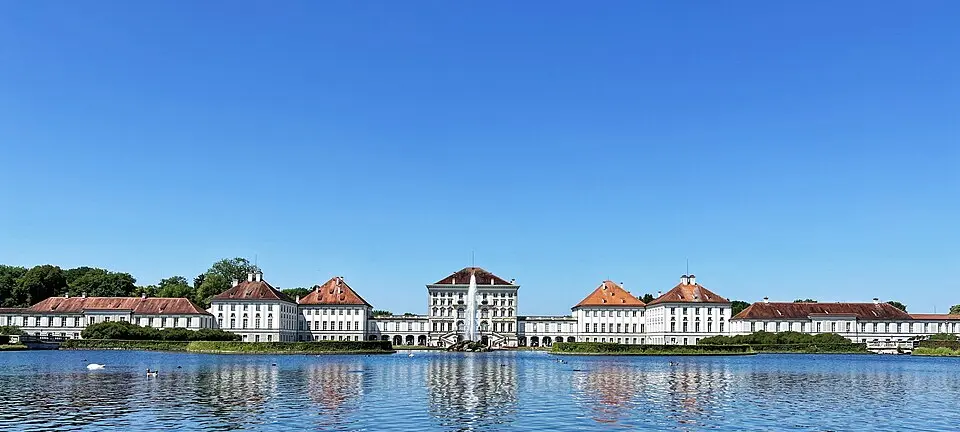
Nymphenburg Palace is one of the most significant architectural monuments in the Bavarian capital of Munich and is located in the Neuhausen-Nymphenburg district. As the summer residence of the Wittelsbach electors and kings, the complex served from 1715 to 1918 as a stately counterpart to the Munich Residenz. Over the course of more than two centuries, what was originally a small country house was expanded into a monumental three-wing complex that shines in the Baroque and Rococo styles. Together with the circular forecourt on the east side, the sprawling park on the west side, four historic pavilions and a complex system of canals, the palace forms a unique ensemble. With a north-south axis of 632 meters, the complex is even wider than the Palace of Versailles and ranks among the largest palaces in Germany as well as among the most important in Europe.
The history of the palace begins in 1663, when Elector Ferdinand Maria gave his wife, Henriette Adelaide of Savoy, the estate of Menzing to celebrate the birth of their long-awaited heir to the throne. That same year, he purchased the Kemnat dairy farm in order to have a new country palace built there. The electress gave the complex the name Nymphenburg, although the Italian name "Borgo delle Ninfe," often used later, was not coined until the 19th century. Initially conceived as a pleasure palace in the style of Italian country villas, the building was expanded into a Baroque summer palace under Elector Max Emanuel. Despite this development, court activities at times shifted to other residences such as Schleissheim Palace.
The actual expansion into the great summer palace got under way when the foundation stone for the extension was laid in 1701 at the request of Max II Emanuel. Construction stalled, however, when the War of the Spanish Succession forced the elector into exile and Bavaria was occupied by Austrian troops. After the ruler's return, work resumed on a larger scale from 1716. The first park pavilions were also built during this phase. In 1730, a convent for Augustinian canonesses, dedicated to the Holy Trinity and St. Clement, was founded in the north wing. Elector Karl Albrecht, who later became emperor, preferred Nymphenburg to other pleasure palaces and often lived there even during his imperial reign.
The palace's importance as a cultural and political site continued to grow in the 18th century. The Nymphenburg Porcelain Manufactory was founded in 1747, and the palace became the setting for numerous celebrations. Particularly worth mentioning is the visit of the Mozart family in 1763, when Wolfgang Amadeus Mozart performed for the elector. In 1792, Elector Karl Theodor had the park opened to the general public, an important step toward the democratization of the space. In 1805, the Austrian lieutenant field marshal Karl Philipp zu Schwarzenberg attempted to occupy the palace, which unintentionally contributed to Bavaria's alliance with France and the country's later elevation to a kingdom.
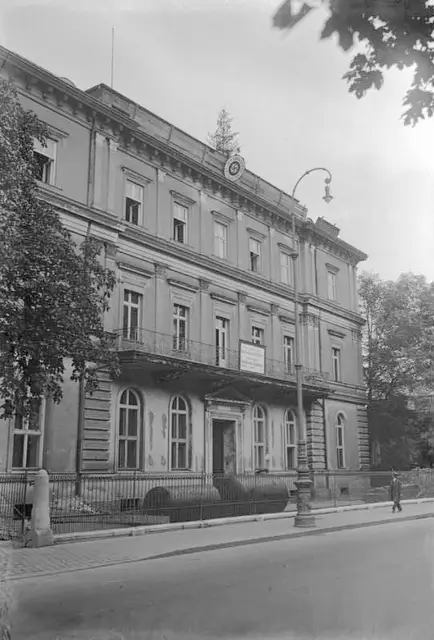
In the 19th century, the palace saw further historic turns. King Maximilian I Joseph died at Nymphenburg in 1825, while his great-grandson King Ludwig II was born here in 1845. The palace was also the site of the only personal meeting between Ludwig II and Otto von Bismarck. After the revolution of 1918, the complex passed into state ownership, though the Wittelsbachs retained the right to reside in a small part of the palace, a right still exercised today by the current head of the house. During the Nazi era, the palace was misused for political purposes. The Nazi Party used parts of the complex, and the German Hunting Museum was set up in the north wing, which led to the demolition of historic buildings and the desecration of the Baroque convent church.
During World War II, the palace complex was largely spared from destruction, as it was painted with camouflage and bunkers were built in the park. However, the already desecrated convent church was destroyed by bomb hits, and in the park the Badenburg and the Great Cascade were severely damaged. After the war, the damage was repaired step by step, and in the following decades the palace often served as a film set for international productions. In 1972, the Olympic dressage competitions were held in front of the palace. Today, the palace houses various museums and institutions, including the Marstallmuseum (carriage museum), the Museum Mensch und Natur (Museum of Man and Nature) and the porcelain manufactory.
The palace's architecture bears witness to the collaboration of several architects. The central building was originally designed by Agostino Barelli and later by Enrico Zuccalli, with the Piedmontese hunting lodge Venaria Reale serving as a model. The side pavilions and the arcaded galleries were built by Zuccalli and Giovanni Antonio Viscardi, while Joseph Effner altered the facades along French lines. The buildings of the circular forecourt in front of the main wing, consisting of ten symmetrically arranged palaces, were considered an architectural sensation in their day. Inside, you will find magnificent rooms such as the Great Hall, decorated with frescoes by Johann Baptist Zimmermann, as well as King Ludwig I's Gallery of Beauties.
A particular highlight for visitors is the palace park, which extends over roughly 180 hectares (about 445 acres). The park combines a French Baroque garden with an English landscape park. The central canal with the Great Cascade divides the park into two areas, enriched by various pavilions such as the Amalienburg, the Badenburg and the Pagodenburg. The Amalienburg is one of the oldest and most significant Rococo buildings in Europe. The park also contains two historic pumping stations that are still in operation today and supply the fountains with water. This feat of engineering is a unique monument to technological history.
Nymphenburg Palace is not only a historic monument but also a living place of cultural significance. It houses the Bavarian Palace Administration and various museums that reflect the history and culture of Bavaria. The Nymphenburg Porcelain Manufactory, located in one of the buildings of the northern semicircle, is known for its high-quality porcelain. The Nymphenburg Palace Concerts take place regularly in the Hubertus Hall, enriching Munich's cultural life. The palace is a popular destination for day trips and attracts hundreds of thousands of visitors every year who come to enjoy the beauty of the architecture and the tranquility of the park.
More recently, the palace has been the subject of criticism, as plans for the new Biotopia museum called for the demolition of part of the north wing. This led to the founding of the "Aktionskreis für Schloss Nymphenburg" (Action Group for Nymphenburg Palace) and to an online petition to preserve the palace wing. The Association of German Art Historians placed the palace on its Red List, as the plans endangered the unity of the ensemble. After intense debate, the project was reconsidered, and it is now intended to serve as the "Naturkundemuseum Bayern" (Bavarian Natural History Museum), an organic evolution of the existing Museum Mensch und Natur. Despite these challenges, Nymphenburg Palace remains a jewel of Bavaria's cultural landscape and a symbol of Munich's historical and artistic tradition.
At a glance
- Category
- Sight › Historic sites
- Rating
- no reviews yet · write a review
- Address
- Schloss Nymphenburg
80638 Munich, Germany - District
- Neuhausen-Nymphenburg
- Phone
- +4989179080
- Website
- www.schloss-nymphenburg.de
- sgvnymphenburg@bsv.bayern.de
- Coordinates
- 48.15825° N · 11.50332° E
- Data quality
- confidence 0.93
- Identifier
- ID 9c3d7aa4-740…
Location & surroundings
Toggle layersRatings & comments
none yetNear Castello Di Nymphenburg
closest 5 per category · 2 kmSights
Restaurants
Museums
Hotels
Cocktail bars
None within 2 km.
More:Historic sites in Munich (291)Sights in Neuhausen-Nymphenburg (20)All sights in Munich (375)
128 places within 2 km loaded.
You need a free account to leave reviews and photos – that keeps comments genuine and lets you edit them later.