About Amalienburg
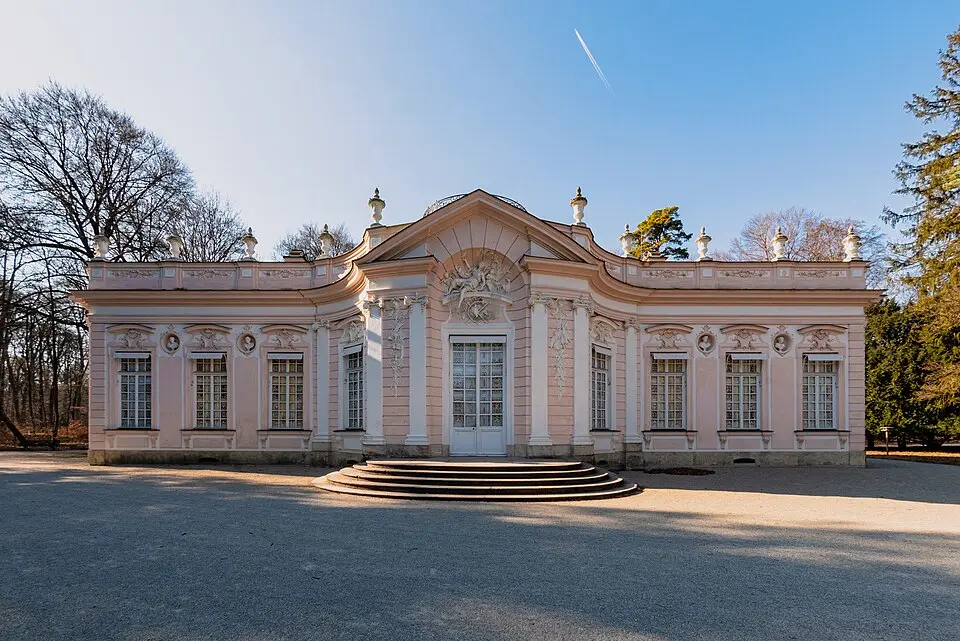
The Amalienburg is a magnificent little Rococo palace in Nymphenburg Palace Park in Munich, considered one of the most important examples of late Baroque architecture. The single-story building was constructed between 1734 and 1739 to plans by François Cuvilliés the Elder and originally served as a hunting lodge for pheasant hunting. It was a gift from Elector Karl Albrecht to his wife Amalie, after whom the complex is named. The little palace impresses with its delicate stucco work and carvings, executed by Johann Baptist Zimmermann and Joachim Dietrich. These works are distinguished by their animated liveliness, soft color schemes, and lavish gold and silver leaf decoration, which rank among the highlights of the era.
At the Amalienburg, you experience a harmonious union of architecture and nature. The central, round Hall of Mirrors forms the heart of the building, its mirrored walls reflecting the surrounding parkland and visually expanding the interior. Arranged around this hall are several rooms, including the Hunting Room, the Pheasant Room, the Rest Room, and the Blue Cabinet. The historic kitchen deserves special attention, decorated with blue-and-white tiles in the Chinese style. It contains a rare example of a Castrol stove, considered one of the first stoves with an enclosed firebox. On the east façade, a half-relief stucco figure of Diana, goddess of the hunt, adorns the building, while a platform on the roof once served as a hunting stand for pheasant hunting.
The Amalienburg is set in the southern part of the park, adjoining the large formal garden parterre. Unlike the park's other pavilions, such as the Badenburg or the Pagodenburg, it has no service buildings of its own, since its integrated kitchen could meet its needs. The complex invites you to admire the exquisite interior and enjoy the peaceful atmosphere of the surrounding garden, which is part of the expansive landscape park that took its present form through the redesign by Friedrich Ludwig Sckell in the 19th century.
At a glance
- Category
- Sight › Palaces
- Rating
- no reviews yet · write a review
- Address
- Schloß Nymphenburg 203
80638 Munich, Germany - District
- Neuhausen-Nymphenburg
- Phone
- +4989179080
- Website
- www.schloss-nymphenburg.de
- sgvnymphenburg@bsv.bayern.de
- Coordinates
- 48.15611° N · 11.50040° E
- Data quality
- confidence 0.98
- Identifier
- ID 2c2f9c18-c18…
Location & surroundings
Toggle layersFAQ about Amalienburg
quick answersWhat is the Amalienburg in Munich?
The Amalienburg is a small Rococo palace in Nymphenburg Palace Park in Munich and is considered one of the most important examples of late Baroque architecture. The single-story building was constructed between 1734 and 1739 based on plans by François Cuvilliés the Elder and originally served as a hunting lodge for pheasant hunting. Elector Charles Albert gave it to his wife Amalie, after whom the Amalienburg is named.
What can you see inside the Amalienburg?
At the Amalienburg in Munich, the main attraction is the round Hall of Mirrors, the heart of the little palace. Its mirrored walls reflect the surrounding parkland and visually expand the space. Grouped around the hall are the Hunting Room, the Pheasant Room, the Rest Room, and the Blue Cabinet. The stucco work and carvings by Johann Baptist Zimmermann and Joachim Dietrich, with delicate color finishes and gold and silver leaf decoration, are among the highlights of the era.
What is special about the kitchen of the Amalienburg?
The historic kitchen of the Amalienburg in Munich is decorated with blue-and-white tiles in the Chinese style. It contains a rare Castrol stove, which is considered one of the first stoves with an enclosed firebox. Thanks to this integrated kitchen, the Amalienburg did not need separate service buildings, unlike the Badenburg or the Pagodenburg.
Where is the Amalienburg in Munich?
The Amalienburg is located in the southern part of Nymphenburg Palace Park in Munich's Neuhausen-Nymphenburg district, at Schloß Nymphenburg 203. It adjoins the large garden parterre and is set within the expansive landscape park, which took on its current form through the redesign by Friedrich Ludwig Sckell in the 19th century. On the eastern facade, you can recognize the building by a half-relief stucco figure of the hunting goddess Diana.
What can you see near the Amalienburg?
Around the Amalienburg in Munich, you'll find several sights belonging to the Nymphenburg Palace complex. travelguide195 lists, for example, the pumping stations of Nymphenburg Palace at about 170 meters, the Marstallmuseum at about 410 meters, Nymphenburg Palace at about 410 meters, the fountain on the city side at about 440 meters, and the Magdalenenklause at about 450 meters away. travelguide195 also lists about 4 restaurants within 500 meters.
Ratings & comments
none yetNear Amalienburg
closest 5 per category · 2 kmSights
Restaurants
Museums
Hotels
Cocktail bars
None within 2 km.
More:Sights in Neuhausen-Nymphenburg (20)All sights in Munich (375)
128 places within 2 km loaded.
You need a free account to leave reviews and photos – that keeps comments genuine and lets you edit them later.