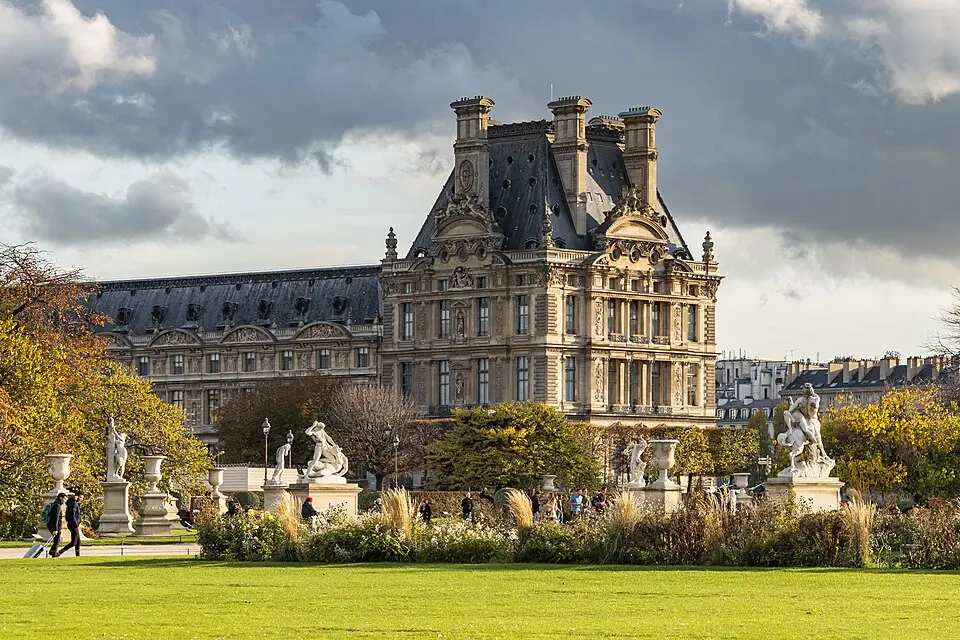
About Pavillon de Flore
The Pavillon de Flore forms the southwestern end of the Louvre Palace in Paris and sits right on the Pont Royal. Originally built between 1607 and 1610 under King Henry IV, the building served as a corner pavilion linking the Grande Galerie of the Louvre with the Tuileries Palace. The richly ornamented façade you see today, in the Second Empire style, dates only from a complete remodeling by the architect Hector-Martin Lefuel between 1864 and 1868. Particularly well known is Jean-Baptiste Carpeaux's sculpture "The Triumph of Flora," mounted beneath the pediment of the south façade. After the Tuileries Palace was destroyed by the Paris Commune in 1871, the pavilion received a new north façade resembling the south one. Today the building is an integral part of the Louvre Museum, housing sculptures on the ground floor and paintings on the second floor.
The pavilion's history is closely interwoven with France's political and cultural events. During the French Revolution it was briefly renamed the Pavillon de l'Égalité and served as a meeting place for various committees, including the notorious Committee of Public Safety. Later, Pope Pius VII used the building as his lodging during the coronation of Napoleon I. In the 20th century the pavilion housed various ministries before being handed over to the museum for good in the 1960s. Today it is also home to the Center for Research and Restoration of the Museums of France, which emerged in 1998 from the merger of several laboratories.
Visitors can admire this architectural ensemble in the heart of Paris, which, despite its historical significance, is still full of life today. Besides the museum exhibitions, the upper floors still contain a few staff apartments for museum personnel, which can be used in an emergency. The location on the banks of the Seine provides an impressive setting in which the building's historic splendor blends with the urban atmosphere of Paris. The pavilion thus remains not only a place of art but also a witness to the eventful history of the French capital.
At a glance
- Category
- Sight › Monuments
- Rating
- no reviews yet · write a review
- Address
- 16 Quai des Tuileries
75001 Paris, France - District
- 1st Arrondissement
- Phone
- —
- Website
- fr.wikipedia.org
- —
- Coordinates
- 48.86101° N · 2.33065° E
- Data quality
- confidence 0.87
- Identifier
- ID 83f830f8-c18…
Location & surroundings
Toggle layersFAQ about Pavillon de Flore
quick answersWhat is the Pavillon de Flore in Paris?
The Pavillon de Flore is a historic corner pavilion that forms the southwestern end of the Louvre Palace in Paris. It stands in the 1st arrondissement at 16 Quai des Tuileries, right next to the Pont Royal on the banks of the Seine. Originally, it connected the Louvre's Grande Galerie with the Tuileries Palace.
When was the Pavillon de Flore built, and who designed it?
The Pavillon de Flore in Paris was originally built between 1607 and 1610 under King Henry IV. Its present-day, richly ornamented façade in the Second Empire style is the work of architect Hector-Martin Lefuel, who completely remodeled the building between 1864 and 1868. Especially well known is the sculpture "Triumph of Flora" by Jean-Baptiste Carpeaux beneath the pediment of the south façade. After the Paris Commune destroyed the Tuileries Palace in 1871, the pavilion received a new north façade that resembles the south façade.
What is the historical significance of the Pavillon de Flore?
The Pavillon de Flore in Paris was the setting for important chapters of French history. During the French Revolution, it was briefly known as the Pavillon de l'Égalité and served as a meeting place for various committees, including the Committee of Public Safety. Pope Pius VII stayed there during the coronation of Napoleon I, and in the 20th century the building housed various government ministries.
What is in the Pavillon de Flore today?
Today the Pavillon de Flore is an integral part of the Louvre Museum in Paris, to which it was permanently handed over in the 1960s. Sculptures are displayed on the ground floor and paintings on the first floor. The pavilion also houses the Center for Research and Restoration of the Museums of France, which was created in 1998 through the merger of several laboratories, as well as a few staff apartments for museum personnel on the upper floors.
What can you see around the Pavillon de Flore in Paris?
Around the Pavillon de Flore in Paris's 1st arrondissement, several historic sites and monuments are within walking distance. These include the Porte des Lions (about 85 m), the Port des Tuileries (about 92 m), the Quais de Seine (about 139 m), and the Arc de Triomphe du Carrousel (about 185 m). If you need a break, travelguide195 lists around 129 restaurants within 500 m.
Ratings & comments
none yetNear Pavillon de Flore
closest 5 per category · 2 kmSights
Museums
Hotels
More:Monuments in Paris (322)Sights in 1st Arrondissement (131)All sights in Paris (1,859)
300 places within 2 km loaded.
You need a free account to leave reviews and photos – that keeps comments genuine and lets you edit them later.