About La Gioconda Musee Du Louvre
The Louvre in Paris is far more than just a museum. It is the cultural heart of the French capital and one of the most important art museums in the world. Located in the 1st arrondissement on the right bank of the Seine, the historic palace houses a collection of more than 380,000 objects, about 35,000 of which are on display across more than 60,000 square meters (about 646,000 square feet). Since opening to the public in 1793, the institution has grown from a private royal collection into a global symbol of art history. With millions of visitors every year, it is not only the most-visited art museum but also an architectural masterpiece that reflects the history of France in impressive fashion.
The roots of the collection reach back to the 14th century, when Duke Jean de Berry assembled an early collection of paintings and tapestries. The true founder, however, is considered to be King Francis I, who welcomed the aging Leonardo da Vinci to France. After Leonardo's death, his works, probably including the famous Mona Lisa, passed into the possession of the Crown. Over the centuries, the holdings grew through purchases under Louis XIV and through the acquisition of Cardinal Richelieu's collection. It was only in the wake of the French Revolution that the collection was opened to the public in 1793, marking the beginning of the Louvre as a national museum.
Under Napoleon Bonaparte, the museum underwent its first major expansion. After his victorious campaigns in Italy, numerous works of art were requisitioned and brought to France, and the collection was renamed the Musée Napoléon. After the end of the empire in 1815, the name Louvre returned, and many of the plundered works were given back to their original owners. In the years that followed, the collection grew through the purchase of significant antiquities such as the Venus de Milo and through the creation of departments for Egyptian and Assyrian art. This historical layering still shapes the character of the museum today.
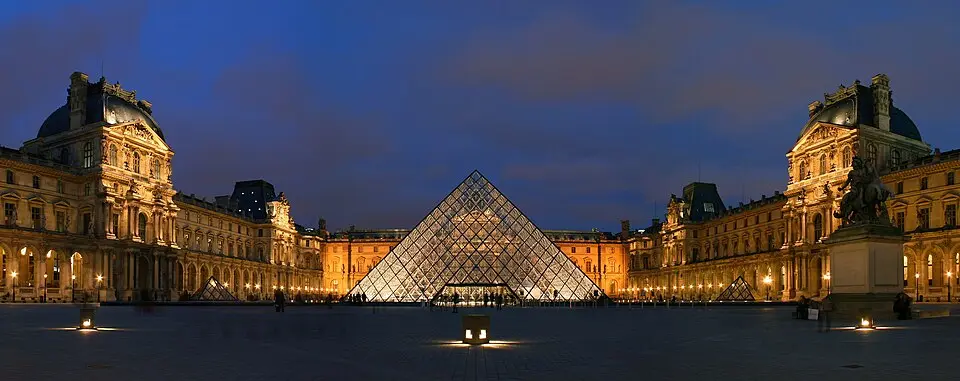
An architectural highlight that has made the Louvre famous around the world is the glass pyramid in the courtyard. Designed by Ieoh Ming Pei and opened in 1989 as part of the Grand Louvre project, it now serves as the main entrance. Although it was controversial at first, it has become an unmistakable Paris landmark. The Grand Louvre project, initiated by President François Mitterrand, made it possible to use the entire building complex for museum purposes and to create new exhibition space, including the underground shopping gallery Carrousel du Louvre.
The collection is divided into three main wings: Richelieu, Sully, and Denon. Here you can take a fascinating journey through the ages. The Denon wing is home to the department of Italian painting, where you can see the Mona Lisa in the Salle des États. You will also find Greek and Roman antiquities here, as well as the Galerie d'Apollon with the French Crown Jewels. The Sully wing houses, among other things, the departments of Egyptian antiquities and French paintings from the 17th to 19th centuries. The Richelieu wing holds works of northern European painting, sculpture, and decorative arts. A separate department of Islamic art opened in 2012 in an annex that displays around 2,500 exhibits.
The experience at the Louvre is enhanced by the chance to encounter the history of the site firsthand. Parts of the medieval fortress walls and moats, built in the 16th century under Charles V, were uncovered during excavations and can be visited on the lower level of the museum. This offers a fascinating glimpse into the military and political history of the site. The museum also offers digital resources such as online tours and a comprehensive online archive in which you can explore a large part of the collection from home.
The Louvre remains a place of lively debate and development. Current projects, such as the planned new department for Byzantine art and the modernization of the infrastructure, show that the museum is committed to continuing to evolve. Despite historical controversies over the return of artworks to their countries of origin, such as the debate with Turkey, the Louvre stands for international exchange and the preservation of cultural heritage. For visitors, it is a place where art, history, and architecture merge in a unique way, making the diversity of human creativity across thousands of years something you can experience for yourself.
At a glance
- Category
- Museum › Art museums
- Rating
- no reviews yet · write a review
- Address
- —
Paris, France - District
- 1st Arrondissement
- Phone
- —
- Website
- —
- —
- Coordinates
- 48.86140° N · 2.33415° E
- Data quality
- confidence 0.79
- Identifier
- ID dc64d6cb-dce…
Location & surroundings
Toggle layersRatings & comments
none yetNear La Gioconda Musee Du Louvre
closest 5 per category · 2 kmSights
Museums
Hotels
More:Art museums in Paris (119)Museums in 1st Arrondissement (59)All museums in Paris (525)
300 places within 2 km loaded.
You need a free account to leave reviews and photos – that keeps comments genuine and lets you edit them later.