About Marché de Noël Paris Notre-Dame
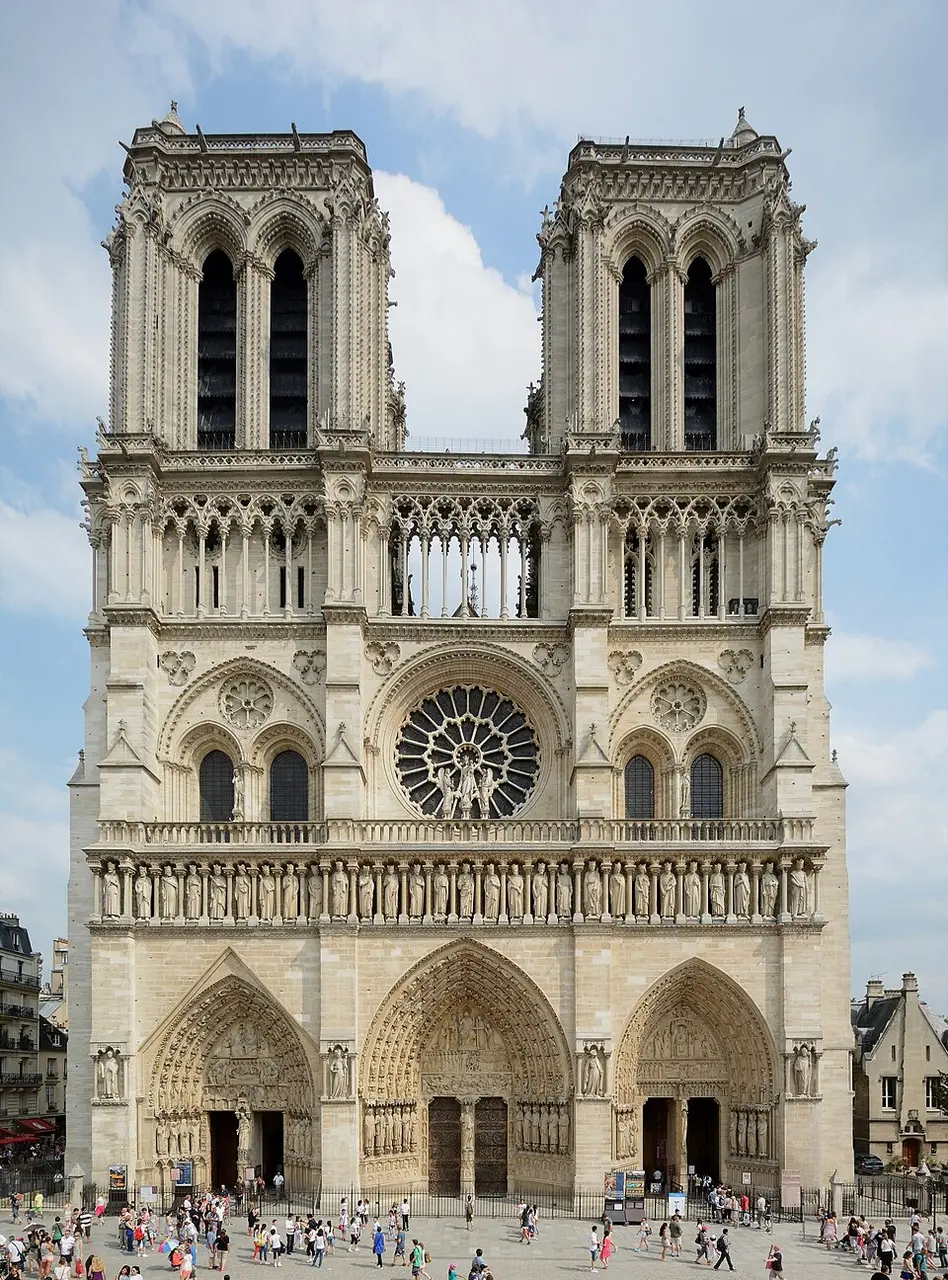
Notre-Dame de Paris Cathedral stands on the Île de la Cité in the heart of the French capital and forms the architectural and spiritual center of the city. As the Roman Catholic cathedral of the Archdiocese of Paris, it is dedicated to the Virgin Mary and ranks among the earliest and most important Gothic churches in France. Construction stretched across nearly two centuries, from 1163 to 1345, and marks the transition from Romanesque to Gothic architecture. Its distinctive silhouette, with two symmetrical west towers and a slender spire over the crossing, shapes the city's skyline and makes the cathedral one of the most visited landmarks in Europe.
The history of the site reaches far back beyond the start of Gothic construction. Christian places of worship stood here as early as the Merovingian and Carolingian periods, including a double church from the 6th century. This makes the site one of the oldest known Christian sites within the present-day city limits of Paris. Construction of today's cathedral began under Bishop Maurice de Sully and King Louis VII, starting with the choir, which was consecrated in 1182. Over time, the building was extended westward and its style continued to evolve, with the west facade not completed until around 1250.
The cathedral's architecture is a masterpiece of Gothic building. Inside, the nave is about 130 meters (427 ft) long, 48 meters (157 ft) wide and 35 meters (115 ft) high. The two west towers reach a height of 69 meters (226 ft), while the wooden spire over the crossing, rebuilt after the 2019 fire, rises 93 meters (305 ft). The west facade is defined by its balanced relationship of vertical and horizontal elements and follows geometric proportions based on musical consonances. The Gallery of Kings, with its 28 statues of the kings of Judah, often mistaken for French kings, is a striking feature of the facade.
The three portals of the west facade, richly decorated with sculpture, deserve special attention. The north portal, the Portal of the Virgin, is dedicated to the Virgin Mary and shows scenes of her coronation and resurrection. The central portal, the Portal of the Last Judgment, depicts the Last Judgment and is one of the best-known representations of this theme in medieval art. The south portal, the Portal of Saint Anne, is dedicated to Saint Anne and contains older elements from the 12th century. Through their imagery, these portals tell the central beliefs of the medieval church.
The interior of the cathedral impresses with its breadth and height. The central nave reaches a height of 32.5 meters (107 ft) and is supported by a complex vault. The arcades leading to the side aisles rest on round columns with Corinthian capitals, typical of early French Gothic. The choir is surrounded by an ambulatory and a ring of chapels, which gives the space the impression of having seven aisles. The choir screen, which separates the inner choir from the ambulatory, is decorated with 14th-century sculptures depicting scenes from the life of Jesus and the appearances of the Risen Christ.
The history of the cathedral is closely intertwined with French history. During the French Revolution, the building was desecrated and for a time rededicated as a Temple of Reason, and many artworks and sculptures were destroyed. It was only Victor Hugo's novel The Hunchback of Notre-Dame, published in 1831, that revived public interest in the cathedral and led to a comprehensive restoration under the direction of Eugène Viollet-le-Duc. This 19th-century restoration decisively shaped the church's present appearance, including the reconstruction of the spire and the renewal of many sculptures.
On April 15, 2019, a devastating fire struck the cathedral, destroying large parts of the roof framework and the wooden spire. The reconstruction, which was meant to be completed within five years, was accompanied by intense debate over the approach to historic preservation. In the end, it was decided to carry out a faithful reconstruction. On December 7, 2024, the nave reopened with a solemn state ceremony attended by numerous heads of state and figures from culture and politics. The reopening marked an important moment of reconciliation and cultural heritage.
Today, visitors can not only explore the majestic interior but also climb the towers and the roof, which opened to the public in September 2025 as a viewing platform. From there, you get a breathtaking view over the historic center of Paris and the Seine. Beneath the cathedral lies an archaeological crypt, open to visitors since 1980, which displays finds from various eras. This archaeological zone offers insight into the long history of the site and the predecessor buildings of today's cathedral.
The cathedral's furnishings include important works of art and relics. In the choir stands a marble Pietà by Nicolas Coustou, flanked by statues of Louis XIV and Louis XIII. In an annex, you can see part of the cathedral treasury, which includes historic chalices, vestments and old crucifixes. Particularly significant are the reliquaries for the Crown of Thorns and a nail from the Cross, which were designed in the Napoleonic era. These relics, originally housed in the Sainte-Chapelle, are now an important part of the cathedral's spiritual heritage.
Organ music plays a central role in the life of the cathedral. The Great Organ, which goes back to a Cavaillé-Coll organ of 1868, now has 115 stops on five manuals and pedal. It is played by four titular organists, who regularly perform concerts and play for services. The history of organ music at Notre-Dame reaches back to the 12th century and is closely tied to the development of European music. The sound of the organ, altered by the restoration after the fire, is now louder and clearer, which calls for new musical approaches.
The cathedral's bells are also an important part of its cultural heritage. The largest bell, Emmanuel, is considered the finest-sounding bell in France and survived the turmoil of the Revolution. Today, ten bells hang in the two west towers and are rung on special occasions. The peal of the bells is an unmistakable acoustic signature of the city of Paris and draws many visitors who want to experience the sound of these historic instruments.
Notre-Dame de Paris is not only a place of worship but also a symbol of French culture and history. As part of the Banks of the Seine in Paris, it was named a UNESCO World Heritage Site in 1991. Each year the cathedral draws millions of visitors who come to experience its architectural beauty, its historical significance and its spiritual atmosphere. It remains a living place that connects the past with the present and plays an important role in the cultural life of France.
At a glance
- Category
- Sight › Historic sites
- Rating
- no reviews yet · write a review
- Address
- 27 Quai de Montebello
75005 Paris, France - District
- Quartier de la Sorbonne
- Phone
- —
- Website
- —
- —
- Coordinates
- 48.85252° N · 2.34808° E
- Data quality
- confidence 0.57
- Identifier
- ID c42ef3e2-b75…
Location & surroundings
Toggle layersRatings & comments
none yetNear Marché de Noël Paris Notre-Dame
closest 5 per category · 2 kmSights
Restaurants
Museums
Hotels
More:Historic sites in Paris (1,524)Sights in Quartier de la Sorbonne (23)All sights in Paris (1,859)
300 places within 2 km loaded.
You need a free account to leave reviews and photos – that keeps comments genuine and lets you edit them later.