About Butte Montmartre
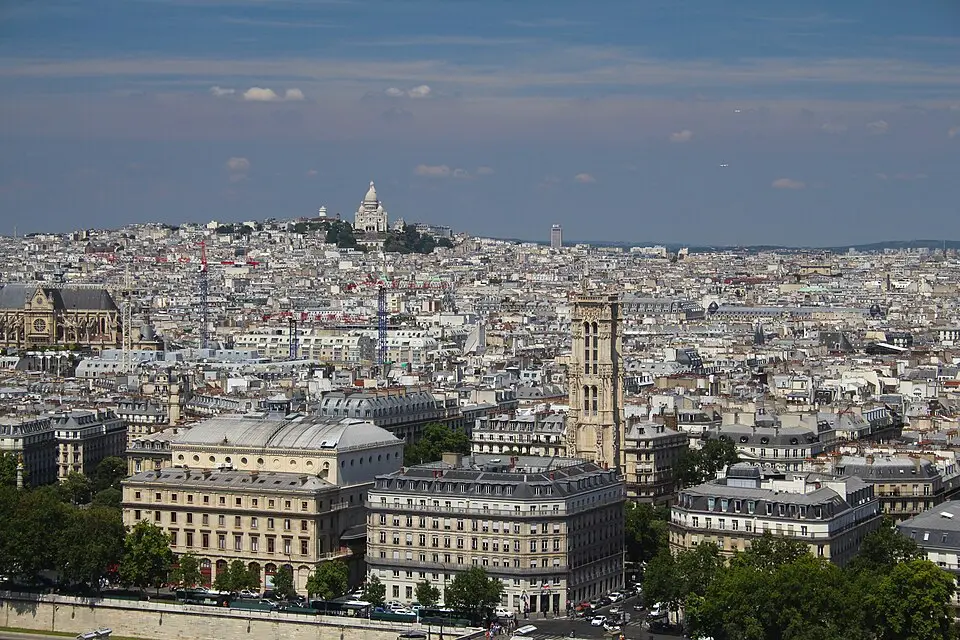
Montmartre, whose name traces back to the "Martyrs' Hill," is the highest natural elevation in Paris and forms the heart of the 18th arrondissement. At 130 meters (427 feet), it towers over the surrounding cityscape and is crowned by the Basilica of Sacré-Cœur, which is visible from far and wide. You can reach the top not only by climbing various flights of stairs but also by taking the historic funicular, the Funiculaire de Montmartre. Originally a rural area that, thanks to its geographic location and proximity to old trade routes, long remained removed from the city's development, the district has grown over the centuries into one of the best-known cultural centers of the French capital.
The history of the hill goes back to the Gallo-Roman era, when temples here were dedicated to the gods Mars and Mercury. A major factor in the early importance of the area was its large gypsum deposits, which made Montmartre one of the richest areas around Paris. These quarries later also served as places of refuge for the first Christians. Around the year 272, Bishop Dionysius, the priest Rusticus, and the archdeacon Eleutherius were beheaded here, which made the hill an important pilgrimage site. In the Middle Ages, Benedictines built a monastery, from which today's parish church, Saint-Pierre de Montmartre, emerged. This church, which stands on the site of a former temple of Mars, is one of the oldest religious buildings in the city and was consecrated in the 12th century.
In the 19th century, Montmartre underwent an enormous transformation. Following its incorporation into Paris and the urban redevelopment under Baron Haussmann, the population grew rapidly. Gypsum quarrying remained an important industry, while the area became a magnet for artists and writers. Cheap rents and a freer way of life attracted famous figures such as Renoir, Van Gogh, Toulouse-Lautrec, Picasso, and Modigliani. Legendary venues such as the Moulin Rouge and the Moulin de la Galette, which became gathering places for the bohemian crowd, were born here. After the Paris Commune of 1871, the National Assembly decided to build the Basilica of Sacré-Cœur, which was intended to serve as a memorial to the victims of the war and as a sign of reconciliation. Construction began in 1876, and the church was consecrated in 1919.
Today, Montmartre is a popular destination visited by tourists from all over the world. A central attraction is the Place du Tertre, where artists display their work and create portraits, caricatures, and silhouette cutouts. The architecture of the Basilica of Sacré-Cœur, built of white stone, dominates the view from the summit. From there, you can enjoy an impressive panoramic view over the rooftops of Paris. Besides the historic sites, the hill also has a small vineyard, the Clos Montmartre, which reflects the area's agricultural past.
The neighborhood around the Moulin de la Galette and the Cimetière de Montmartre feels quieter than the bustling center and still preserves a touch of old-world charm. The streets at the foot of the hill, especially between Place Blanche and Place Pigalle, developed into a red-light district in the 20th century after many artists had left the area. Despite these changes, Montmartre remains a place full of history and cultural significance, offering insights into the artistic and social development of Paris. The mix of religious sites, historic buildings, and a lively art scene makes the hill a distinctive part of Parisian identity.
At a glance
- Category
- Sight › Historic sites
- Rating
- no reviews yet · write a review
- Address
- Montmartre, 97 Rue Ordener
75018 Paris, France - District
- 18th Arrondissement
- Phone
- —
- Website
- —
- —
- Coordinates
- 48.88694° N · 2.34111° E
- Data quality
- confidence 0.83
- Identifier
- ID e167cd8b-534…
Location & surroundings
Toggle layersRatings & comments
none yetNear Butte Montmartre
closest 5 per category · 2 kmSights
Restaurants
Hotels
More:Historic sites in Paris (1,524)Sights in 18th Arrondissement (48)All sights in Paris (1,859)
300 places within 2 km loaded.
You need a free account to leave reviews and photos – that keeps comments genuine and lets you edit them later.