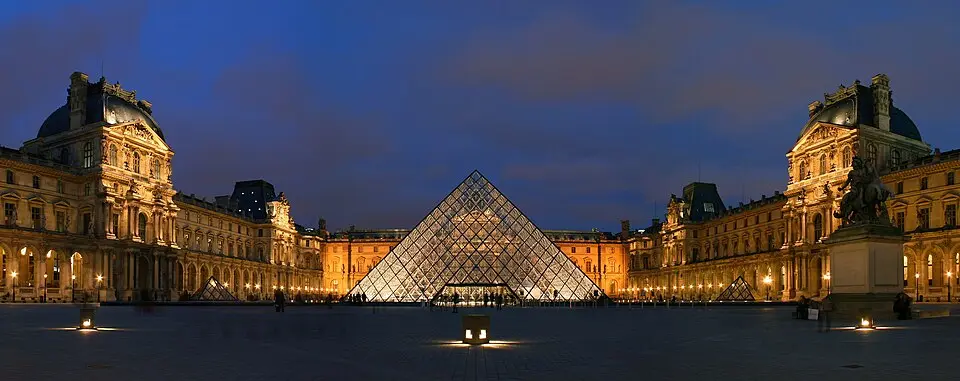
About Musée du Louvre
The Louvre in Paris is far more than an art museum; it is the cultural heart of the French capital and an architectural monument of unparalleled scale. Located in the 1st arrondissement on the Right Bank of the Seine, the historic Louvre Palace houses one of the largest art collections in the world. Since opening to the public in 1793, it has evolved from a royal residence into one of the most visited museums on earth. With more than 72,000 square meters of exhibition space and several million visitors every year, the Louvre stands for the diversity of human creativity across millennia. The collection now comprises more than 380,000 objects, of which about 35,000 are on permanent or rotating display. This immense abundance turns a visit into a journey through the history of art, stretching from antiquity to the early modern era.
The roots of the collection go back to the 14th century, when Duke Jean de Berry assembled an early collection of paintings and tapestries. The true founder of the royal art collection, however, was King Francis I, who is regarded as a great patron of the arts. He succeeded in bringing Leonardo da Vinci to France, and the artist's works, probably including the famous Mona Lisa, passed into the royal holdings after his death. Under Cardinal Richelieu and later Louis XIV, the collection continued to grow through the purchase of precious works by masters such as Titian and Raphael. It was only in the course of the French Revolution that the collection was opened to the public in 1793, marking the beginning of the modern museum era in France. Napoleon Bonaparte later enlarged the holdings through requisitions from Italy and other European countries, and the museum was temporarily renamed the Musée Napoléon. After the end of the empire in 1815, many of the plundered works were returned, and the focus shifted back to the national heritage.
The architecture of the Louvre reflects its long history as a royal residence. The building complex extends across three main wings: Richelieu, Sully, and Denon. Each wing houses specific departments spread across different levels. In the Richelieu Wing, you will find the collections of Northern European and French painting as well as decorative arts. The Sully Wing houses, among other things, the departments of Egyptian, Greek, and Italic antiquities as well as the graphic arts. The Denon Wing is especially known for Italian Renaissance painting, home to the Mona Lisa, as well as for Roman antiquities and Islamic art. A striking architectural feature is the glass pyramid in the courtyard, designed by Ieoh Ming Pei and opened in 1989. Controversial at first, it is now considered one of the landmarks of Paris and serves as the museum's main entrance.
The Louvre's collection is organized into numerous thematic departments covering the full breadth of art history. Particularly noteworthy are the Greek and Roman antiquities collections, which offer a deep insight into classical antiquity. The departments of Italian Renaissance painting and Flemish painting of the 16th and 17th centuries bear witness to the golden age of European art. French painting from the 15th to the 19th century is also strongly represented. Alongside the paintings, the Louvre houses important sculptures, including the Venus de Milo, acquired in 1821. The Egyptian department presents a chronological and thematic selection of antiquities, while the department of Islamic art, opened in 2012 in a new extension, displays around 2,500 exhibits. The French Crown Jewels are on display in the Galerie d'Apollon, which is also part of Napoleon III's historic apartments.
For visitors, the Louvre offers not only the chance to marvel at world-famous works of art but also to experience the architecture of the historic ensemble. The underground shopping arcade Carrousel du Louvre, opened in 1993, combines a museum visit with cultural and culinary offerings. Parts of the medieval ramparts and moats of the old fortress, uncovered during excavations, can also be seen there. The museum also places great importance on digital accessibility and offers an extensive online archive in which hundreds of thousands of artworks can be viewed free of charge. Virtual tours make it possible to explore certain departments and the architecture of the glass pyramid from afar. This digital complement underscores the museum's modern outlook, which combines traditional values with contemporary forms of presentation.
The Louvre is also a place that plays a major role in pop culture. Numerous novels and films, including works by Maurice Leblanc and Dan Brown, use the museum as a backdrop for their plots. This cultural presence adds to the site's fame and draws millions of tourists every year. Despite its size and the enormous visitor numbers, the Louvre remains a place of quiet and contemplation, where artworks from different eras and cultures come together. The continuing expansion of the collection, such as the planned new department of Byzantine art, shows that the Louvre is a living institution that keeps evolving. With projects like the Louvre-Lens and the Louvre Abu Dhabi, the collection is also being shared internationally, underscoring the museum's global significance. The Louvre thus remains an indispensable part of humanity's cultural heritage.
At a glance
- Category
- Museum › Art museums
- Rating
- no reviews yet · write a review
- Address
- Musée du Louvre, 99 Rue de Rivoli
75001 Paris, France - District
- 1st Arrondissement
- Phone
- +33140205050
- Website
- www.louvre.fr
- info@louvre.fr
- Coordinates
- 48.86096° N · 2.33760° E
- Data quality
- confidence 0.99
- Identifier
- ID 0137b6d8-104…
Part of the tour
Paris in One Day: From Notre-Dame to the Eiffel Tower →Location & surroundings
Toggle layersRatings & comments
none yetNear Musée du Louvre
closest 5 per category · 2 kmSights
Restaurants
Museums
Hotels
More:Art museums in Paris (119)Museums in 1st Arrondissement (59)All museums in Paris (525)
300 places within 2 km loaded.

You need a free account to leave reviews and photos – that keeps comments genuine and lets you edit them later.
Its exhibits come from such diverse origins as ancient Egypt, classical Greece and the Roman Empire, medieval Europe, and Napoleonic France, but controversially including many items that were looted from their places of origin. Its most famous exhibit, of course, is Leonardo da Vinci's painting of the Mona Lisa (French: La Joconde , Italian: La Gioconda ), generally to be found surrounded by hordes of camera-flashing tourists. The Louvre poses many of the same challenges to the visitor as Paris itself; overwhelming in size, crowded in high seasons, and much information available only in French. If you want to see everything in the Louvre, plan at least two full days. However, it is better to pick and choose, as the collection was assembled with an eye to completeness rather than quality. As of July 2019, due to intense crowding and reports of ticket fraud, entry now almost always requires a pre-booked timed ticket, even for holders of the Paris Museum Pass.
Source: Wikivoyage, „Paris/1st arrondissement“ · authors per page history · CC BY-SA 4.0