About Palmenhaus
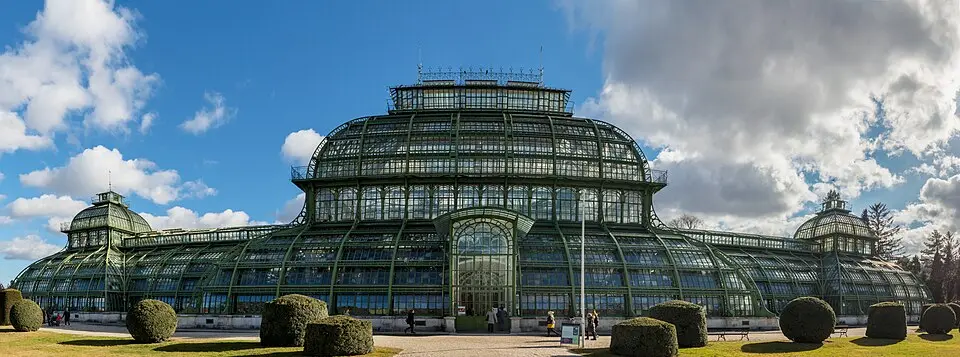
The Palm House in the Schönbrunn Palace Gardens in Vienna is the best known of the four greenhouses there and one of the largest of its kind in the world. It was opened by Emperor Franz Joseph I on June 19, 1882, and today houses around 4,500 different plant species. The history of the site goes back to the 18th century, however, when Emperor Franz I acquired an area for a Dutch Garden. The original glasshouses and hothouses were torn down during the construction of the new building, since an all-glass iron structure was considered necessary to create optimal conditions for light-loving exotic plants. The present building was designed by the court architect Franz-Xaver von Segenschmid and built by the court locksmith Ignaz Gridl.
Architecturally, the building impresses with its imposing size: 111 meters long, 29 meters wide and 25 meters high. It is made of wrought iron and cast iron and is covered with 45,000 panes of glass. The rectangular central building is flanked by a cold house to the north and a tropical house to the south, which were originally separated by movable glass walls. Inside, the curved structure rests on cast-iron columns. The Palm House barely survived World War II; in a bombing raid in 1945, almost all of the glazing was shattered and many plants froze. Reconstruction began in 1948, and the restored house was ceremonially reopened in 1953. A comprehensive renovation, which had to be carried out in stages because of the building's protected status and its function as winter quarters for the plants, took place between 1986 and 1990.
For visitors, the Palm House is a place to discover tropical and subtropical flora. At the center stands, traditionally, the largest palm in the house, which has to be replaced regularly when it threatens to reach the glass roof. Well-known specimens were the Maria Theresa Palm and the Sisi Palm, which was replaced by the Mirna Palm. Special highlights include an olive tree estimated to be 350 years old, the living fossil Wollemia nobilis, and a coco de mer palm. The azalea collection with centuries-old specimens and the tree ferns are also worth a look. Modern technology such as a misting system to control humidity and a water treatment system that collects rainwater for irrigation now keeps the delicate plants thriving.
At a glance
- Category
- Sight › Historic sites
- Rating
- no reviews yet · write a review
- Address
- Maxingstraße 13b
1130 Vienna, Austria - District
- Katastralgemeinde Schönbrunn
- Phone
- +4318775087406
- Website
- schoenbrunn.at
- office@palmenhaus.at
- Coordinates
- 48.18472° N · 16.30278° E
- Data quality
- confidence 0.99
- Identifier
- ID cdd2545d-bd3…
Location & surroundings
Toggle layersFAQ about Palmenhaus
quick answersWhat is the Palm House at Schönbrunn in Vienna?
The Palm House is a historic greenhouse in the grounds of Schönbrunn Palace in Vienna and the best known of the four greenhouses there. It is one of the largest structures of its kind in the world and today is home to around 4,500 different plant species from tropical and subtropical regions. You'll find it at Maxingstraße 13b.
When was the Palm House at Schönbrunn built, and who designed it?
The Palm House in Vienna was opened by Emperor Franz Joseph I on June 19, 1882. It was designed by the court architect Franz-Xaver von Segenschmid and built by the court locksmith Ignaz Gridl. A bombing raid in 1945 destroyed almost all of the glazing; reconstruction began in 1948 and the building reopened in 1953. A comprehensive renovation followed in stages between 1986 and 1990.
How big is the Palm House at Schönbrunn?
The Palm House at Schönbrunn in Vienna is 111 meters long, 29 meters wide and 25 meters high. The wrought-iron and cast-iron structure is covered with 45,000 panes of glass and rests on cast-iron columns on the inside. The rectangular central building is flanked by a cool house to the north and a tropical house to the south.
What special plants can you see in the Palm House at Schönbrunn?
At the Palm House at Schönbrunn in Vienna, you can see an olive tree estimated to be 350 years old, the living fossil Wollemia nobilis and a Seychelles palm, among other plants. Traditionally, the largest palm in the house stands at the center; the former Sisi Palm has been replaced by the Mirna Palm. Also worth seeing are the azalea collection, which includes specimens centuries old, and the tree ferns.
What can you visit around the Palm House at Schönbrunn?
Around the Palm House in Vienna's Schönbrunn Palace Park, there are several other sights and museums. travelguide195 lists, for example, the Desert House at Schönbrunn about 50 meters away, the Hietzing District Museum about 130 meters away, the Otto Wagner Court Pavilion Hietzing of the Wien Museum about 390 meters away, the Naiad Basin about 460 meters away and the Imperial Carriage Museum (Wagenburg) about 560 meters away. travelguide195 also lists 29 restaurants within 500 meters.
Ratings & comments
none yetNear Palmenhaus
closest 5 per category · 2 kmSights
Restaurants
Museums
Hotels
Cocktail bars
More:Historic sites in Vienna (518)All sights in Vienna (661)
166 places within 2 km loaded.
You need a free account to leave reviews and photos – that keeps comments genuine and lets you edit them later.