About Wiener Pestsäule
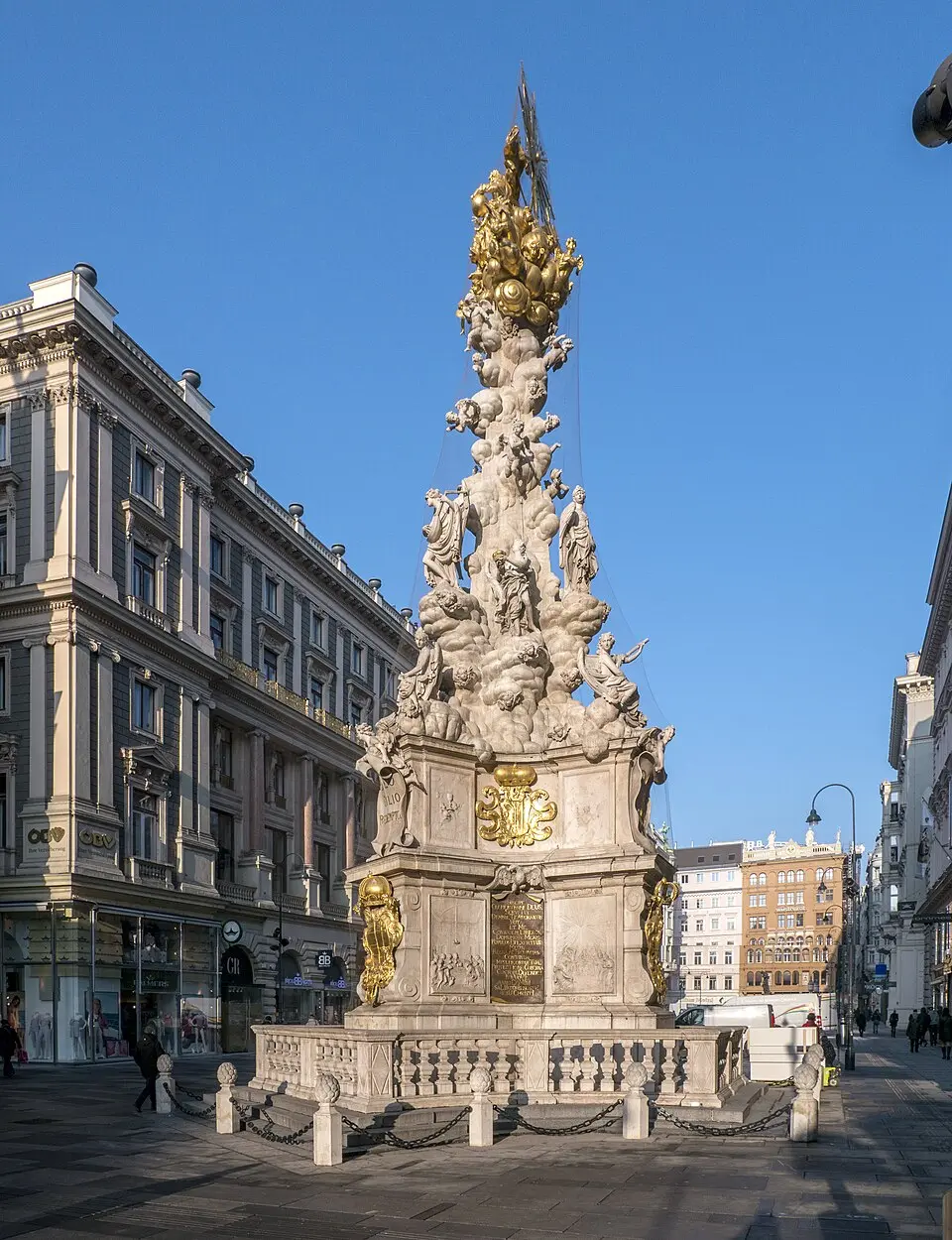
Vienna's Plague Column is a striking Baroque work of art that stands on the Graben in Vienna's Inner City. It was erected as a votive offering of thanks after the devastating plague epidemic of 1679 and was solemnly consecrated on October 29, 1693. At a height of 21 meters (69 feet), the monument is among the city's best-known sculptural works. Building it was a long process involving numerous artists, among them Mathias Rauchmiller, Johann Bernhard Fischer von Erlach, and Paul Strudel. During the planning phase, the project evolved from a simple devotional column into a theatrical High Baroque spectacle. Despite the many contributors, the ensemble looks harmonious today and marks a style-defining transition into a new artistic phase, one that was imitated throughout the Habsburg Monarchy.
The column's iconographic program is complex and is organized vertically into three tiers symbolizing the Holy Trinity. The lower section is dedicated to humankind and shows Emperor Leopold I praying to God as an intercessor. The middle tier is reserved for the angels as intermediaries, while the top level belongs to the Holy Trinity. The ground plan also follows a threefold division that links the three constituent realms of the monarchy. The western wing, with the double-headed eagle and the coats of arms of the Inner Austrian lands, is assigned to God the Father; the eastern wing, with the coats of arms of Hungary, Croatia, Dalmatia, and Bosnia, to God the Son; and the northern wing, with the coats of arms of Bohemia, the Lusatias, and Silesia, to the Holy Spirit.
On the column you can see several Latin inscriptions that honor the three persons of the Trinity and express the emperor's gratitude for the end of the plague. One special inscription on the east side contains a chronogram in which the year 1679 is encoded in the sum of the capital letters. In recent times the Plague Column has also served as a symbolic place; during the COVID-19 pandemic it became a gathering point where residents laid candles, children's drawings, and written prayers, asking for the crisis to end without lasting harm.
At a glance
- Category
- Sight › Historic sites
- Rating
- no reviews yet · write a review
- Address
- Graben 27
1010 Vienna, Austria - District
- Innere Stadt
- Phone
- +43121114084
- Website
- www.planet-vienna.com
- —
- Coordinates
- 48.20870° N · 16.36978° E
- Data quality
- confidence 0.96
- Identifier
- ID 87cebd2b-30e…
Part of the tour
Vienna in a Day: Cathedral, Hofburg and Ringstrasse →Location & surroundings
Toggle layersFAQ about Wiener Pestsäule
quick answersWhat is the Vienna Plague Column?
The Vienna Plague Column is a 21-meter-high (69-foot) Baroque monument on the Graben (Graben 27) in Vienna's Inner City. It was erected as a votive offering of thanks after the devastating plague epidemic of 1679 and is one of the city's best-known sculptural works. It has also been a symbolic place in recent times: during the COVID-19 pandemic, Viennese left candles, children's drawings, and written prayers there.
Who built the Vienna Plague Column, and when was it consecrated?
The Vienna Plague Column on the Graben came into being through a lengthy process involving numerous artists, including Mathias Rauchmiller, Johann Bernhard Fischer von Erlach, and Paul Strudel. It was solemnly consecrated on October 29, 1693. During planning, the project evolved from a simple devotional column into a theatrical High Baroque production that was imitated throughout the Habsburg Monarchy.
What do the figures and coats of arms on the Vienna Plague Column mean?
The Vienna Plague Column is divided vertically into three tiers symbolizing the Trinity. At the bottom is humanity, with Emperor Leopold I depicted as a praying intercessor; in the middle are the angels as mediators; and at the top is the Holy Trinity. The three-winged floor plan also ties together the constituent realms of the monarchy: the west wing, with the double-headed eagle and the coats of arms of Inner Austria, belongs to God the Father; the east wing, with the coats of arms of Hungary, Croatia, Dalmatia, and Bosnia, to God the Son; and the north wing, with the coats of arms of Bohemia, the Lusatias, and Silesia, to the Holy Spirit.
What inscriptions can you find on the Vienna Plague Column?
On the Vienna Plague Column on the Graben, you'll find several Latin inscriptions that honor the three persons of the Trinity and express Emperor Leopold I's gratitude for the end of the plague. One special feature is the inscription on the east side: it contains a chronogram in which the sum of the capital letters yields the year 1679, the year of the plague epidemic.
What can you see around the Vienna Plague Column?
Around the Vienna Plague Column in Vienna's Inner City, several sights are within walking distance, such as the Leopold Fountain (about 57 meters), the Palais Bartolotti-Partenfeld (about 68 meters), and the birthplace of Johann Nestroy (about 84 meters). travelguide195 also lists about 288 restaurants within 500 meters. The Plague Column is also part of the tour "Vienna Compact: Cathedral, Hofburg, and Ringstrasse in One Day."
Ratings & comments
none yetNear Wiener Pestsäule
closest 5 per category · 2 kmRestaurants
Museums
Hotels
More:Historic sites in Vienna (518)Sights in Innere Stadt (216)All sights in Vienna (661)
300 places within 2 km loaded.
You need a free account to leave reviews and photos – that keeps comments genuine and lets you edit them later.