About Heldendenkmal der Roten Armee
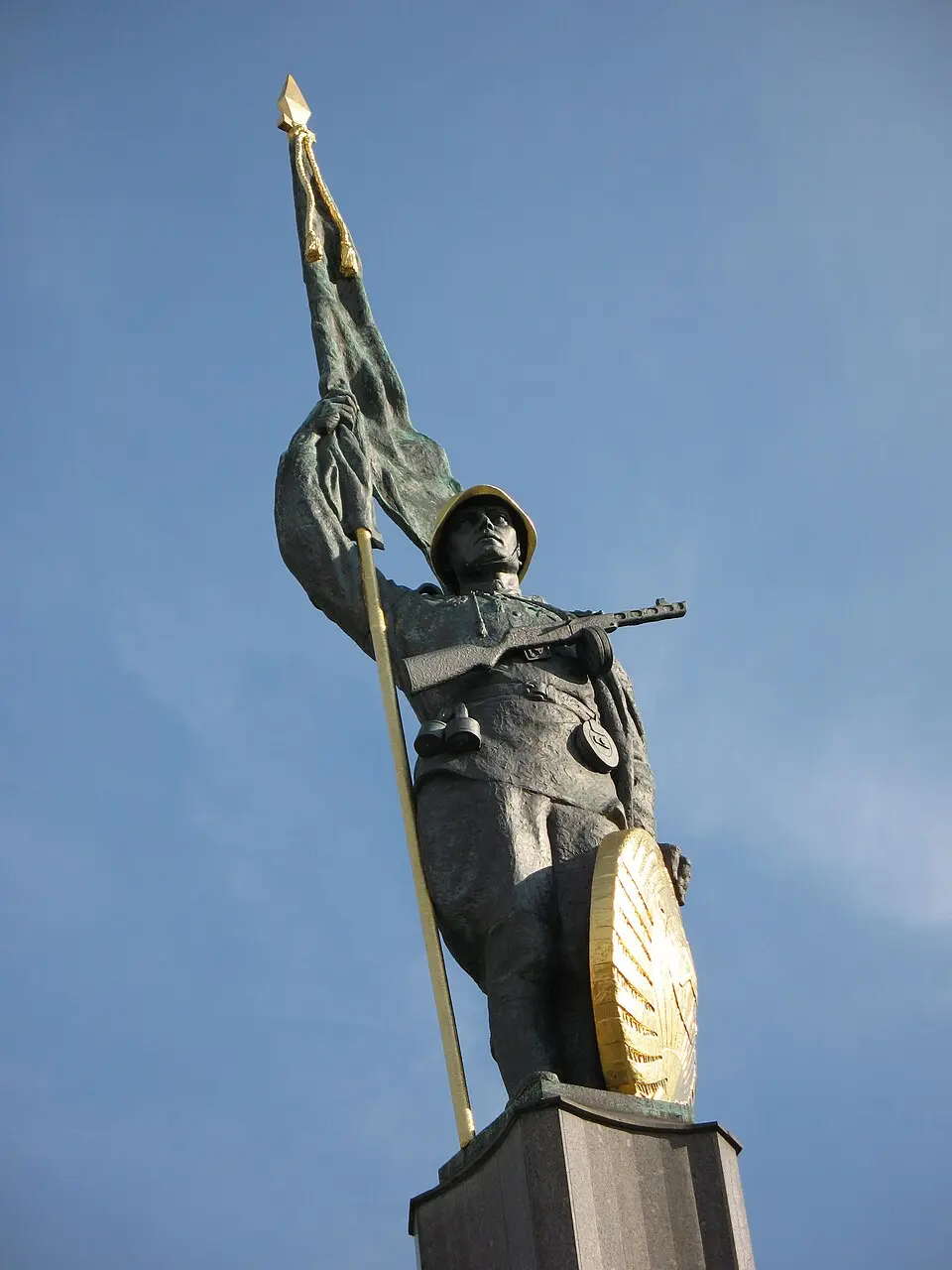
The Heroes' Monument of the Red Army, often called the Russian Monument or Liberation Monument, stands at the southern end of Schwarzenbergplatz in Vienna's third district. It was erected in 1945 to commemorate the roughly 17,000 Red Army soldiers who lost their lives in the Battle of Vienna toward the end of World War II. The planning and design of the monument began during the campaign itself, before Soviet troops had even reached Austria. Major S. G. Yakovlev won the architectural competition, while the sculptor Mikhail Avakovich Intezarian shaped the models for the central figure. Because no clay was available for work in the field, the artists modeled the statue from bread scraps around a bottle.
Architecturally, the ensemble is dominated by a 20-meter-tall column topped by a gilded soldier holding a flag and a shield bearing the Soviet coat of arms. This central figure is framed by a semicircular colonnade eight meters high with twenty-six columns, with two dynamic sculptural groups at each end. Extensive inscriptions in Russian appear on the colonnade and at the base of the main column, including a text by the poet Sergei Mikhalkov as well as quotations from Joseph Stalin. In front of the column is a tilted metal cube with a dedication to the fallen soldiers in German and Russian. Austrian laborers and German prisoners of war were used in the construction, which required roughly fifteen tons of bronze and three hundred square meters of marble.
The unveiling of the monument on August 19, 1945, was broadcast live on the radio and attended by high-ranking Austrian politicians such as State Chancellor Karl Renner and Mayor Theodor Körner. The City of Vienna took over the care and maintenance of the monument, an obligation that was written into the 1955 State Treaty with the occupying powers. Among locals, the monument was also nicknamed the Pea Monument because of a donation of peas after the war. During the Soviet era, the southern part of the square was called Stalinplatz. The monument underwent a thorough restoration in 2009 and remains a controversial but firmly established part of Vienna's cityscape, one that returned to the focus of public debate after Russia's invasion of Ukraine in 2022.
At a glance
- Category
- Sight › Monuments
- Rating
- no reviews yet · write a review
- Address
- Schwarzenbergplatz
1010 Vienna, Austria - District
- Landstraße
- Phone
- —
- Website
- en.wikipedia.org
- —
- Coordinates
- 48.19787° N · 16.37613° E
- Data quality
- confidence 0.97
- Identifier
- ID da5524a5-bab…
Location & surroundings
Toggle layersFAQ about Heldendenkmal der Roten Armee
quick answersWhat is the Heroes' Monument of the Red Army in Vienna?
The Heroes' Monument of the Red Army is a memorial at the southern end of Schwarzenbergplatz in Vienna's third district, Landstrasse. It commemorates the roughly 17,000 Red Army soldiers who fell in the Battle of Vienna toward the end of World War II. It is often also called the Russian Monument or the Liberation Monument. It was built in 1945 and unveiled on August 19, 1945.
What does the Heroes' Monument of the Red Army on Vienna's Schwarzenbergplatz look like?
The Heroes' Monument of the Red Army in Vienna is dominated by a 20-meter-tall column topped by a gilded soldier holding a flag and a shield bearing the Soviet coat of arms. The column is framed by an eight-meter-high, semicircular colonnade with 26 columns, and at each end stand two sculptural groups of fighting figures. On the colonnade and the base you'll find Russian inscriptions, including a text by the poet Sergei Mikhalkov and quotations from Joseph Stalin. In front of the column lies a tilted metal cube with a dedication to the fallen soldiers in German and Russian.
Who designed and built the Heroes' Monument of the Red Army in Vienna?
The architectural competition for the Heroes' Monument of the Red Army in Vienna was won by Major S. G. Yakovlev, and the models for the central figure were shaped by the sculptor Mikhail Avakovich Intezarian. Because no clay was available in the field, the artists modeled the statue from leftover bread around a bottle. The monument was built by Austrian laborers and German prisoners of war, who worked with roughly fifteen tons of bronze and 300 square meters of marble. State Chancellor Karl Renner and Mayor Theodor Körner took part in the unveiling, which was broadcast live on the radio.
Why is the Heroes' Monument of the Red Army in Vienna also called the Pea Monument, and why is it controversial?
The Heroes' Monument of the Red Army in Vienna got the nickname Pea Monument because of a donation of peas after the war. The City of Vienna maintains the monument, an obligation enshrined in the 1955 State Treaty with the occupying powers; during the Soviet era, the southern part of Schwarzenbergplatz was called Stalinplatz. The monument, thoroughly restored in 2009, remains controversial to this day and returned to the center of public debate after Russia's invasion of Ukraine in 2022.
What can you see around the Heroes' Monument of the Red Army in Vienna?
Around the Heroes' Monument of the Red Army on Vienna's Schwarzenbergplatz, several museums and historic sites are within walking distance. travelguide195 lists, among others, Palais Fanto (about 170 meters), the Arnold Schönberg Center (about 190 meters), the Orangery in the Lower Belvedere (about 210 meters), the Raphael Donner Monument (about 260 meters), the Lower Belvedere (about 280 meters), and the Wien Museum (about 300 meters). Within 500 meters, travelguide195 also lists around 47 restaurants.
Ratings & comments
none yetNear Heldendenkmal der Roten Armee
closest 5 per category · 2 kmSights
Restaurants
Museums
Hotels
More:Monuments in Vienna (87)Sights in Landstraße (34)All sights in Vienna (661)
300 places within 2 km loaded.
You need a free account to leave reviews and photos – that keeps comments genuine and lets you edit them later.
An imposing Soviet-style monument near Karlsplatz commemorates the Soviet victory in Vienna over the Nazi army.
Source: Wikivoyage, „Vienna/Landstraße“ · authors per page history · CC BY-SA 4.0