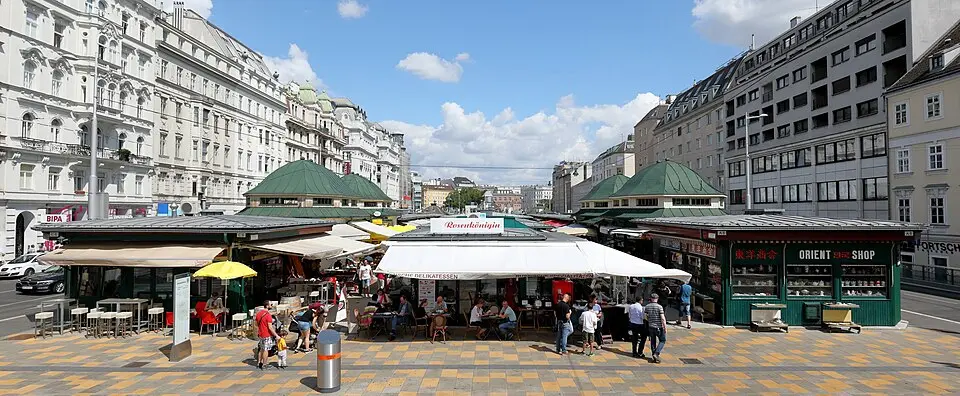
About Naschmarkt
The Naschmarkt, in Vienna's sixth district of Mariahilf, covers more than two hectares (about five acres) and is the largest inner-city market in Vienna. It stretches along the vaulted-over course of the former Wien River, between Getreidemarkt at Karlsplatz and the Kettenbrückengasse subway station. The site's history goes back to 1780, when a farmers' market for dairy products sprang up here outside the city walls, originally called the Kärntnertormarkt. The current name probably derives from the exotic sweets that were traded here in the 19th century. After the Wien River was regulated and the Stadtbahn (city railway) was built, the market was moved to its present site starting in 1902, following a concept by Friedrich Jäckel. More than a hundred masonry market stalls in a uniform style were built at that time, and they still give the place its distinctive look today.
At the Naschmarkt you'll find a wide range of fresh fruit, vegetables, baked goods, fish, and meat. The market is especially well known for its international flavor, with shops selling goods from the former Yugoslavia, Greece, and Turkey, as well as, increasingly, from East Asia, such as Japan and China. Since 2000, the character of the market has changed markedly with the arrival of numerous restaurants and cafés. Many of the original sales stalls have been converted into restaurants, so that today, especially in the summer months, the Naschmarkt is also a lively meeting place in the evening, where market vendors and night owls cross paths. Restaurants that stay open until late in the evening add to this special atmosphere.
The immediate surroundings of the market are shaped by culture and architecture. At the end nearest the city center stands the famous exhibition building of the Vienna Secession, while the Theater an der Wien is nearby. In recent years, the market's infrastructure has been comprehensively renovated and modernized, including the replacement of all utility lines and the creation of barrier-free access. At the end of 2025, a new market hall with a partly planted roof that you can walk on also opened, complementing the market space. The Naschmarkt is considered an integral part of Vienna's cityscape and attracts locals and tourists alike who want to combine an authentic market experience with the chance to linger in the surrounding restaurants and cafés.
At a glance
- Category
- Sight › Historic sites
- Rating
- no reviews yet · write a review
- Address
- Linke Wienzeile 4
1060 Vienna, Austria - District
- Mariahilf
- Phone
- +4315463405430
- Website
- www.wienernaschmarkt.eu
- redaktion@wienernaschmarkt.eu
- Coordinates
- 48.19895° N · 16.36412° E
- Data quality
- confidence 0.97
- Identifier
- ID 9060cc68-e79…
Part of the tour
Vienna in a Day: Cathedral, Hofburg and Ringstrasse →Location & surroundings
Toggle layersFAQ about Naschmarkt
quick answersWhat is the Naschmarkt in Vienna?
At more than two hectares (about five acres), the Naschmarkt is the largest inner-city market in Vienna. It sits in Vienna's sixth district, Mariahilf, and is known for its more than one hundred masonry market stalls built in a uniform style. Locals and tourists alike come here to shop and linger in the eateries.
How did the Naschmarkt in Vienna come about?
The history of Vienna's Naschmarkt dates back to 1780, when a farmers' market for dairy products sprang up outside the city walls, originally called the Kärntnertormarkt. The current name probably derives from exotic sweets that were traded here in the 19th century. After the Wien River was regulated and the Stadtbahn (city railway) was built, the market was moved to its present site starting in 1902, based on a concept by Friedrich Jäckel. Most recently, the infrastructure was extensively renovated, step-free access was added, and at the end of 2025 a new market hall opened with a partially green roof you can walk on.
What can you buy and eat at the Naschmarkt in Vienna?
At Vienna's Naschmarkt you'll find fresh fruit, vegetables, baked goods, fish, and meat. The market has a distinctly international focus, with goods from the former Yugoslavia, Greece, and Turkey, and increasingly from Japan and China. Since 2000, many stalls have been converted into restaurants, so the market is a lively gathering spot in the evening too, especially in summer. travelguide195 lists around 243 restaurants within 500 meters.
Where exactly is the Naschmarkt in Vienna?
The Naschmarkt is located at Linke Wienzeile 4 in Vienna's Mariahilf district. It stretches along the vaulted-over course of the former Wien River between the Getreidemarkt at Karlsplatz and the Kettenbrückengasse subway station. The Naschmarkt is also part of the tour "Vienna Compact: Cathedral, Hofburg, and Ringstrasse in One Day."
What can you see around the Naschmarkt in Vienna?
Around Vienna's Naschmarkt, several art museums and monuments are within walking distance. At the end closest to the city center stands the Vienna Secession exhibition building, about 190 meters away according to travelguide195, followed by the Marc Anthony Chariot after about 220 meters. You can reach the Kunsthalle Wien Karlsplatz and the Gemäldegalerie of the Academy of Fine Arts after about 300 meters each, as well as the Otto Wagner Monument and the Franz Werfel Monument. The Theater an der Wien is also nearby.
Ratings & comments
none yetNear Naschmarkt
closest 5 per category · 2 kmSights
Restaurants
Museums
Hotels
More:Historic sites in Vienna (518)Sights in Mariahilf (19)All sights in Vienna (661)
300 places within 2 km loaded.
You need a free account to leave reviews and photos – that keeps comments genuine and lets you edit them later.
This is the largest of Vienna's 22 market places and provides a unique blend of typical Vienna costumely and oriental flair. Stroll through the market and be part of the amazing ambiance. If you like to cook, you will find all the spices you could possibly want at the Naschmarkt; on offer are regional and exotic fruits and vegetables, cheeses, meats, baked goods, and seafoods, as well as many small restaurants serving Viennese as well as international dishes. The side of the Secession tends to be more touristy and thus more expensive than the side of the Kettenbrueckengasse.
Source: Wikivoyage, „Vienna/Mariahilf“ · authors per page history · CC BY-SA 4.0