About Spanische Hofreitschule
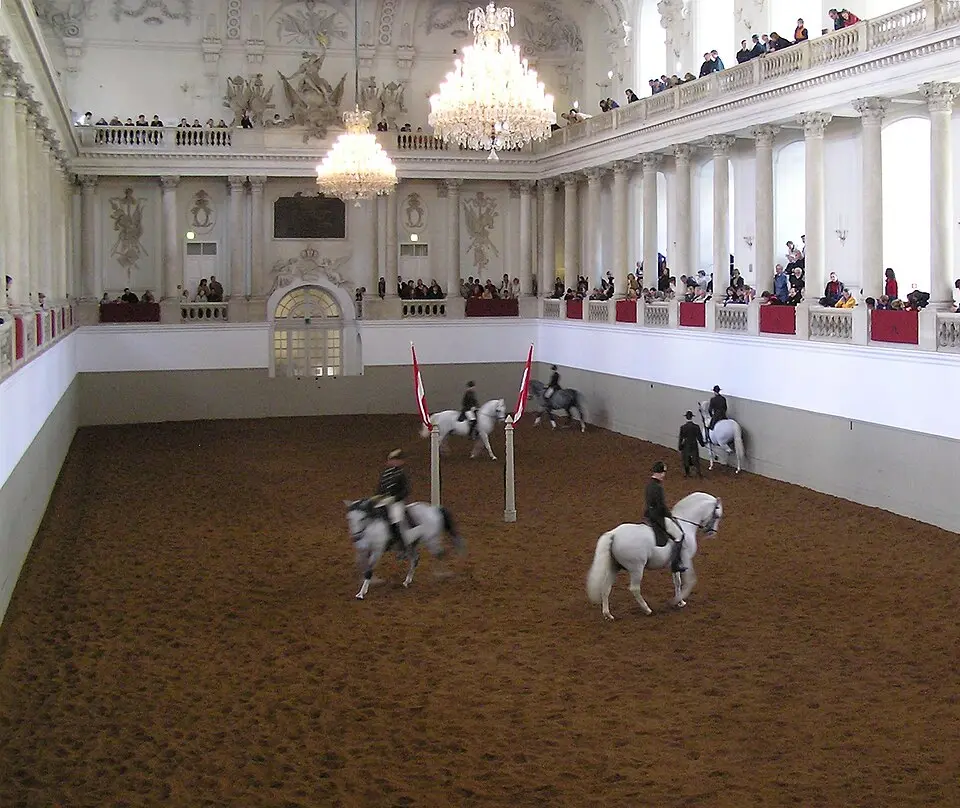
The Spanish Riding School is a renowned equestrian institution housed in the Michaelertrakt (Michael Wing) of Vienna's Hofburg. Originally it served as the riding academy for the imperial family, but today it is considered one of the most important places in the world for preserving classical horsemanship. A distinctive feature of the school is that only stallions of the Lipizzaner breed are trained here. The name derives from the horse breed native to the Iberian Peninsula, which historically proved especially gifted for the refined art of classical riding. In 2015, classical horsemanship and the High School of the Spanish Riding School were added to UNESCO's Representative List of the Intangible Cultural Heritage of Humanity, underscoring their cultural significance.
The history of the institution is older than the present building. As early as the reign of Emperor Ferdinand I, who grew up in Spain, Spanish horses and riders were employed at the Viennese court. He had stables built and put Spanish retainers in charge of horse breeding, laying the foundation for a Habsburg Spanish riding tradition. The first documented mention of a riding ground, the so-called Thumblplatz, dates to 1565. This open-air ground in the Burggarten was used for training until the weather made a covered riding hall necessary.
Under Emperor Leopold I, planning began for a permanent structure. In 1681, the imperial order was issued to build a new riding school on the Tummelplatz. The master builder Johann Philipp Quenzer led the project, but the Turkish siege of 1683 badly damaged the largely finished building. Construction then stalled for decades, as the funds and the political will to complete the project were lacking. Only under Emperor Charles VI was the project taken up again.
Between 1729 and 1735, Charles VI had the Winter Riding School built. The design came from the famous architect Johann Bernhard Fischer von Erlach, who conceived the light-filled riding hall. His son Joseph Emanuel carried out the plans. The palace chapel at Versailles probably served as a model. The result is an architectural masterpiece that many consider the most beautiful riding hall in the world. To this day, the riders doff their hats to the portrait of the emperor when entering the arena, in thanks for the construction of this magnificent space.
In the 19th century, the school reached another high point under Maximilian von Weyrother. He coined the concept of the thinking rider and made the institution a magnet for riders from all over Central Europe. His students, including Louis Seeger and Ernst Friedrich Seidler, helped spread classical horsemanship. The riders' uniform, consisting of a coffee-brown riding tailcoat, white buckskin breeches, and a bicorne hat, has remained almost unchanged for about 200 years and underscores the school's historical continuity.
After World War I, the Spanish Riding School was opened to the public and placed under the Ministry of Agriculture. Count Rudolf van der Straten ensured the institution's survival during the First Republic. He made the school popular and organized the first foreign tours, which took the stallions to Berlin, London, The Hague, and Brussels. These appearances contributed significantly to the fame of the white stallions and secured the school's finances in a difficult period.
During World War II, the school was taken over by the Wehrmacht and renamed. Alois Podhajsky assumed its leadership and played a major role after the war in its reconstruction and the restoration of its name. Because the Stallburg had been badly damaged by bombs, the stallions spent the years between 1945 and 1955 in Wels in Upper Austria. Since 2001, the Spanish Riding School has been legally and economically separated from the public administration and organized as an independent company dedicated to preserving the breed and the art of riding.
Training the stallions is a lengthy process that takes about six years in total. It begins at age four with the Remonte School, where the horses are accustomed to saddle and bridle and their basic gaits are refined. Next comes the Campaign School, which takes up most of the training period. Here the stallions learn collection, lateral movements, and riding on the curb bit. The highest level is the High School, where the horses learn complex lessons such as the piaffe, passage, and airs above the ground.
Visitors can watch the riders at work every day during the so-called Morning Exercise. This public training session takes place every day except Sundays and Mondays and shows stallions at various stages of training. The actual performance is a festive occasion that culminates in the School Quadrille. It is performed by eight fully trained stallions and is regarded as the ballet of the white stallions. The program includes several items, among them work in hand, the pas de deux, and the airs above the ground, in which the stallions show their skill without a rider or with a rider riding without stirrups.
The Summer Riding Arena, located between the Imperial Treasury and the Winter Riding School, is used for daily training when the weather permits. It is surrounded by shady trees and offers a peaceful setting for the work. Since 2005, the school's stallions have spent their summer vacations at the Heldenberg training center in Lower Austria. A modern training facility there is also open to international students. This expansion makes it possible to care for the stallions and continue their development in a natural environment.
The Spanish Riding School is not only a training institution but a living monument to European equestrian culture. The combination of historic architecture, traditional horsemanship, and the unique Lipizzaner breed makes it a special experience for visitors. The dedication of the riders, who often begin their careers at a young age and spend years on the lunge line and in the saddle, is crucial to preserving this tradition. The school remains a symbol of precision, elegance, and the deep bond between human and horse, nurtured over centuries.
At a glance
- Category
- Sight › Historic sites
- Rating
- no reviews yet · write a review
- Address
- Michaelerplatz 1
1010 Vienna, Austria - District
- Innere Stadt
- Phone
- +4315339031
- Website
- www.srs.at
- office@srs.at
- Coordinates
- 48.20731° N · 16.36671° E
- Data quality
- confidence 1.00
- Identifier
- ID 1b25b6b2-68b…
Part of the tour
Vienna in a Day: Cathedral, Hofburg and Ringstrasse →Location & surroundings
Toggle layersFAQ about Spanische Hofreitschule
quick answersWhat is the Spanish Riding School in Vienna?
The Spanish Riding School is a time-honored riding institution in the Michaelertrakt (Michael Wing) of Vienna's Hofburg, located at Michaelerplatz 1 in the Innere Stadt (Inner City) of Vienna. It is considered one of the most important places in the world for preserving the art of classical riding, and only Lipizzaner stallions are trained here. Since 2015, classical horsemanship and the High School of the Spanish Riding School have been on UNESCO's Representative List of the Intangible Cultural Heritage of Humanity.
Why is the Spanish Riding School in Vienna called "Spanish"?
The name of the Spanish Riding School in Vienna comes from the horse breed native to the Iberian Peninsula, which historically proved especially gifted for the refined art of riding. Emperor Ferdinand I, who grew up in Spain, already employed Spanish horses and riders at the Viennese court. He had stables built and put Spanish retainers in charge of horse breeding, laying the foundation for the Habsburg court riding tradition.
When and by whom was the Winter Riding School of the Spanish Riding School built?
The Winter Riding School of the Spanish Riding School in Vienna was built by order of Emperor Charles VI between 1729 and 1735. The design is by Johann Bernhard Fischer von Erlach, and the plans were carried out by his son Joseph Emanuel; the model was probably the palace chapel at Versailles. An earlier building, ordered in 1681 under Emperor Leopold I, was badly damaged during the Turkish siege of 1683. To this day, the riders doff their hats to the portrait of Charles VI when they enter the arena.
What can you see around the Spanish Riding School in Vienna?
Around the Spanish Riding School on Michaelerplatz in Vienna, several museums and historic sites of the Hofburg are just a few minutes' walk away. travelguide195 lists the Lipizzaner Museum at about 40 meters, the Imperial Treasury at about 55 meters, the Sisi Museum at about 75 meters, and the Redoutensaal at about 80 meters, among others. The Palais Pallavicini is also only about 100 meters away.
Are there restaurants and tours near the Spanish Riding School in Vienna?
Yes, around the Spanish Riding School in Vienna's Innere Stadt you'll find a wide range of places to eat: travelguide195 lists about 174 restaurants within 500 meters. If you want to combine the Riding School with other highlights, it is part of the tour "Vienna Compact: Cathedral, Hofburg and Ringstrasse in One Day."
Ratings & comments
none yetNear Spanische Hofreitschule
closest 5 per category · 2 kmSights
Restaurants
Museums
Hotels
More:Historic sites in Vienna (518)Sights in Innere Stadt (216)All sights in Vienna (661)
300 places within 2 km loaded.
You need a free account to leave reviews and photos – that keeps comments genuine and lets you edit them later.
First mentioned in a document dated 1572, it is the only equestrian institute in the world which follows a Renaissance model of classical schooling. Eleves, or students, begin their training immediately after completion of Austrian primary education (age 15 or 16), and are expected to be both sporty and clever. The school takes its name from a Spanish breed of horse first mentioned in Roman writings. In 1562, Emperor Maximilian II brought some of these Spanish horses to Austria to found a royal stud farm in Kladrub (Bohemia), housing them for a time in the "Stallburg" (oldest section of the Imperial Palace). The present school location was built in 1572. In 1580, Maximilian's brother, Archduke Karl, founded the stud farm in Lipizza near Trieste (now Slovenia). Interest in elegant riding had been growing for about 50 years at that point. During Renaissance times, powerful gentlemen who had already conquered the worlds of finance and politics looked to the writings of antiquity for new learning and an educated lifestyle to which they could aspire. Horsemanship which followed the ancient models described by Socrates and others became the fashion. Xenophon (430 – 354 BC) wrote "Men who understand the art of horsemanship, in truth, look magnificent." Who wouldn't want that? In the new Winter Riding School (built 1729-35), tournaments, masked balls, and other entertainment was held, but this would soon draw to a close – the royal stud farms at Lipizza were threatened by Napoleon several times and twice the precious stud horses were evacuated to Hungary. No photos or video taping allowed.
Source: Wikivoyage, „Vienna/Innere Stadt“ · authors per page history · CC BY-SA 4.0