About Palatul Schönbrunn
Schönbrunn Zoo in Vienna is considered the oldest continuously operating zoo in the world and is one of the most important sights in the Austrian capital. Founded in 1752 by the Habsburg dynasty, it sits within the expansive grounds of Schönbrunn Palace in Vienna's 13th district, Hietzing. Covering seventeen hectares, the zoo is home to around 7,800 animals from roughly 700 different species. The site's historical significance is underscored by the fact that the ensemble of palace, zoo, and palace gardens has been a UNESCO World Heritage Site since 1996. With more than two million visitors a year, the zoo is a popular destination that appeals to families and animal lovers alike.
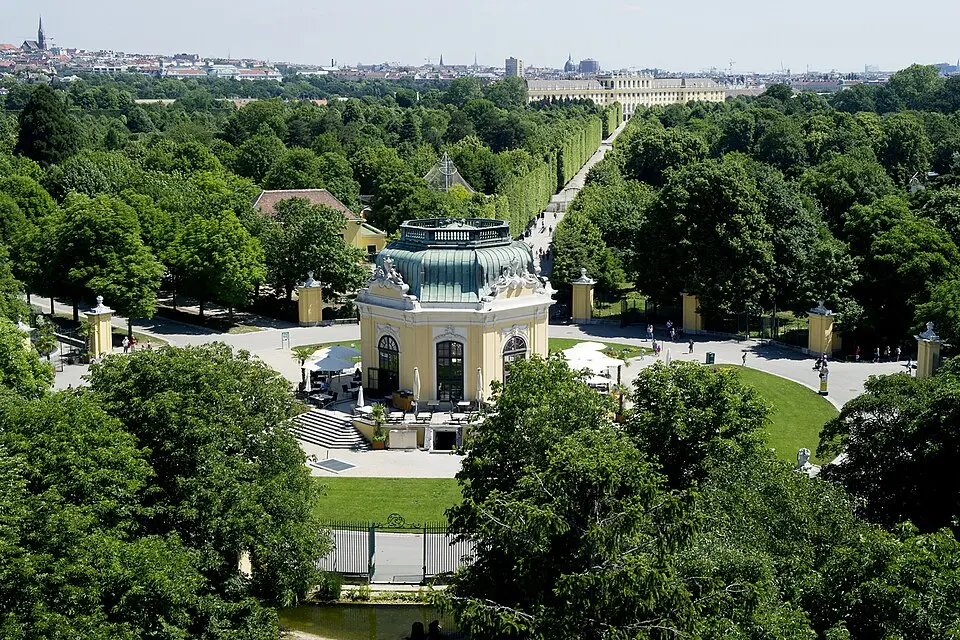
The history of the zoo reaches back to the middle of the 18th century. Emperor Francis I, the husband of Maria Theresa, commissioned the architect Jean Nicolas Jadot de Ville-Issey to design a menagerie in the park of the imperial summer residence. The original complex consisted of twelve enclosures of equal size, an administration building, a pond, and two courtyards. After roughly a year of construction, the menagerie was first presented to the public in the summer of 1752. The historic center is still the octagonal pavilion, completed in 1759 and originally used as a reception room. Since 1949, the building has housed a restaurant and is a popular meeting spot for visitors.
At first, access to the menagerie was reserved for the imperial family, but before long diplomats, private guests, and school groups were also allowed to view the animals. In 1778, the grounds were opened to the general public, initially only on Sundays and on the condition that visitors were suitably dressed. The first exotic animals, such as the Indian elephant in 1770 or predators like wolves and bears in 1781, increasingly drew visitors from Vienna and abroad. A special event was the arrival of the first giraffe in 1828, which set off a veritable craze in Vienna and even influenced the fashion and social life of the era.
In the late 19th century, the zoo underwent a significant transformation under the direction of Alois Kraus. The historic enclosures were modernized to be friendlier to both animals and visitors, and the grounds were expanded to the east and south. At the start of the 20th century, with almost 3,500 animals, Schönbrunn ranked among the finest zoos in the world. A milestone came in 1906 with the birth of the first elephant conceived in a zoo. Despite the difficult years of the world wars, in which many animals died and buildings were damaged, the zoo managed to rebuild its collection through relief efforts and the dedication of directors such as Otto Antonius. Antonius also promoted the idea of breeding endangered species and supported scientific research.
After World War II, the zoo was gradually restored and expanded. Under the leadership of Walter Fiedler, the area was doubled to twelve hectares, and new facilities such as a children's zoo and a zoo education department were created. In the 1990s, the zoo faced the challenge of modernizing its image and improving animal care. After it was spun off from the federal administration and taken over by the veterinarian Helmut Pechlaner, nearly all enclosures were renovated and enlarged. This phase produced new highlights such as the Small Monkey House, the Elephant Park, and the big cat facility.
Schönbrunn Zoo pays special attention to its giant pandas. It is one of the few institutions in Europe that exhibit this endangered species. Pandas have lived here since 2003 and have achieved great breeding success, including the first panda cubs conceived naturally in Europe. Each cub was transferred to China at the age of two. After the death of the male panda Long Hui in 2016 and the departure of the pair in 2024, the facility was modernized. In 2025, a new panda pair arrived to continue the successful research partnership with China.
The Polar Bear World, opened in 2014, is another attraction that delights visitors. In this 1,700-square-meter facility, you can watch polar bears swim underwater in a five-meter-deep diving pool. The name of the exhibit pays tribute to the historic exploration of Arctic regions by Austria-Hungary. The accompanying visitor center, the Polardom, has been recognized by international organizations as an Arctic Ambassador Center and serves to educate visitors about protecting polar bears in their natural habitat.
The Rainforest House, opened for the zoo's 250th anniversary, presents a section of a tropical mountainside in Southeast Asia. In this glasshouse, which maintains a minimum temperature of 25 degrees Celsius and high humidity year-round, rare species such as the Batagur turtle, pythons, and Fiji iguanas live. Elaborate building technology simulates rainforest conditions, allowing the animals a life suited to their species. The house is a popular place to experience the diversity of the tropical habitat before it undergoes a complete renovation in 2026.
The Aquarium and Terrarium House, which you enter through the Crocodile Pavilion, offers visitors a fascinating underwater world. Among its residents are giant tortoises, which reach a great age, as well as tanks with piranhas, moray eels, and rays. A particular highlight is the large coral reef with hundreds of fish from the Indo-Pacific. Various species of jellyfish are shown in circular tanks, and a tunnel aquarium with arapaimas leads to the terrarium house, where you can see snakes, iguanas, and other reptiles. A new conservation aquarium is planned for 2028 to further strengthen the breeding of endangered species.
Schönbrunn Zoo is deeply committed to species conservation and research. It takes part in international breeding programs for endangered animal species and coordinates projects to reintroduce birds such as the northern bald ibis and the Ural owl. The zoo also supports projects in Morocco, Bangladesh, and South America dedicated to protecting Barbary macaques, Batagur turtles, and lowland tapirs. Collaboration with universities and research institutes makes it possible to gather valuable data on the biology and behavior of the animals. This scientific work helps secure the survival of endangered species in the wild.
For visitors, the zoo offers a varied world of experiences that goes beyond simply watching animals. At the Tirolerhof, a historic farmstead relocated from Tyrol, endangered breeds of livestock are cared for. The nature trail leads through a treetop walkway and past outdoor terrariums with native reptiles and amphibians. In the South America Park, animals such as the giant anteater and the capybara live in a landscaped pampa. These varied exhibits allow you to experience the animals in surroundings modeled on their natural habitat and foster an understanding of the importance of species conservation.
At a glance
- Category
- Sight › Monuments
- Rating
- no reviews yet · write a review
- Address
- —
Vienna, Austria - District
- Katastralgemeinde Schönbrunn
- Phone
- —
- Website
- —
- —
- Coordinates
- 48.18326° N · 16.30196° E
- Data quality
- confidence 0.85
- Identifier
- ID b3ae17b7-e07…
Location & surroundings
Toggle layersRatings & comments
none yetNear Palatul Schönbrunn
closest 5 per category · 2 kmSights
Restaurants
Museums
Hotels
Cocktail bars
More:Monuments in Vienna (87)All sights in Vienna (661)
166 places within 2 km loaded.
You need a free account to leave reviews and photos – that keeps comments genuine and lets you edit them later.